
Yellow Tremella
Tremella lutescens
Description
Symptoms
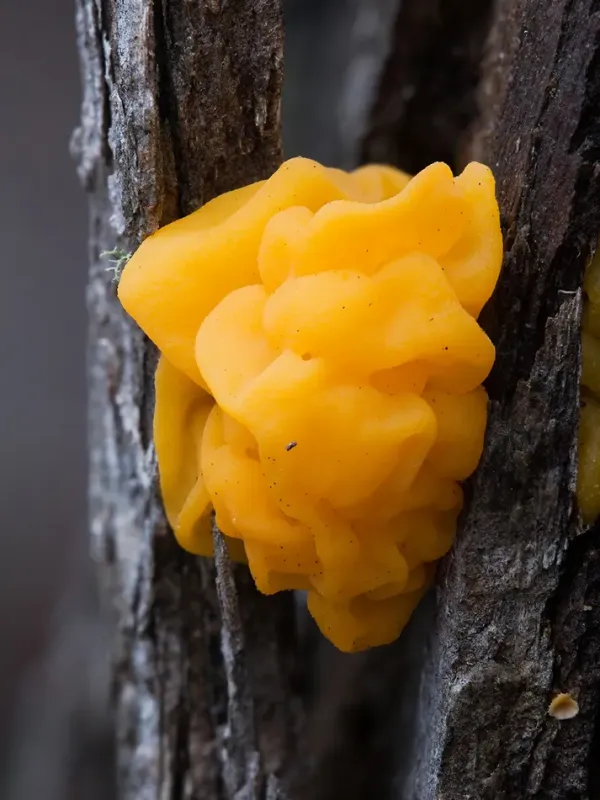
The most prominent sign is the appearance of vibrant yellow, jelly-like fruiting bodies. These shapes are often lobed, folded, or brain-like, appearing on the surface of bark after periods of rain or high humidity.
In dry conditions, these fruiting bodies shrink significantly, becoming nearly invisible films that are difficult to detect. When rainfall returns, they rehydrate and regain their gelatinous, soft texture.
Unlike pathogenic fungi that cause wilting, leaf spotting, or twig dieback, Yellow Tremella does not interfere with the plant's vascular or photosynthetic functions. The tree's health is unaffected by its presence.
These fungal growths are localized strictly to the dead woody material. If you observe them on a tree, it is a clear indicator that the specific bark or branch section is already dead or in a state of decay.
Diagnostically, one can distinguish this fungus from harmful pathogens by checking the underlying wood. If the tissue is brittle and non-living, the fungus is saprotrophic and harmless to the surrounding healthy tissue.
Pathogen
Yellow Tremella, known by the scientific name Tremella lutescens, is not a plant pathogen. It is a saprotrophic fungus belonging to the Basidiomycota division, which feeds on decaying organic matter rather than living tissue.
The fungus is characterized by its gelatinous, bright yellow to orange fruiting bodies. It lacks the enzymes required to penetrate or digest healthy plant cells, meaning it poses no threat to the vitality of trees or shrubs.
This species is found exclusively on dead or dying wood, such as fallen branches or decaying stumps of deciduous trees. Its biological function is to break down complex lignin and cellulose structures.
Its mycelium penetrates the substrate deeply, while the visible fruiting bodies emerge only when moisture conditions are optimal. This process is entirely distinct from the infection cycle of parasitic fungi that cause plant diseases.
From an agronomic perspective, Tremella lutescens is categorized as a beneficial decomposer. It accelerates the nutrient cycle in garden ecosystems without causing necrotic or systemic disease in plants.
Conditions for development
The development of Tremella lutescens is heavily dependent on moisture levels. It thrives in environments with frequent precipitation, high humidity, and overcast skies, which keep the surface of the wood damp.
Temperature plays a secondary role, with moderate temperatures being ideal for the growth of its mycelium. It is commonly observed during spring and autumn when climatic conditions are temperate.
The fungus colonizes wood that has already been exposed to the elements or weakened by other factors. It requires a specific moisture content within the wood to maintain its gelatinous structures.
Spore dispersal occurs via wind and water splashes. Once spores land on suitable dead wood, they germinate and form a mycelial network that eventually produces visible fruiting bodies.
While the fungus prefers damp conditions, it is hardy. The mycelium survives inside the wood during dry spells, waiting for the return of favorable conditions to resume growth and reproduction.
Why it matters
There is no economic or physiological harm caused to plants by Yellow Tremella. It does not produce toxins, nor does it inhibit plant growth or defense mechanisms.
Because it is a saprotroph, it does not have the capability to attack living tissues. Therefore, no crop loss or plant damage is associated with this species in orchards or gardens.
The presence of the fungus should be interpreted as a natural indicator that the wood it is growing on is dead. This can actually be helpful for gardeners, signaling which parts of a tree require pruning.
Many people mistake these fungi for parasitic infections, but they actually fulfill an ecological role by cleaning the environment of decaying debris, which helps prevent the buildup of more harmful pathogens.
In conclusion, Tremella lutescens has zero negative impact on agricultural or horticultural production, making it a harmless and ecologically interesting inhabitant of the garden.
Protection
No control measures are necessary for Yellow Tremella. Since it does not act as a disease agent, applying fungicides is considered a waste of resources and may harm the garden's beneficial microbiome.
The most effective management strategy is standard horticultural maintenance. By pruning away dead wood and maintaining tree health, you naturally remove the substrate the fungus relies on.
- Perform regular sanitary pruning of dead or diseased branches.
- Ensure adequate crown ventilation to reduce overall garden humidity.
- Dispose of rotting woody debris properly to keep the area tidy.
- Maintain tree vitality through appropriate nutrition and care.
There is no need for chemical intervention. If the presence of the fungus is aesthetically undesirable, simply remove the affected dead bark or branches, which will also improve the tree's overall hygiene.
Focusing on the overall vitality of the trees is the best way to ensure they remain resistant to real threats, whereas the presence of saprotrophic fungi like Yellow Tremella can be safely ignored.
Discussion
No discussions yet — be the first.