
Orange jelly spot
Tremella aurantia
Description
Symptoms
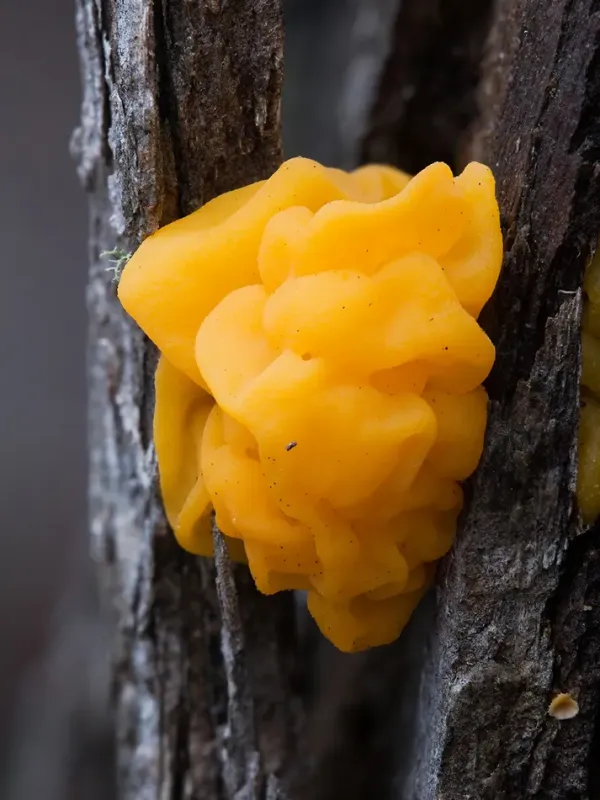
The most visible sign of this fungus is the formation of bright, jelly-like, orange-yellow fruiting bodies. They have a convoluted or coral-like appearance and become significantly more prominent following periods of heavy rain.
During dry weather, the fruiting bodies shrink considerably, turning into a barely visible, thin, hardened film on the bark. They rapidly rehydrate and regain their vibrant, gelatinous structure once moisture returns.
The fungus is typically located in close proximity to Stereum colonies, which appear as thin, leathery, fan-shaped crusts on the wood surface. This close association is the most reliable visual identifier for Tremella aurantia.
There are no symptoms of infection on the leaves, fruits, or shoots, as the fungus does not interact with the plant's metabolic systems. All signs are strictly confined to the bark surface where the host fungus resides.
When inspecting trees, it is essential to distinguish between this harmless indicator fungus and necrotic bark diseases. The lack of underlying tissue rot directly attributable to the jelly spot is the key diagnostic feature.
Pathogen
Orange jelly spot (Latin: Tremella aurantia) is a species of fungus within the jelly fungus group. It is important to clarify that this organism is not a primary plant pathogen and does not cause diseases in agricultural or garden crops.
The fungus is biologically classified as a mycophilic parasite. This means it grows exclusively on other fungi, specifically members of the Stereum genus, which are commonly found on dead or decaying wood.
Since it lacks the physiological capability to penetrate or degrade living plant tissues, it does not function as a pathogen in the traditional sense of phytopathology. It survives entirely by consuming the mycelium of its host fungus.
The life cycle of Tremella aurantia is inherently linked to the presence of decay-causing fungi on a tree. It acts as a secondary colonizer and cannot propagate without the host fungus being present.
For agronomists, this fungus serves as a bio-indicator. Its appearance is a direct signal that the host tree is suffering from structural degradation caused by wood-rotting fungi, requiring an assessment of the tree's health.
Conditions for development
High relative humidity is the primary prerequisite for the growth and fruiting of this fungus. Consequently, it is most frequently observed during autumn and spring, or in areas with consistent moisture levels.
The fungus thrives within a moderate temperature range, typically between 10 and 20 degrees Celsius. It is rarely active during extreme summer heat or mid-winter frosts, as the mycelium requires stable conditions.
The presence of deadwood is essential, as the host fungi (Stereum) require organic matter to develop. Without decaying or weakened wood, the environment is unsuitable for the entire complex of fungi.
Shaded, poorly ventilated areas of the orchard or garden often provide the microclimate needed for these fungi to persist. Low air movement prevents the bark from drying out, facilitating fungal development.
Spore dispersal occurs via wind currents. While the spores are ubiquitous in many wooded environments, their successful colonization is limited by the availability of specific host fungi, which must already be established on the tree bark.
Why it matters
The orange jelly spot fungus causes no direct harm to trees. It does not reduce yield, inhibit plant growth, or affect the quality of fruits or ornamental aesthetics.
Its only negative significance is its diagnostic role. By revealing the presence of Stereum species, it alerts the grower to the presence of wood-rotting agents that may, over time, weaken the structural integrity of the tree.
The harm is purely indirect and linked to the underlying decay process triggered by the host fungi. The jelly spot fungus itself is a passenger on this process and does not add to the damage.
Removing the jelly spot fungus alone does not improve tree health. Instead, growers should focus on the primary issue: the presence of decaying wood and the associated rot-inducing fungi.
Overall, the presence of this fungus is a benign indicator. It should not cause alarm but rather serve as a cue to schedule routine garden maintenance and improve tree health management practices.
Protection
Specific chemical or biological control measures against Tremella aurantia are unnecessary. Effective management is achieved through standard horticultural practices that maintain tree vigor and prevent decay.
- Routine sanitary pruning to remove dead or damaged branches.
- Cleaning bark surfaces to remove debris and reduce potential fungal habitats.
- Optimizing tree density to ensure proper sunlight penetration and air circulation.
- Applying pruning sealants or fungicides to wound sites to prevent infection by host fungi.
- Proper disposal of rotting wood and stumps that harbor decay-causing organisms.
If wood rot is confirmed, the application of systemic fungicides to manage the host Stereum populations may be beneficial. This slows the decay process and keeps the trees structurally sound.
Maintaining balanced fertilization and correct irrigation practices improves the tree's internal defense mechanisms, making it less susceptible to colonization by wood-degrading fungi.
Regular monitoring allows for the early detection of issues, enabling growers to keep their garden healthy and resilient against various environmental stressors and opportunistic fungi.
Discussion
No discussions yet — be the first.