
Trechisporales
Trechisporales
Description
Symptoms
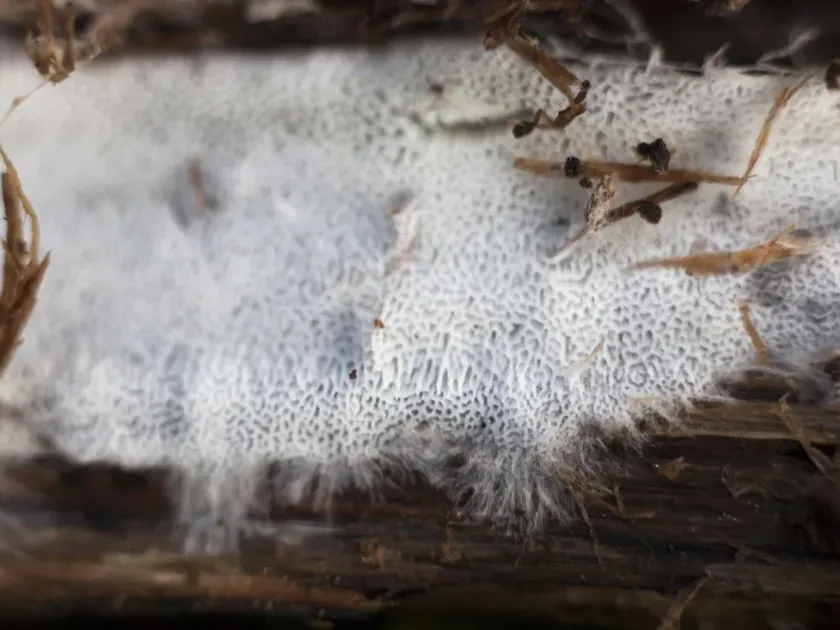
A primary visual symptom is the formation of a dense, felt-like white or creamy fungal mat on the surface of infected bark, roots, or the lower parts of stems.
Infected tissues lose their structural integrity, becoming soft or mushy. This degradation is often accompanied by a distinct discoloration of the host surface, turning it brown or grey as necrosis sets in.
Vascular system blockage often manifests as sudden wilting of the leaves or branches, even if the plant appears adequately watered. Upon peeling back the bark, one might see white mycelial strands spreading underneath.
In humid conditions, small, pored, or honeycombed fruiting structures develop on the surface of the host, indicating that the fungus is actively sporulating and spreading.
- Felt-like white fungal mats.
- Softening and rotting of plant tissues.
- Sudden wilting and vascular decline.
- Mycelial strands visible beneath the outer bark.
- Formation of small honeycombed fruiting bodies.
Pathogen
The order Trechisporales belongs to the class Agaricomycetes and consists of a diverse group of basidiomycete fungi. While many species are primarily saprotrophic, some can act as opportunistic pathogens on weakened crops.
Biologically, these fungi are characterized by the formation of resupinate (flat) fruiting bodies that adhere tightly to their substrate. They possess advanced enzymatic systems capable of breaking down complex plant cell wall structures like lignin and cellulose.
The life cycle involves the production of basidiospores that are easily dispersed by wind. Once a spore lands on a suitable host with moisture present, it germinates into a mycelium that invades the plant tissues.
These fungi are highly adaptable, capable of surviving on diverse organic substrates in the soil, which allows them to remain present in a field even in the absence of a primary host.
The taxonomic group is known for its ability to colonize weakened roots and stems, often acting as a secondary invader that accelerates the decline of already stressed agricultural plants.
Conditions for development
High humidity and consistent moisture are the most critical factors for the development of Trechisporales. Waterlogged soils and poorly ventilated crop canopies create the ideal microclimate for infection.
Temperature plays a significant role, with the optimal range for mycelial growth typically falling between +18°C and +25°C. However, these fungi are hardy and can endure lower temperatures throughout the winter.
Poor agricultural practices, such as excessive crowding of plants or insufficient weed control, contribute to higher moisture levels and reduced airflow, which favors the spread of spores.
Mechanical damage to roots or stems during cultivation or harvesting provides entry points for the fungus, making plants significantly more susceptible to colonization.
Soils with poor aeration or high clay content that tend to hold water provide a persistent reservoir for the fungus, leading to frequent root-based infections in vulnerable crops.
Why it matters
The major impact of Trechisporales is the rapid destruction of the plant's vascular network, which cuts off the supply of water and nutrients, leading to death or severe decline.
Root collar and root system rot are particularly damaging, as they compromise the stability and vitality of the entire plant, leading to stunted growth or complete collapse.
Post-harvest losses can be catastrophic if crops are infected in the field. The fungus continues to develop in storage, turning healthy produce into a decayed, unsalable mass within days.
The infection is often difficult to eradicate once it is well-established within the plant tissue, frequently necessitating the removal and destruction of the entire crop to protect adjacent fields.
Economic damage includes reduced yield, loss of product quality, and the high cost of implementing corrective sanitation measures and chemical treatments.
Protection
Effective management begins with robust cultural practices, including consistent crop rotation and the thorough removal of crop residues that serve as a bridge for the pathogen.
Improving greenhouse ventilation and implementing effective soil drainage systems are essential to lower ambient humidity and prevent stagnant water from pooling around the base of plants.
If an infection is detected, affected plants must be promptly removed and destroyed. Tools used during the process must be sanitized to prevent the mechanical transfer of fungal spores.
Preventative application of fungicides, particularly those containing copper or systemic active ingredients, can protect crops during high-risk, humid weather periods.
Enhancing plant vigor through balanced fertilization and the use of growth promoters can help plants maintain their natural defenses against fungal invasion.
Discussion
No discussions yet — be the first.