
Hairy bracket
Trametes hirsuta
Description
Symptoms
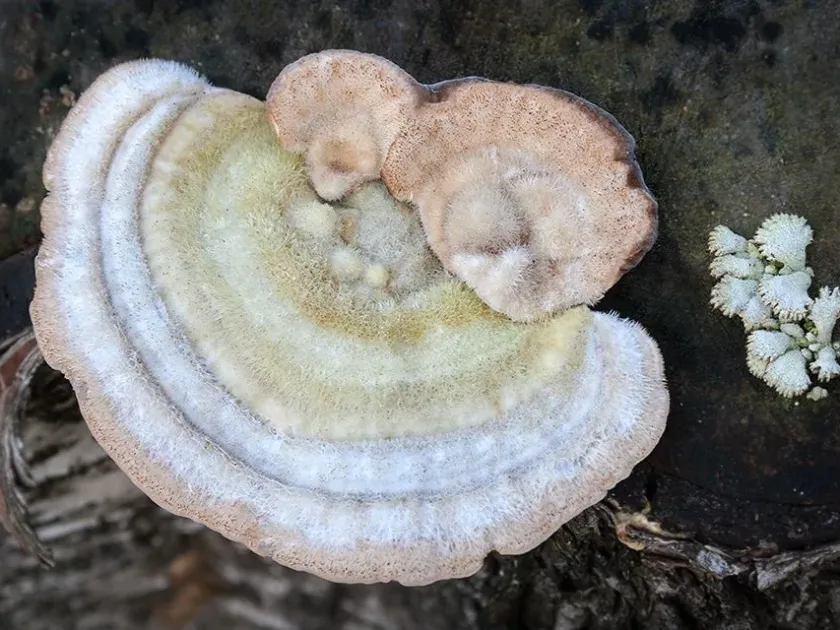
The most recognizable sign is the presence of the characteristic fuzzy brackets on tree trunks, stumps, or branches. They often overlap like tiles on a roof and are firmly attached to the substrate.
Internally, the wood undergoes significant changes known as white rot. The decayed wood becomes pale, soft, spongy, and may display a fibrous appearance that easily crumbles under pressure.
Early signs of infection include cracking and discolouration of the bark. Beneath the bark, thin white threads of mycelium may be visible, spreading through the vascular system and cambium layer.
Affected trees often show symptoms of stress, such as yellowing leaves, thinning of the canopy, and premature senescence. Large skeletal branches may begin to die back as the rot progresses.
Over time, the structural integrity of the wood is so compromised that the tree becomes brittle. This creates a high risk of branch breakage or total tree failure during windy weather.
Pathogen
The hairy bracket fungus, or Trametes hirsuta, is a wood-decaying Basidiomycete. It primarily functions as a saprotroph, decomposing dead wood, though it can opportunistically infect weakened living trees.
The fungus produces shelf-like or semicircular fruit bodies (sporocarps) that grow in clusters. These brackets are covered in a dense layer of short, stiff, greyish-white hairs, which gives them their distinctive fuzzy texture.
The mycelium of the fungus penetrates deep into the wood tissue. It secretes enzymes capable of breaking down the complex structures of lignin and cellulose, which provide the tree with its structural integrity.
Reproduction is carried out via basidiospores released from the undersides of the fruit bodies. These spores are dispersed by air currents, landing on wounded bark where they germinate to initiate a new infection.
As an adaptive organism, this fungus remains viable even in fluctuating environmental conditions, allowing it to persist in woody debris for several seasons until suitable host trees are found.
Conditions for development
High moisture levels are a critical requirement for the growth of Trametes hirsuta. The fungus thrives in humid environments, particularly following extended periods of rain, which keeps the bark and wood tissues moist.
Mechanical damage serves as the primary entry point for the fungus. Sunscald, frost cracks, and improper pruning cuts leave exposed tissue vulnerable to spore germination and hyphal colonization.
Trees suffering from environmental stress—such as prolonged drought, poor soil fertility, or insect infestation—are significantly more susceptible to infection by this pathogen.
The optimal temperature range for the rapid development of the fungal mycelium is between 18 and 25 degrees Celsius. Within this range, the rate of wood decay accelerates substantially.
The presence of decomposing logs, neglected stumps, and standing dead trees in the vicinity provides a continuous source of spores, dramatically increasing the risk of infection in healthy plantations.
Why it matters
The primary danger lies in the physical degradation of the wood, which leads to the loss of mechanical strength. This makes infected trees unstable and hazardous to their immediate surroundings.
By interfering with the tree's vascular system, the fungus severely impairs the transport of water and nutrients. This results in stunted growth, decreased yields, and eventually, the death of the tree.
The infection can spread rapidly through the heartwood. Even if the outer appearance seems acceptable, the internal decay may have already caused extensive hidden damage.
In forest management and commercial orchards, the presence of this fungus necessitates the removal of affected trees to prevent the spread of the pathogen, leading to direct economic losses.
Once established in a tree, it is very difficult to eradicate the fungus completely. The progressive nature of the rot eventually renders the affected timber useless for any structural purpose.
Protection
Rigorous sanitation practices are the most effective way to control this fungus. All dead, decaying, or diseased branches must be removed and destroyed to minimize the local spore load.
Immediate care of tree wounds is essential. All pruning cuts or accidental damage should be treated with appropriate fungicides or wound-sealing agents to prevent the entry of fungal spores.
Stumps and woody debris should be removed and disposed of correctly rather than left on-site. Burning or deep burial of infected wood is recommended to stop the life cycle of the pathogen.
Maintaining the overall vitality of the trees through balanced fertilization and adequate irrigation is crucial, as healthy trees have better natural defenses against fungal colonization.
Regular inspections of the orchard or garden allow for the early detection of fruit bodies. If noticed early, targeted surgery of the infected area may save the tree if the damage is not yet extensive.
Discussion
No discussions yet — be the first.