
Tilletiales
Tilletiales
Description
Symptoms
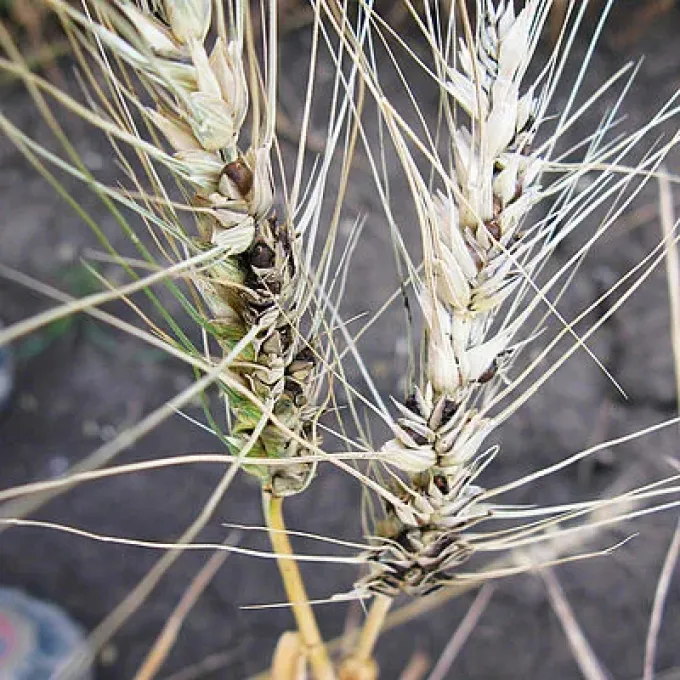
The primary symptom is the transformation of grain kernels into "bunt balls" filled with a black powdery mass of spores. Healthy grain is completely replaced by the pathogen, although the pericarp of the kernel often remains intact.
Infected ears often look different from healthy ones: they may remain green longer, and the glumes tend to spread open due to the swollen, deformed grains inside. Crushing these kernels releases a distinct, unpleasant fishy odor caused by trimethylamine.
In the field, infected plants may appear stunted compared to healthy ones due to the systemic disruption of plant metabolism. Sometimes, excessive tillering or stem distortion near the ear can be observed.
As the crop matures, the spore masses become fragile and break, contaminating healthy grain during harvesting. This leads to the "smutting" of grain batches, which severely degrades quality and market value.
Inside the ear, the fungus forms tiny dark spores that create clouds of dust upon mechanical disturbance, facilitating the rapid spread of infection to adjacent areas of the field.
Pathogen
The causal agents of this group of diseases are basidiomycete fungi of the order Tilletiales, commonly known as bunt or smut fungi. The primary hosts include various cereal crops such as wheat, rye, and numerous wild grass species.
These fungi develop within the host plant tissues, where they form masses of spores known as teliospores. The pathogen's mycelium infects the embryo of the seed or the tissues of the young seedling, coexisting with the plant throughout its growth cycle.
The life cycle of the pathogen is closely tied to the host's phenology, allowing the fungus to synchronize spore production with the heading phase of cereals. These pathogens can remain viable in the soil or on seed surfaces for extended periods.
The biology of these fungi involves infection primarily at the seedling stage, when the pathogen penetrates through the coleoptile. Later, the mycelium spreads systemically through the stem to reach the ovaries, where spore formation occurs.
Taxonomically, the family Tilletiaceae includes many specialized species, each targeting a limited range of plants, which makes crop rotation a fundamental aspect of biological disease management.
Conditions for development
The development of Tilletiales is critically dependent on soil temperature during seed germination. The optimal temperature for infection is between 5 and 12 degrees Celsius, making early-sown winter crops particularly vulnerable.
Soil moisture plays a crucial role in spore germination and successful penetration into seedling tissues. Moderately moist soil provides the ideal conditions for the pathogen to establish itself during early development.
Soil type influences disease incidence indirectly through the activity of soil microorganisms, which can act as antagonists to the fungus. Soils rich in healthy microbial life can help suppress the development of the disease.
The presence of spores on the seed surface is the primary driver of outbreaks in any given field. High spore density on seeds significantly increases the probability of successful infection during the planting season.
Climatic conditions that delay seedling growth, such as cold and prolonged springs or autumns, extend the window of vulnerability, leading to higher rates of infection in the crop.
Why it matters
The damage is manifested in direct yield losses, as the grain is replaced by fungal spore masses, rendering it useless for human consumption or livestock feed.
Contamination of healthy grain with spores lowers the grade of the harvest and makes it unsuitable for milling due to the foul odor and dark color imparted to the flour. Processed products from such grain can pose health risks.
Infected seeds lose their germination potential and cannot be used for planting. Even low levels of contamination necessitate rigorous fungicide treatment of seed batches.
Smut fungi reduce the overall immunological vigor of cereal crops, making them more susceptible to secondary pathogens and other abiotic environmental stressors.
Economic losses are compounded by the costs of additional grain cleaning, lower prices for downgraded batches, and the mandatory application of protective chemicals across all sown areas.
Protection
The primary method of control is pre-sowing seed treatment with systemic fungicides. This effectively eliminates spores located both on the surface and within the seed tissues.
Adhering to optimal sowing dates helps prevent the synchronization of pathogen development with the vulnerable seedling stage of the cereal crop. Planting in optimal temperature windows is highly recommended.
The use of resistant cultivars and hybrids is the most sustainable and eco-friendly way to manage the disease. Breeding programs continuously focus on developing lines with high resistance to various species of Tilletia.
Implementing proper crop rotation breaks the cycle of spore accumulation in the soil, depriving the fungus of susceptible hosts over several seasons.
Regular phytosanitary inspection of seed stock using laboratory diagnostic methods is essential to detect latent infections before sowing begins.
Discussion
No discussions yet — be the first.