
Thamnolia
Thamnolia
Description
Symptoms
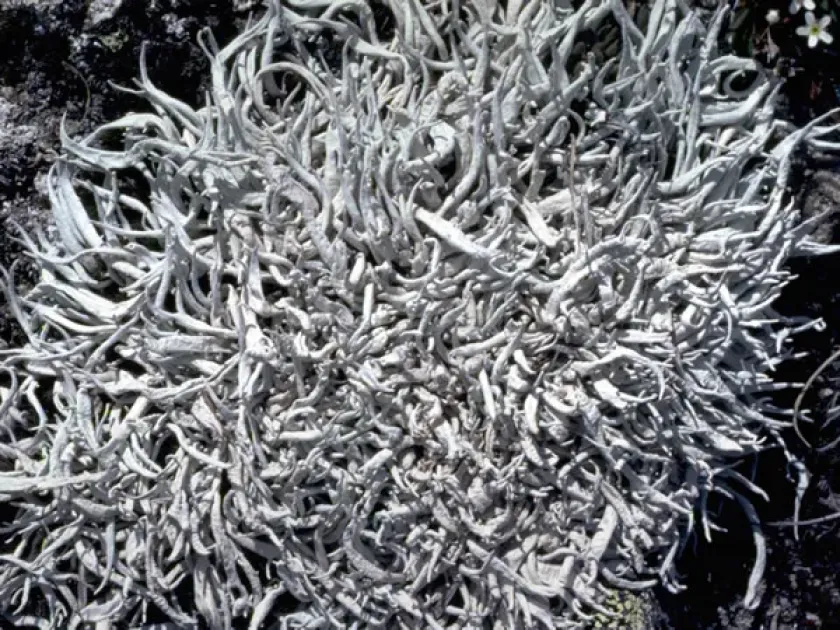
Thamnolia is a genus of lichens that appear as hollow, branched, white or cream-colored tubes. It is essential to note that these organisms are not plant pathogens and do not cause diseases in agricultural crops.
Externally, the lichen looks like a collection of small, dry worm-like structures scattered on the soil or among mosses. It lacks roots and does not attach to a substrate, allowing it to be easily moved by the wind.
A key sign of Thamnolia presence is the formation of distinctive tufts in open, cold environments. Unlike fungal diseases, this lichen does not produce necrotic spots, wilting, or tissue decay on higher plants.
The presence of this lichen often signifies a clean, undisturbed ecosystem, as it is highly sensitive to chemical pollution, particularly pesticides and high levels of fertilizers.
Some gardeners might mistake it for fungal growth, such as powdery mildew, due to its whitish appearance, but closer inspection reveals it is a self-contained organism that does not penetrate plant tissues.
Pathogen
Thamnolia is not a plant disease pathogen. It is a symbiotic organism consisting of a fungus and an alga, living independently of higher plants. It does not parasitize crops or cause harm to yields.
Biologically, Thamnolia is classified as a lichenized fungus in the family Icmadophilaceae. Its metabolism relies on the photosynthesis of the algae contained within its thallus.
It does not possess the enzymes required to break down plant cell walls (cellulose or lignin), which makes it incapable of initiating an infectious process in cultivated plants.
In phytopathology, Thamnolia is not considered an object of control. It does not produce phytotoxins and does not act as a vector for viruses, bacteria, or mycoplasmas.
Therefore, the misconception that Thamnolia is a disease is based entirely on a visual similarity to certain fungal formations and not on its actual biological behavior.
Conditions for development
Thamnolia thrives only in specific conditions: cold climates, arctic, subarctic, or alpine regions. It prefers open, well-lit, and well-drained areas.
High air humidity and atmospheric purity are critical for its function. In intensive agro-ecosystems, it cannot survive due to the presence of agricultural chemicals.
The lichen obtains mineral nutrients from the air by absorbing moisture and dust deposited on its surface. It does not depend on soil fertility, making it a successful pioneer colonizer.
The temperature range for its development is limited to moderate and low values. Excessive heat inhibits its metabolism, forcing it into a dormant state.
It spreads vegetatively through thallus fragmentation, which is carried by the wind to new areas. This process is very slow under natural conditions.
Why it matters
Thamnolia poses no threat to agricultural production. It does not compete for resources and does not impact the development or health of crops.
The harm caused by this object is zero. It does not cause yield loss, quality degradation, or the death of plants in a cultivated field.
The presence of Thamnolia in or near fields serves more as an indicator of favorable ecological conditions than as a threat to the agricultural sector.
Misinterpreting the presence of this lichen as a disease can lead to unnecessary expenditures on fungicides, which can harm the local ecosystem without providing any agronomic benefit.
Thamnolia is a valuable part of the biodiversity in northern regions and does not require intervention or elimination in agronomic practice.
Protection
No protection measures are necessary, as Thamnolia is not a disease. Any attempt to control it with chemical agents is futile and environmentally unjustified.
If removal from decorative sites is desired, only mechanical methods of cleaning the surface and improving drainage are recommended.
The best prevention is the maintenance of standard agronomic practices. Under active soil cultivation and fertilization, this lichen naturally disappears due to competition with higher plants.
It is recommended to verify the diagnosis whenever unknown formations are discovered. Use of a magnifying lens will easily distinguish Thamnolia from pathogenic fungi.
Always remember the ecological value of lichens, which serve as important bio-indicators of environmental health in natural habitats.
Discussion
No discussions yet — be the first.