
Tetragoniomycetaceae
Tetragoniomycetaceae
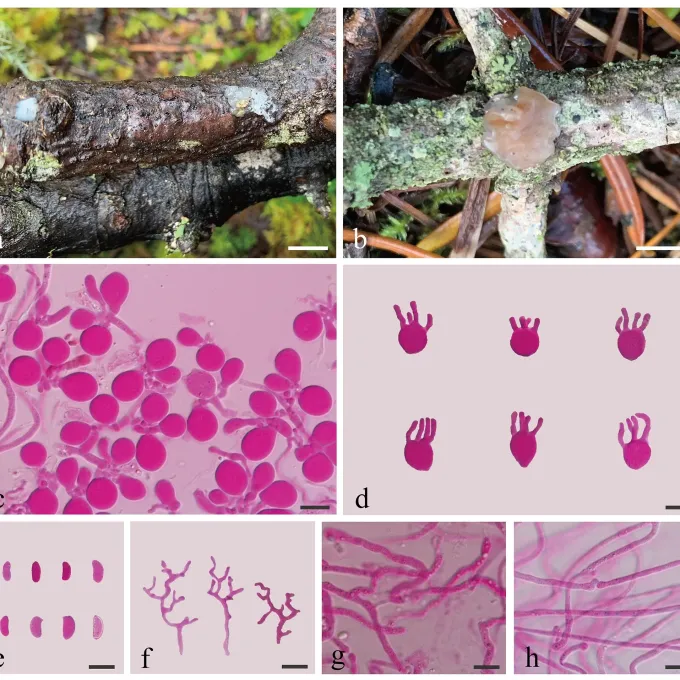
Description
Symptoms
The primary symptom is the appearance of atypical growths or galls, which can develop on various parts of the plant. These formations often have a dense structure and specific coloration.
In the early stages, signs may manifest as deformation of leaf blades or distortion of stems. Affected areas often become entry points for secondary bacterial infections.
Visual inspection often reveals white or cream-colored growth on the surface of the galls, representing masses of spores or mycelium. These structures become particularly noticeable in high-humidity conditions.
Microscopic analysis of internal plant tissues shows the presence of hyphae penetrating intercellular spaces, leading to cell hyperplasia. This causes local metabolic disruption.
Symptomatology varies depending on the host species, but is consistently associated with abnormal tissue proliferation resulting from the fungal parasitic activity.
Pathogen
The family Tetragoniomycetaceae belongs to the order Cystobasidiales, class Microbotryomycetes. This group consists of basidiomycete fungi that exhibit a dimorphic lifestyle.
The pathogens are characterized by both yeast-like and mycelial phases within their life cycle. They are frequently observed as hyperparasites of other fungi, making their biology complex to classify within traditional phytopathology.
Unlike common pathogens, members of this family are often associated with galls or specific abnormal growths on host tissues. They are capable of forming complex basidia, which serve as a diagnostic feature for mycologists.
Genetic studies confirm that these organisms are evolutionarily related to smut pathogens, which explains their capacity for parasitism on higher plants.
The type of disease caused by these organisms is generally classified as mycoparasitism or a systemic infection that disrupts the normal growth and physiological development of the host plant tissues.
Conditions for development
The development of Tetragoniomycetaceae is closely linked to high relative humidity, typically exceeding 80%. These conditions are critical for spore germination and basidia formation.
The optimal temperature for pathogen development ranges from +15 to +22 degrees Celsius. Significant deviations from this range slow down the fungus's life cycle.
The presence of free moisture on plant surfaces following rain or heavy dew facilitates rapid infection spread via spores carried by wind or insects.
Stressed plants with mechanical damage are more susceptible to infection. The disease pressure significantly increases in dense plantings with poor ventilation.
The seasonality of development usually coincides with periods of active plant growth, as the host's metabolic activity creates a favorable environment for the parasite.
Why it matters
The primary harm lies in the inhibition of plant growth, leading to substantial yield losses. Abnormal growths divert nutrients away from the plant's reproductive organs.
Damage to tissues through galls creates entry points for pathogenic bacteria and other fungal infections, often leading to the premature death of specific plant parts.
In commercial production, infections reduce market value due to product deformation. Such produce becomes unsuitable for long-term storage due to rot risks.
Systemic impact can lead to premature leaf drop, which critically reduces the photosynthetic capacity of the crop during the critical harvest formation period.
The long-term presence of the pathogen in soil or plant debris makes it impossible to cultivate susceptible crops on the same site for several seasons.
Protection
Prevention begins with strict crop rotation. It is inadvisable to plant susceptible crops on previously affected fields for at least 3–4 years.
An essential element is the timely removal and destruction of plant debris, which serves as the primary reservoir for infection during the off-season.
Systemic fungicide application is effective during the early stages of disease manifestation. Copper-based or triazole-based products show satisfactory results.
- Ensuring optimal plant density for improved aeration.
- Conducting phytosanitary pruning to remove galls.
- Monitoring humidity levels in greenhouses via ventilation systems.
Utilizing resistant cultivars and hybrids is the most economically viable strategy, minimizing the need for intensive chemical interventions.
Discussion
No discussions yet — be the first.