
Bellini's bolete
Suillus bellinii
Description
Symptoms
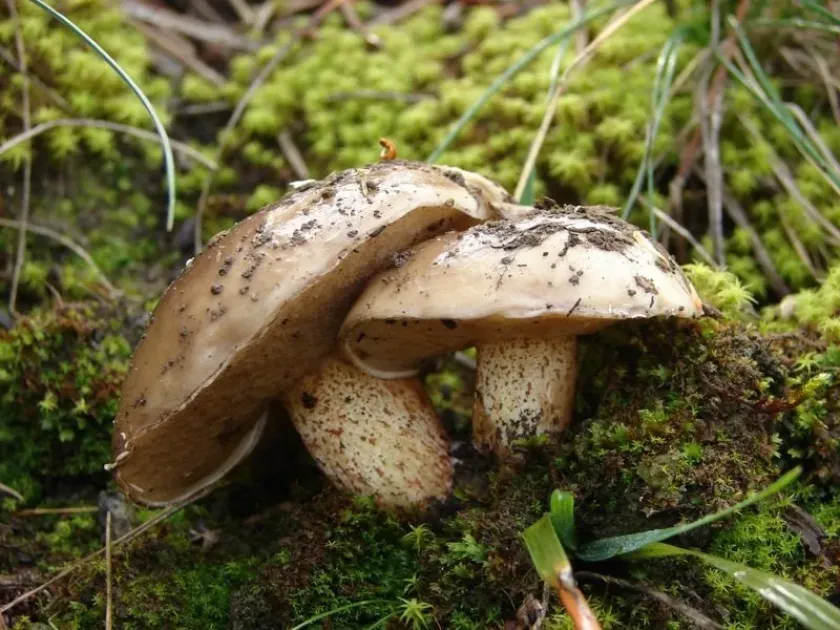
The primary external sign of the fungus's presence is the emergence of fruiting bodies in coniferous forests. These mushrooms typically grow in clusters, tightly packed together.
Young caps are covered in a sticky slime that becomes shiny when dry. The color varies from whitish-cream to brownish, often marked with darker spots.
The stipe is short, thick, and typically light-colored with reddish or brownish dots. Notably, it lacks a ring, which serves as a key identifying morphological marker.
The porous tubular surface under the cap is initially covered by a thin white veil in young specimens. As the mushroom grows, this veil breaks, releasing spores into the surrounding area.
The mycelium forms an extensive network around the host tree roots, often visible as white threads or strings within the upper layers of the forest soil.
Pathogen
Bellini's bolete (lat. Suillus bellinii) is a basidiomycete fungus belonging to the Suillaceae family. It is essential to note that this organism is not a plant disease or pathogen, but a beneficial symbiont.
Biologically, this mushroom acts as an obligate mycorrhizal partner. It enters into a close symbiotic relationship with the root systems of specific coniferous trees, exchanging nutrients for carbohydrates.
The fungus is not a disease agent for any cultivated crops. Its life cycle is focused on mycelium growth in the soil and the development of fruiting bodies near the host tree roots.
It reproduces via spores generated in the tubular layer beneath the cap. Once mature, these spores are dispersed by environmental factors to colonize new areas of the forest floor.
Morphologically, the species is distinguished by its lack of a ring on the stipe and its specific cap coloration, differentiating it from other members of the Suillus genus.
Conditions for development
Bellini's bolete prefers specific environmental conditions, typical of warmer regions, particularly those in the Mediterranean, where favorable temperatures prevail.
The main condition for its development is the presence of symbiotic coniferous trees, especially pines. The fungus cannot survive without direct contact with these root systems.
It thrives in sandy or well-drained soils that heat up effectively. Moderate rainfall is critical to triggering the growth of fruiting bodies after dry periods.
The optimal temperature range for development is between 15 and 25 degrees Celsius. The species is sensitive to extreme frost and prolonged drought.
It is most frequently found in forest openings, along paths, or in areas with sufficient sunlight to stimulate mycorrhizal activity in the soil.
Why it matters
This object does not cause any harm to agricultural or forestry crops. Its impact on plants is strictly positive, characterized by a mutualistic relationship.
The mycorrhiza formed by the fungus assists trees in absorbing water and mineral nutrients more efficiently, which significantly enhances growth in adverse conditions.
The fungus also contributes to the biological defense of the root system against certain pathogens by forming a physical barrier and producing beneficial compounds.
The presence of this fungal mycelium in the soil is an indicator of a stable ecological condition and healthy forest soil quality.
Therefore, classifying Suillus bellinii as a threat is incorrect; it is a valuable organism that supports the vitality of the forest ecosystem.
Protection
There are no control or protection measures for this species, as it is not a pest or parasite that threatens crops or forest stands.
In forestry, the preservation of natural mycorrhizal fungi is encouraged as it promotes the robust development of young coniferous seedlings.
The use of aggressive fungicides should be avoided in areas where beneficial mycorrhizal fungi are present to prevent disrupting the natural soil balance.
Maintaining the natural forest floor and avoiding excessive mechanical soil compaction are the best practices for supporting the local population of the fungus.
To encourage growth in artificial stands, it is essential to ensure adequate soil moisture and prevent chemical pollution of the environment.
Discussion
No discussions yet — be the first.