
Stilbella fimetaria
Stilbella fimetaria
Description
Symptoms
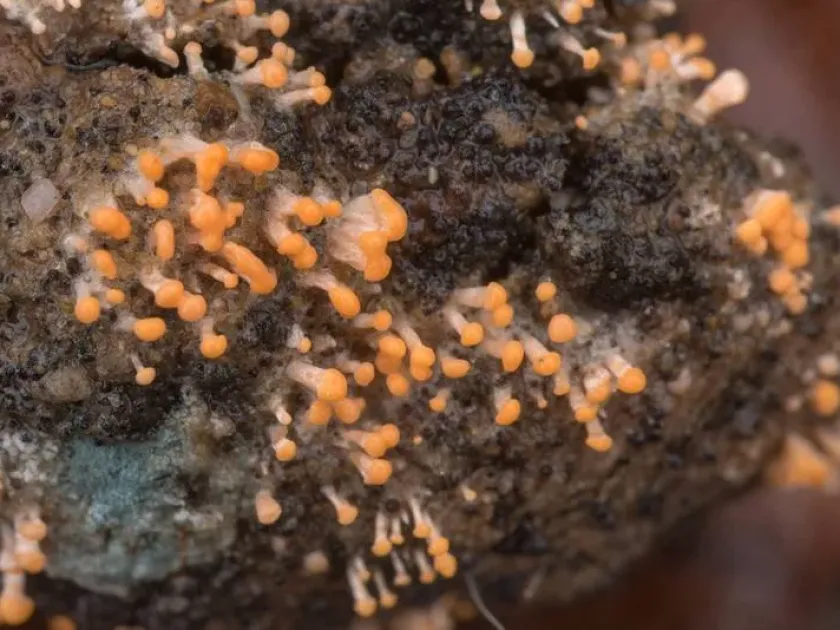
The main sign of this fungus is the formation of dense colonies, resembling a coating or tiny "pins" on the surface of the casing soil.
Visually, affected areas look like patches of white, yellowish, or pink cotton-like mycelium that gradually densifies. Unlike healthy mushroom mycelium, Stilbella has a specific dense structure.
As the disease progresses, growth inhibition of the beneficial fungal mycelium is observed. The cultivated mushroom stops forming fruit bodies, and in areas colonized by the pathogen, the substrate becomes unsuitable for further use.
In the early stages, signs may be invisible; however, the appearance of a specific odor or color change in the casing soil can signal the development of this infection.
Infection is often localized in areas with excessive humidity or poor aeration, where the fungus forms its reproductive organs, which are visible to the naked eye as small growths.
Pathogen
Stilbella fimetaria is a microscopic fungus belonging to the Ascomycota division. In industrial mushroom farming, this microorganism is classified as a dangerous parasite or saprotrophic competitor that develops in substrates used for growing edible mushrooms.
The pathogen belongs to a group of fungi capable of actively decomposing organic residues; however, when it enters cultivation facilities, it switches to consuming nutrients intended for the mycelium of mushrooms like champignons or oyster mushrooms.
Biologically, this fungus forms characteristic conidiophores that look like club-shaped or droplet-like structures. They often have a cream, pinkish, or whitish hue, which makes them easy to identify upon close inspection of the substrate.
The pathogen's life cycle is closely linked to the availability of accessible cellulose and nitrogen compounds in processed compost. The fungus is capable of forming spores, which are easily transported by air currents and equipment.
The spread of Stilbella fimetaria occurs primarily through improperly pasteurized casing material or contaminated raw materials used for substrate preparation, where the pathogen survives in the form of resting structures.
Conditions for development
The development of Stilbella fimetaria is favored by high air humidity exceeding 85–90% and the presence of excess moisture directly within the structure of the casing layer.
The temperature range of 20 to 25 degrees Celsius is optimal for the active growth of the fungus's vegetative body and subsequent sporulation.
Poor ventilation in facilities contributes to the accumulation of pathogen spores in the air, which significantly accelerates the infection of adjacent blocks or beds in the mushroom facility.
Failures in compost thermal treatment technology are the primary factor allowing this fungus to survive and quickly colonize the substrate after inoculation.
The use of contaminated peat or non-sterile water for irrigation creates additional risks for infection outbreaks, as the pathogen actively multiplies in the presence of organic contaminants.
Why it matters
The main harm consists of direct competition with the cultivated mycelium for substrate nutrients, which leads to a sharp decrease in the biological efficiency of the yield.
In the case of mass spread, Stilbella fimetaria completely suppresses mycelium growth, making it impossible for fruit bodies to form in affected areas.
The infection leads to significant economic losses, as affected blocks require immediate disposal to prevent the spread of spores throughout the facility.
Additionally, the presence of the pathogen can lead to changes in substrate acidity, which negatively affects the physical and chemical parameters of the environment necessary for mushroom metabolism.
In commercial farm conditions, the presence of spores in the air poses a long-term threat, complicating subsequent cultivation cycles due to the accumulation of an infectious background.
Protection
A key protection method is strict adherence to substrate pasteurization and casing soil sterilization technology, which eliminates the survival of pathogen spores.
It is necessary to maintain optimal microclimate parameters, avoiding the formation of stagnant zones with excessive humidity, where the fungus thrives.
An important element of prevention is compliance with sanitary standards: using clean clothing, disinfecting tools, and restricting personnel access to cultivation zones.
If localized outbreaks are detected, it is recommended to immediately remove the substrate along with the affected area and perform local treatment with disinfectants.
Regular monitoring of crop conditions and the use of high-quality mycelium minimize the risks of Stilbella fimetaria development and ensure stable mushroom production.
Discussion
No discussions yet — be the first.