
Proso millet stem smut
Sphacelotheca macrospora
Description
Symptoms
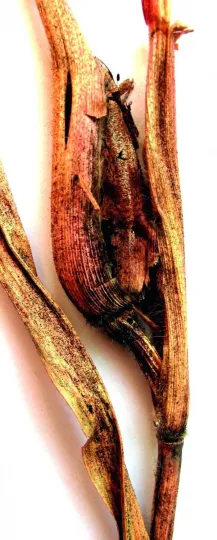
Proso millet stem smut typically becomes visible during the tillering or stem elongation stage, manifesting as characteristic galls on stems, leaf sheaths, and panicles. These growths often have an elongated shape and are covered by the host plant's epidermis.
As the plant matures, the epidermis ruptures, exposing a dark, almost black mass of fungal spores. The interior of the gall contains a dense columella, which remains after the spores have dispersed.
Infected plants often exhibit excessive tillering, appear stunted, and significantly lag behind healthy plants in growth. In some cases, deformation of the entire above-ground part of the plant is observed.
Panicles on infected plants often fail to develop fully or never emerge from the upper leaf sheath. This results in complete sterility for the affected stems.
The disease can be identified during careful field inspections in the first half of the growing season, as most spores are dispersed by wind before harvest, leaving behind only empty remnants of the spore sacs.
Pathogen
The pathogen responsible for the disease is the basidiomycete fungus Sphacelotheca macrospora. It belongs to the group of smut fungi that specifically target cereal crops.
The infection persists in the soil in the form of teliospores, which remain viable for several years. Spores adhering to the surface of seeds can also serve as a primary source of inoculum.
Infection occurs during the early seedling stage when the plant is tender, allowing the fungal mycelium to penetrate the plant's apical meristem. The infection process is systemic.
The fungus develops inside the plant tissues throughout the entire growing season, gradually migrating upward along with the growth point as the stem elongates.
By the end of the season, the mycelium transforms into teliospores, forming masses of sori that ensure the spread of the infection for the following season.
Conditions for development
The development of stem smut is favored by moderately moist and cool weather conditions during the germination of millet seeds. This environment provides optimal conditions for the fungus to penetrate the young seedlings.
High soil moisture at the time of sowing significantly increases the rate of infection, as fungal spores germinate more rapidly and exhibit increased infectious potential.
Temperatures ranging between 15°C and 20°C are most favorable for the active infection of the crop by the smut pathogen.
Agronomic factors, such as planting seeds too deep, slow down emergence, thereby extending the period of susceptibility of the seedlings to fungal penetration.
Continuous cropping of millet on the same field leads to an accumulation of spores in the soil, which increases the intensity of the disease and reduces overall crop productivity.
Why it matters
The primary economic impact of stem smut is the total loss of grain yield on affected stems, as the plant fails to produce a functional panicle.
The disease causes severe suppression of the crop, a reduction in biomass, and disruption of photosynthesis due to damage to vegetative organs.
During severe outbreaks, grain losses can be substantial, particularly in years with weather conditions conducive to the spread of the fungus.
Beyond direct yield loss, smut spores contaminate the seed material, necessitating additional costs for cleaning and fungicide treatment.
The quality of the harvested grain is significantly degraded, often rendering it unsuitable for food consumption without expensive processing.
Protection
The most effective control strategy is the use of high-quality, certified seeds treated with systemic fungicides that inhibit spore development.
Adhering to proper crop rotation schedules allows for the interruption of the pathogen's lifecycle in the soil, ensuring that millet is not planted on the same field for at least 3 to 4 years.
Optimal planting dates, when the soil is sufficiently warm, promote rapid seedling growth, which minimizes the window of susceptibility to soil-borne infection.
The breeding and adoption of millet varieties resistant to stem smut represent the most economically viable and environmentally friendly method of disease management.
- Deep autumn plowing to bury spores in the soil.
- Thorough cleaning of seeds to remove contaminants.
- Implementing crop rotations with a 3-4 year interval.
- Selection of regionally adapted resistant varieties.
Discussion
No discussions yet — be the first.