
Cauliflower fungus
Sparassis crispa
Description
Symptoms
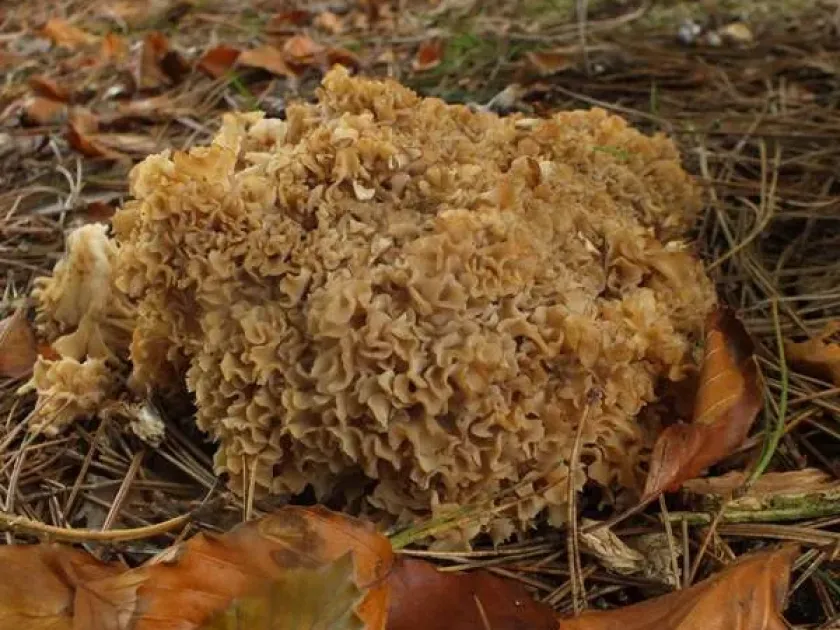
The most visible diagnostic sign of infection is the emergence of distinctive, yellowish-white, curly, branched fruiting bodies at the base of the tree during late summer and autumn.
Internal wood symptoms include a marked color change to reddish-brown or dark brown, indicating the degradation of cellulose components while leaving lignin intact.
In advanced stages, the wood decays and fractures into cubical blocks due to the loss of tensile strength, a condition characteristic of severe brown cubical rot.
External symptoms in the tree canopy include progressive thinning of the crown, yellowing of the needles, and a reduction in annual growth increments as root health declines.
Trees affected by the fungus often exhibit a lack of anchorage, leading to increased vulnerability to windthrow, even if the tree appears relatively healthy from a distance.
Pathogen
Cauliflower fungus (Sparassis crispa) is a parasitic basidiomycete fungus known to cause severe brown root rot and butt rot in coniferous tree species, particularly pine. It acts as a facultative parasite that destroys the structural integrity of wood.
The fungus typically infects trees through their root systems, spreading via root contacts between adjacent trees or through wounds in the roots and root collar caused by environmental stress or human activities.
The vegetative part of the fungus, the mycelium, colonizes the heartwood and sapwood of roots, slowly moving upward into the base of the trunk. This process gradually compromises the tree's ability to transport water and nutrients.
The reproductive structures, or fruiting bodies, are easily identifiable by their unique cauliflower-like appearance at the base of the tree. They produce spores that are disseminated by wind, rain, or insects to infect other susceptible hosts.
As a pathogen, Sparassis crispa is highly persistent, capable of surviving for many years as a saprophyte on dead wood and stumps, acting as a constant source of infection in forest stands.
Conditions for development
The fungus thrives in temperate climates with high soil moisture and moderate temperatures, which are optimal for mycelial growth and the germination of spores in the forest floor.
Dense forest stands with high root density increase the probability of root-to-root transmission of the pathogen, allowing the disease to spread rapidly through the stand.
Mechanical injuries to tree roots during forestry operations create open wounds that serve as ideal entry points for the fungus, significantly increasing the likelihood of successful colonization.
The presence of old stumps and logging debris serves as a long-term reservoir for the pathogen, allowing it to maintain a stable population before moving to living hosts.
Site conditions, such as poorly drained soils or nutrient deficiencies, can weaken the tree's natural defense mechanisms, making it more susceptible to infection by Sparassis crispa.
Why it matters
The disease causes substantial economic losses in the forestry sector by killing mature coniferous trees, which are the most valuable for commercial timber production.
The decay of root and butt wood renders the logs unsuitable for high-quality lumber, as the structural degradation significantly lowers the timber grade and usable volume.
Root rot reduces the stability of forest stands, increasing the risk of windthrow events that can destroy large areas of forest and disrupt long-term management plans.
Invasive rot reduces the biological productivity of the stand, potentially leading to long-term decline in forest health and a reduction in carbon sequestration capabilities.
For park and urban environments, the presence of this fungus poses a safety risk, as infected trees may suddenly become unstable and fall, necessitating expensive removal operations.
Protection
Effective management relies on the early detection and removal of infected trees, including stump removal, to eliminate the reservoir of the pathogen within the stand.
Forestry practices should prioritize minimizing damage to tree roots and the trunk base during thinning or harvesting operations to reduce the number of infection sites.
Maintaining high stand vigor through appropriate silvicultural techniques helps trees better withstand potential infection and limits the impact of the disease.
Regular monitoring for fruiting bodies is essential in high-risk areas, as it provides a clear indication of disease presence before widespread mortality occurs.
If clear-cutting is necessary due to severe infestation, a fallow period or planting with non-host species may be required to break the disease cycle before replanting conifers.
Discussion
No discussions yet — be the first.