
Sclerosporosis
Sclerosporales
Description
Symptoms
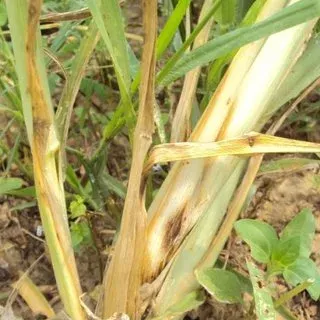
Early symptoms of Sclerosporosis include the appearance of chlorotic streaks on leaves, which usually run parallel to the veins. As the infection progresses, these areas may turn yellow, white, or even necrotic.
Under high humidity, a dense, whitish fungal growth consisting of conidia and conidiophores appears on the underside of leaves. In dry conditions, leaves often curl and wither, showing signs of severe stress.
Infected plants exhibit stunted growth and a general dwarfed appearance compared to healthy crops. Abnormal tillering, where the plant produces excessive side shoots, is also a common observation.
The reproductive organs are significantly affected; tassels or ears may become deformed and converted into leaf-like structures, rendering the plant completely sterile and unable to produce grain.
Weakened root systems are another indicator of systemic infection. This lack of root development makes the plants highly vulnerable to lodging and environmental stresses like drought.
Pathogen
Sclerosporosis is a serious plant disease caused by oomycetes belonging to the order Sclerosporales, primarily species of the genus Peronosclerospora. These organisms are obligate parasites that specifically target grass species, causing systemic infections.
The life cycle of the pathogen involves the production of zoospores and durable oospores. While conidia facilitate rapid spread through the air, oospores persist in the soil for several years, serving as the primary source of inoculum.
The pathogen typically invades plant tissues through the root system or stomata. Once inside, the mycelium spreads systemically, disrupting the host plant's physiological functions and metabolic processes.
The biological nature of the pathogen makes it highly adaptable to varying environmental conditions. Its ability to colonize host tissues completely often leads to severe deformation and sterility.
Management of the pathogen is particularly difficult because oospores can remain viable even in unfavorable conditions. This biological resilience requires integrated management approaches to mitigate risks to agricultural production.
Conditions for development
Sclerosporosis development is heavily dependent on specific environmental factors. High relative humidity (above 80%) combined with moderate temperatures (20–25°C) creates ideal conditions for disease outbreaks.
Frequent rainfall or persistent dew encourages the release and germination of conidia, facilitating rapid spread across fields. Moist soil conditions are particularly critical for the activation of soil-borne oospores.
Delayed germination of seeds due to cold or excessively wet soil provides a critical window for the pathogen to enter young seedlings. Strong, early-stage growth is essential to minimize the risk of successful infection.
Continuous cropping of susceptible varieties on the same land facilitates the buildup of oospores in the soil. This creates a high infection pressure that becomes increasingly difficult to manage over time.
Dense plant canopies can further trap moisture and create a microclimate that promotes the survival and transmission of the pathogen throughout the vegetative growth period.
Why it matters
The economic impact of Sclerosporosis is substantial, as it can cause significant yield losses. In severe cases, entire field areas may suffer from total crop failure, making harvesting non-profitable.
The disease depletes the host plant of vital nutrients, leading to poor grain filling and reduced seed quality. Such seeds often have low germination rates, which compromises the next season's crop establishment.
Plants affected by the disease are more susceptible to secondary infections and pest infestations due to their compromised systemic immunity. The overall plant population density decreases over the season.
Direct costs include expensive fungicide applications, soil treatments, and the loss of inputs on infected areas. Indirect costs stem from lower market value of affected crops and restrictions on international trade.
For breeders, the presence of Sclerosporosis is particularly damaging, as it can ruin high-value genetic material. The disease's high mobility through airborne spores makes local containment a major challenge.
Protection
The primary control strategy is the use of resistant hybrids or varieties. Genetic resistance is the most sustainable and efficient method to mitigate the impact of Sclerosporosis in agricultural systems.
Crop rotation is crucial to prevent the accumulation of oospores in the soil. Implementing a break of 3 to 4 years between susceptible crops helps reduce the pathogen load effectively.
Seed treatment with systemic fungicides is a standard preventive measure. Applying appropriate chemicals helps protect seedlings during the early, most vulnerable stage of development.
- Deep plowing to bury infested plant debris.
- Effective weed management to remove alternative hosts.
- Optimizing planting times to ensure rapid seedling emergence.
- Spatial isolation of seed production fields.
When localized outbreaks are detected, rogueing (removing infected plants) can help reduce the amount of inoculum in the field. Fungicide sprays during the vegetative stage may be used to suppress secondary spread in highly infested areas.
Discussion
No discussions yet — be the first.