
Sarcoscypha
Sarcoscypha
Description
Symptoms
The main sign of the fungus's presence in forest litter is its bright fruit bodies. They appear in early spring, often immediately after the snow melts, when most other fungi are still inactive.
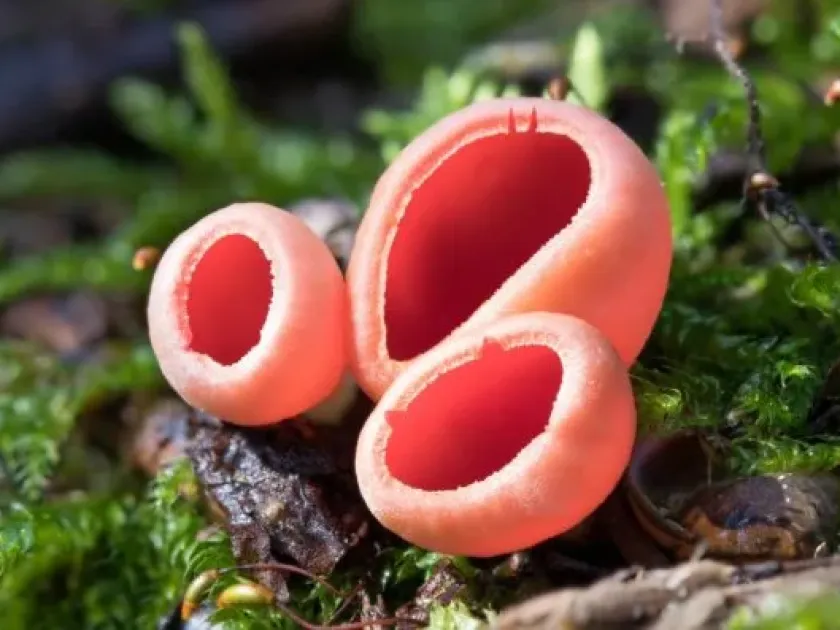
The fruit bodies are cup-shaped with a diameter of 1 to 5 centimeters. The outer surface is usually light or pinkish, while the inner cup is colored a vibrant, bright red.
The fungi are located on a substrate — decaying branches that are often partially buried in soil or leaf litter. Visually, this appears as a scatter of "scarlet cups" against the dark background of the forest floor.
Spores of the fungus mature inside the hymenial layer covering the inner surface of the cup. Upon mechanical disturbance or wind gusts, they are released into the air as a fine cloud.
Signs of the fungus's activity do not include leaf spots, necrosis, or shoot wilting. Any damage to the bark or leaves near the fungi is caused by other factors, not by this species.
Pathogen
Important clarification: Sarcoscypha is a genus of sac fungi (ascomycetes) in the family Sarcoscyphaceae, not a plant disease. In agronomic and phytopathological terms, this organism is not a pathogen of agricultural crops.
Biologically, this fungus is a saprotroph that develops on decaying wood. It leads the lifestyle of a decomposer, participating in the natural cycle of organic matter decomposition within forest ecosystems.
The mycelium of the fungus penetrates deep into the structure of dead branches of deciduous trees, such as willow, maple, or alder. It uses enzymatic mechanisms to break down cellulose and lignin, obtaining nutrients from non-living wood.
The life cycle of the fungus is dominated by the production of fruit bodies, which have a characteristic cup or goblet shape and a bright red color. These structures serve to produce and disperse spores.
The fungus does not infect living plant tissues and possesses no pathogenic properties toward garden or agricultural crops. Its presence on a site indicates only the availability of decaying wood.
Conditions for development
For the development of Sarcoscypha fruit bodies, high humidity in the air and soil is required. The ideal time for their appearance is the early spring period, when temperatures remain between +5 and +12 degrees Celsius.
The fungus prefers shaded and moist areas characteristic of deciduous and mixed forests. An important factor is the presence of dense litter that retains moisture around the woody substrate.
Since the fungus is a saprotroph, it develops actively only when there is a sufficient amount of wood organic matter available for decomposition. In dry conditions, fruiting ceases or becomes impossible.
Spore dispersal is carried out by air currents. After landing on a suitable substrate (dead wood of deciduous species), the spores germinate, forming a new mycelium.
Light levels play a secondary role, although the fungus performs better in partial shade, as direct sunlight quickly desiccates the fruit bodies.
Why it matters
From an agronomic point of view, Sarcoscypha does not cause any harm to cultivated plants. It is incapable of colonizing living tissues because it lacks the parasitic apparatus required to suppress a plant's immune system.
Moreover, this fungus performs a useful ecological function. As a decomposer, it accelerates the mineralization of plant residues, converting nutrients into a form available for uptake by soil microflora.
In gardens and parks, the presence of this fungus on dead branches should be perceived as a natural process of cleaning the site of dead woody material. It is not an indicator of garden disease.
The lack of harmfulness is confirmed by the fact that the fungus does not secrete toxins capable of damaging the vascular system of trees or shrubs. It is completely safe for fruit and berry plantings.
Unlike true pathogens, Sarcoscypha does not require control measures. Its presence is not a threat to the harvest or the health of green spaces on a site.
Protection
Protection measures against Sarcoscypha are not needed as it is not a pest. Nevertheless, to maintain the sanitary condition of a garden, it is recommended to regularly clean up old, rotting wood.
If the presence of the fungus on a site is undesirable from an aesthetic point of view, simply collecting and disposing of the affected branches is sufficient. This will deprive the fungus of its food substrate.
The use of chemical fungicides against this fungus is unnecessary and economically unjustified. The fungus does not cause harm, and fungicides can disrupt the balance of beneficial soil microbiota.
Prevention comes down to general agrotechnical rules: timely pruning of dry branches and clearing the site of plant debris. This prevents the accumulation of organic matter suitable for the activity of saprotrophic fungi.
Thus, the best way to "control" it is to maintain cleanliness in the garden and understand the biology of this species, which is a natural part of the ecosystem, not a threat to agriculture.
Discussion
No discussions yet — be the first.