
Blackening brittlegill
Russula nigricans
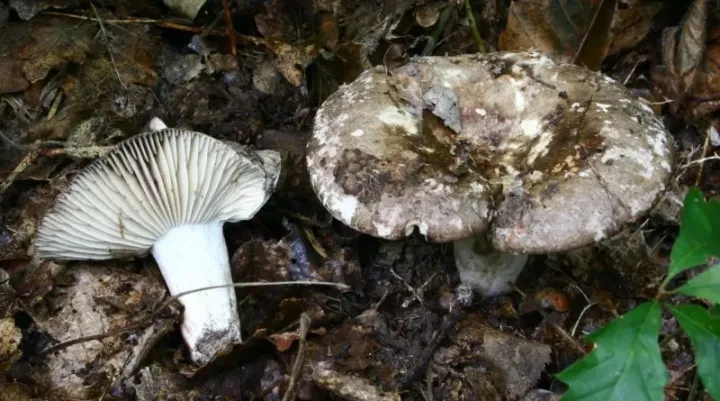
Description
Symptoms
The fruit bodies of Russula nigricans are robust and fleshy. The cap typically measures 5–15 cm across and transitions from convex to depressed or funnel-shaped.
The cap color ranges from dull white to dark brown or charcoal black. The flesh is firm and, most notably, turns red and then black upon cutting or bruising.
The gills are thick and distant, which distinguishes this species from many other brittlegill mushrooms found in similar environments.
The stem is thick and hard, often matching the color of the cap, and it does not feature a ring or volva at the base.
Spore prints are white, which is a helpful characteristic for mycologists and forest researchers identifying the mature fungus.
Pathogen
The blackening brittlegill (Russula nigricans) is a mushroom species belonging to the Russulaceae family. It is not a plant pathogen and does not cause diseases in agricultural crops.
This fungus acts as a mycorrhizal partner to various tree species, forming beneficial associations that support root system development in forest trees.
Biologically, it plays a vital role as a decomposer of forest litter, breaking down organic matter and contributing to soil health within forest ecosystems.
Unlike parasitic fungi, Russula nigricans does not invade living plant tissue or impair the vital functions of cultivated plants or forest trees.
Its presence in areas adjacent to farmland is indicative of a healthy and diverse soil microbiome rather than a disease threat.
Conditions for development
This species is commonly found in deciduous and coniferous forests, establishing mycorrhizal networks with trees such as beech, oak, and spruce.
It thrives in moist environments with significant leaf litter and well-aerated soil that is slightly acidic to neutral in pH.
The formation of fruit bodies is most intense during periods of high humidity, particularly following summer and autumn rains.
Temperatures ranging from 15°C to 22°C are optimal for the growth of the mycelium and subsequent emergence of the sporocarps.
Effective dispersal of spores is facilitated by wind currents and forest-dwelling invertebrates that traverse the woodland floor.
Why it matters
Russula nigricans does not pose any danger to agricultural crops, plantations, or horticultural industries. It causes no damage to crops.
The species is ecologically neutral regarding agricultural production, meaning no economic losses are associated with its occurrence in fields.
It does not produce toxins that could harm nearby plants, nor does it compete with crops for critical nutrients in a harmful way.
Misidentifying this fungus as a crop disease could lead to unnecessary and potentially harmful use of chemical treatments in a field.
Its classification as a harmless mycorrhizal fungus makes it a beneficial component of forest shelterbelts, aiding in the stability of tree roots.
Protection
Since the blackening brittlegill is not a pathogen, no control measures, chemical treatments, or pest management strategies are required.
Integrated pest management (IPM) protocols do not include this mushroom as it is a non-target species that poses zero risk to crops.
Protection of forest belts and natural soil environments encourages the growth of these beneficial mycorrhizal fungi, which support tree health.
No herbicides or fungicides should be applied to manage the presence of this mushroom, as it serves as a sign of environmental stability.
Field monitoring programs should focus on identifying actual crop pathogens rather than harmless forest fungi like Russula nigricans.
Discussion
No discussions yet — be the first.