
Vinegar brittlegill
Russula acetolens
Description
Symptoms
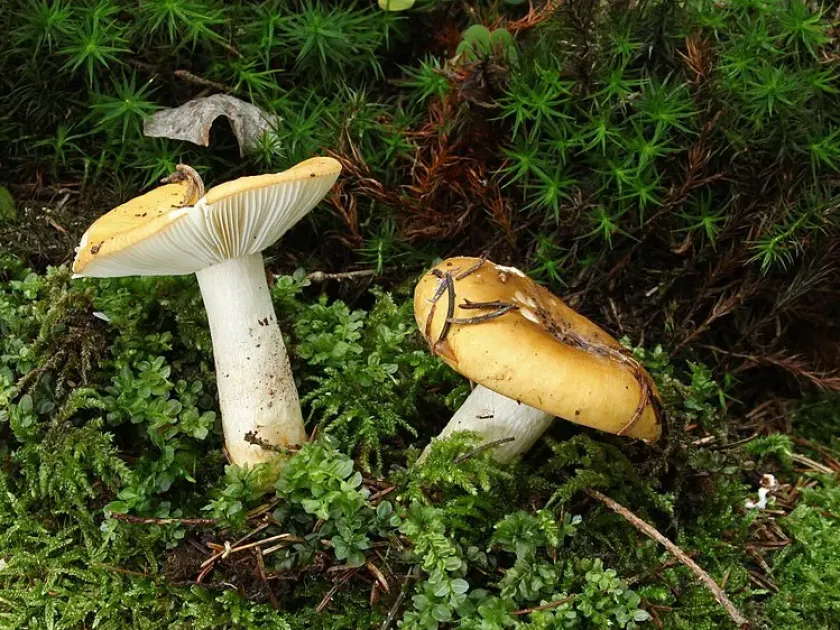
The Vinegar brittlegill is a medium-sized mushroom belonging to the Russulaceae family. Its cap typically ranges from 4 to 8 cm in diameter and features a convex to flat shape.
The color of the cap is generally ochre-yellow or honey-brown, often darkening towards the center. The skin is usually dry and matte, potentially cracking under dry conditions.
The gills are cream-colored and attached to the stem. They are densely packed and are a distinctive feature of this particular species within the genus.
The stem is white, solid, and cylindrical, occasionally showing yellow or brownish stains as the mushroom matures or dries out.
The most reliable identifying characteristic is its distinct odor. It emits a sharp, pungent scent reminiscent of vinegar, which becomes more pronounced as the fruit body dehydrates.
Pathogen
It is important to clarify that Russula acetolens is not a plant pathogen. It does not cause diseases in crops and poses no threat to agricultural production.
This fungus is classified as a mycorrhizal species, living in a symbiotic relationship with trees such as oaks and beeches. It relies on forest trees for survival.
The fungus is a saprotrophic-mycorrhizal organism, meaning it plays a role in breaking down organic matter in forest soil rather than attacking living plant tissues.
It does not produce spores that infect agricultural crops. Its lifecycle is entirely contained within the forest ecosystem and the soil underneath tree canopies.
From an agronomical perspective, the Vinegar brittlegill is completely benign and holds no status as a pest or disease-causing agent.
Conditions for development
Development of the Vinegar brittlegill depends heavily on the presence of broad-leaved forest ecosystems. It requires specific tree hosts to establish its mycorrhizal network.
High soil moisture and mild temperatures are essential for the production of fruit bodies. These conditions are typically met during the late summer and early autumn.
The soil should be rich in organic humus, providing the necessary nutrients for the mycelium to thrive. Well-drained soils are preferred over waterlogged areas.
Shaded environments are critical for maintaining the stable microclimate required for the growth of the fungus. Direct sunlight can dehydrate the mycelium and prevent growth.
The fungal mycelium is highly sensitive to environmental changes and chemical inputs, such as fertilizers or fungicides commonly used in intensive agriculture.
Why it matters
There is no evidence of harm caused by this fungus to agricultural crops. It is not capable of inducing wilting, rot, or any form of plant disease.
As a mycorrhizal species, it actually supports tree health by improving nutrient absorption, which is beneficial for the forest ecosystems bordering farmland.
It does not compete with agricultural crops for nutrients, sunlight, or water, as its growth is restricted to the forest habitat.
There are no recorded instances of this fungus interfering with crop yields, quality, or the overall health of the agricultural environment.
The presence of this fungus is simply an indicator of a balanced and healthy forest soil environment, posing no threat to adjacent cultivated fields.
Protection
Control measures against the Vinegar brittlegill are neither required nor recommended. It does not warrant any agronomical intervention or pesticide application.
Preventative actions are unnecessary as the fungus does not exhibit any characteristics of an invasive or pathogenic species for crops.
Sustainable agricultural practices already favor the preservation of beneficial fungi; there is no reason to target this species specifically.
General farm hygiene and proper land management do not need to account for this species, as it remains strictly within its natural woodland boundaries.
Understanding the role of such fungi is part of general ecological education, ensuring that farmers can distinguish between beneficial woodland species and actual crop pathogens.
Discussion
No discussions yet — be the first.