
Description
Symptoms
Stunting is the most prominent symptom of the disease. Infected plants exhibit significantly reduced height and shortened internodes compared to healthy plants in the same field.
Dark-colored, raised waxy swellings or galls appear on the veins of leaf blades and sheaths. These galls are distinct pathological indicators of RBSDV infection caused by hyperplastic tissue growth.
Infected plants often display excessive tillering, giving them a bushy or broom-like appearance. The leaves are typically dark green, thickened, and may show curling or twisting.
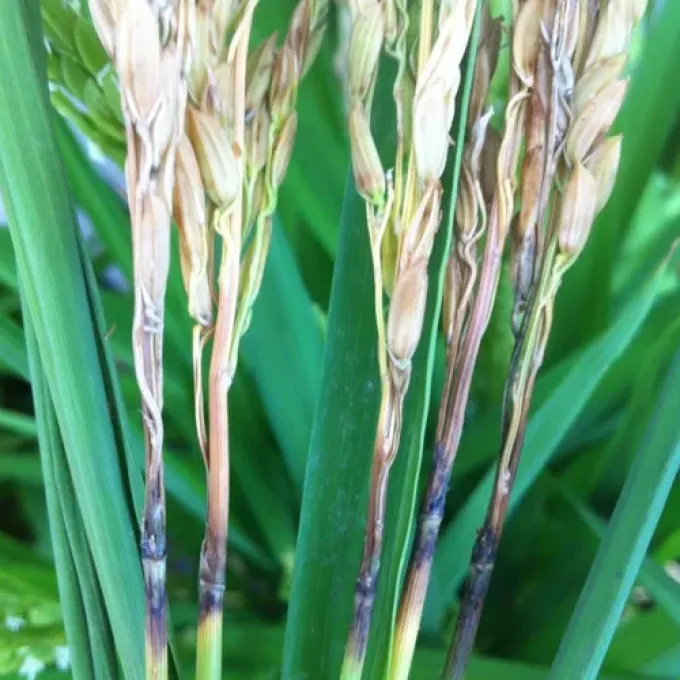
Reproductive development is severely affected. Panicles often fail to emerge properly from the leaf sheath, and if they do emerge, they are usually underdeveloped, deformed, and completely sterile.
- Characteristic raised black galls on leaf veins.
- Severe growth stunting and reduced plant height.
- Bushy, excessive tillering of the stems.
- Deformed, dark green, and twisted leaves.
- Partial or total sterility of the panicle.
Pathogen
The disease is caused by the Rice black-streaked dwarf virus (RBSDV), a member of the Fijivirus genus within the Reoviridae family. The virus contains a segmented, double-stranded RNA genome.
The virus is transmitted by planthoppers, specifically the small brown planthopper Laodelphax striatellus. Transmission is persistent and circulative, meaning the virus replicates within the insect vector.
Winter cereals, such as winter wheat and winter barley, act as critical reservoirs for the virus during the winter months. They provide a continuous source of inoculum for spring-sown crops.
The virus has a wide host range, including various wild grasses. Its distribution is heavily dependent on the migration patterns and population dynamics of its vector species.
RBSDV biology is uniquely tied to the metabolic processes of both plants and insects. Once inside the host plant, the virus disrupts hormonal balance, leading to the characteristic morphological abnormalities observed in infected crops.
Conditions for development
The prevalence of RBSDV is directly correlated with the population density of planthopper vectors during the early stages of crop growth. Favorable weather conditions, such as warm spring temperatures, enhance insect activity.
Proximity to winter wheat or winter barley fields increases the infection risk for rice, as these crops harbor both the virus and the overwintering vector population.
Delayed planting dates can expose young, susceptible seedlings to peak migration periods of the planthoppers, leading to higher rates of disease incidence in the field.
Weed infestation serves as a habitat for vectors. Many grassy weeds act as alternative hosts that maintain the viral reservoir throughout the agricultural season.
Optimal conditions for virus replication in the plant and vector activity generally occur between 20°C and 28°C. High moisture levels often correlate with increased vector survival and movement.
Why it matters
Rice black-streaked dwarf is a major limiting factor for cereal production in infested regions. Severe outbreaks can result in total crop failure if infection occurs at the seedling stage.
Yield losses are primarily caused by plant stunting and the failure to produce grain. Even mild infections significantly reduce the quality and weight of the harvested crop.
Beyond rice, the virus poses a significant threat to winter wheat and winter barley, causing similar growth distortions and reductions in total grain yield.
The physiological stress caused by the virus makes the crops more susceptible to secondary fungal or bacterial pathogens, further exacerbating the damage to plant health.
Financial losses for farmers are substantial due to the need for replanting, additional insecticide applications, and the overall reduction in marketability of the stunted, diseased crop.
Protection
Effective management focuses on controlling the vector population. Proactive use of systemic insecticides during the early growth stages is essential to prevent primary infection.
Adjusting planting times to avoid the peak migration period of the Laodelphax striatellus planthopper is a key cultural practice to reduce disease prevalence.
Utilizing resistant or tolerant crop varieties is the most sustainable approach to long-term control. Breeding programs continuously work to integrate resistance genes into commercial cultivars.
Rigorous weed control in and around fields reduces the survival of vectors and potential viral reservoirs. Clearing crop residues post-harvest is also a necessary hygiene measure.
Regular monitoring of planthopper populations using light traps allows for precise timing of chemical interventions. Spatial isolation of susceptible crops from winter cereal fields helps disrupt the virus transmission cycle.
Pathogens and affected parts
Affects crops · 2
Discussion
No discussions yet — be the first.