
Himalayan tar spot
Rhytisma himalense
Description
Symptoms
The primary symptom is the appearance of small, yellowish-green spots on the leaves in early summer, which gradually enlarge over the season.
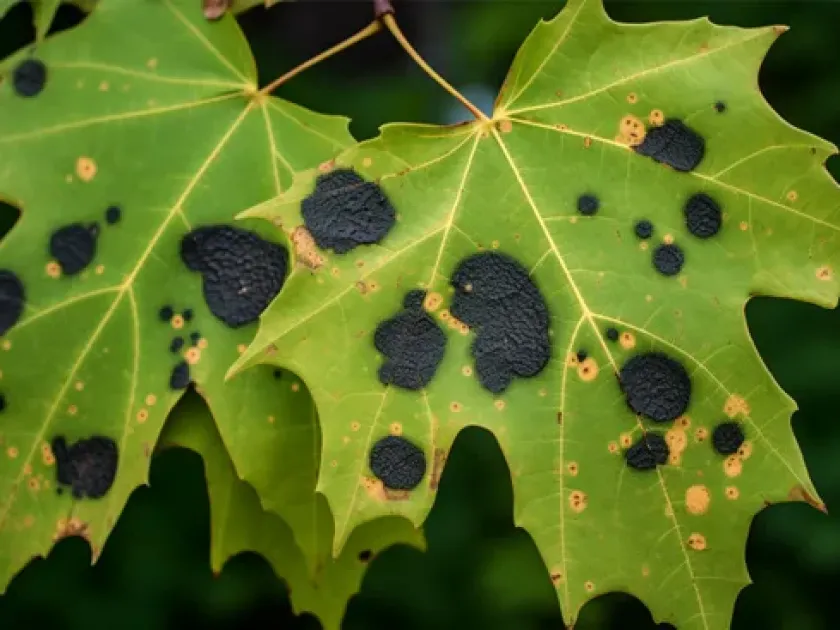
As the infection progresses, the centers of these spots become thickened, raised, and jet-black, resembling spots of tar deposited on the leaf surface.
A distinct pale or yellow halo usually surrounds each black spot, representing the tissue where the fungus is actively interacting with the plant cells.
In cases of severe infection, leaves may turn prematurely yellow and drop from the tree long before the autumn season naturally begins.
Microscopic examination of the black stromata reveals the presence of fungal fruiting bodies that are essential for the survival and spread of the disease.
Pathogen
The pathogen responsible for this condition is the ascomycete fungus Rhytisma himalense, which is a specialized parasite of certain maple species. It belongs to the Rhytismatales order.
The fungus survives the winter on fallen leaves, where it develops its reproductive structures known as apothecia, which appear as hard black crusts.
During the following spring and early summer, these structures release ascospores that are dispersed by wind and rain to infect new, developing leaves.
Biological specialization allows the pathogen to thrive in the specific microclimates of high-altitude or cool, humid forest regions where its host trees grow.
The fungus colonizes the leaf tissue, disrupting its metabolism and eventually causing the characteristic appearance of tar-like spots on the foliage.
Conditions for development
Himalayan tar spot thrives in environments characterized by high humidity, frequent rain, and moderate temperatures that prevent leaves from drying out quickly.
Dense forest stands that lack proper air circulation provide a stable, damp microenvironment that is highly conducive to fungal spore germination.
The presence of uncollected leaf litter from the previous season is the most critical factor for the disease cycle to persist and spread in a specific area.
Years with particularly wet spring weather significantly increase the incidence of the disease, as these conditions match the spore release and infection window.
Shaded locations within landscapes where sunlight penetration is limited often exhibit higher levels of infection compared to trees growing in open, well-ventilated areas.
Why it matters
The main impact of the disease is the reduction of the leaf surface area capable of photosynthesis, which weakens the overall vigor of the tree.
Repeated annual infections can lead to a decrease in annual growth increments, making the trees less resilient to other environmental stressors.
While the disease rarely kills mature trees, it can significantly retard the development of young seedlings and saplings in nurseries or young plantations.
Premature leaf drop reduces the tree's ability to store necessary carbohydrates for winter survival and early spring growth in the following year.
The aesthetic damage caused by the unsightly spots often leads to reduced property value and poor appearance in ornamental and park settings.
Protection
The most effective management strategy is the thorough removal and destruction of fallen leaves during the autumn to eliminate the overwintering source of the fungus.
Pruning of affected branches and thinning the crown of the tree can help improve air circulation, making the leaf surface less hospitable for fungal infection.
Ensuring that trees are healthy through proper watering and balanced nutrition can improve their natural defenses against fungal colonization.
- Raking and burning of infected leaf litter as the primary control measure.
- Monitoring trees closely during the bud-break and leaf-expansion phase.
- Selecting and planting maple species or cultivars that show natural resistance to tar spot fungi.
In nursery settings, protective fungicide applications timed with the initial spore release can be used to prevent widespread infection of young crops.
Discussion
No discussions yet — be the first.