
Description
Symptoms
The primary symptom of infection is the sudden yellowing and browning of the needles, followed by widespread crown dieback. This deterioration often progresses rapidly within a single growing season.
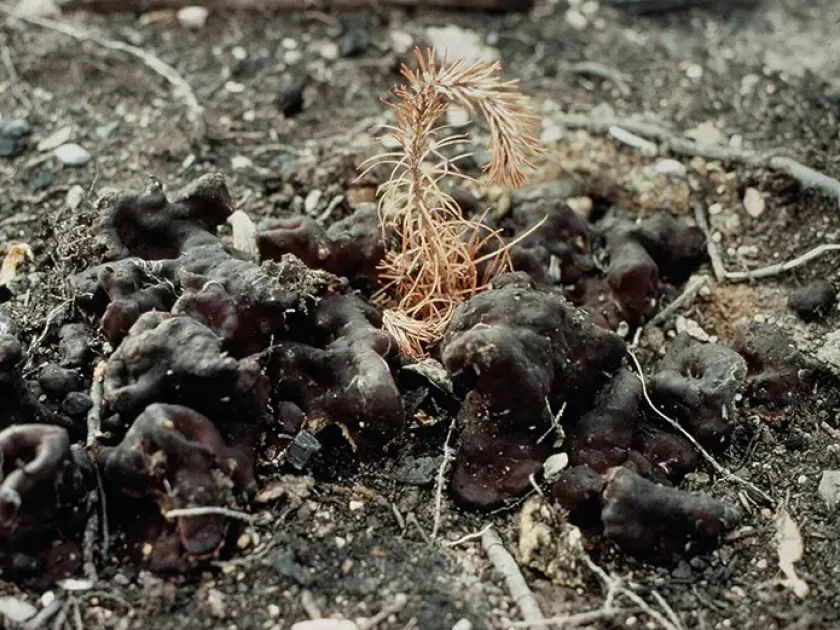
Small, wavy, chestnut-brown to reddish-brown fruiting bodies are frequently observed on the soil around the base of the infected trees. These serve as a diagnostic indicator of the presence of the pathogen.
Excavation of the root collar reveals dead, blackened bark. Beneath this layer, a thick, white fungal mycelium is often visible, permeating the wood and indicating advanced stages of decay.
In Douglas fir plantations, affected trees typically occur in localized patches where the fungus has spread from tree to tree through underground contact. The entire group may die simultaneously.
Trees show reduced growth rates and loss of vigor long before the complete collapse of the canopy. The root systems of affected individuals become brittle and fail to provide stability.
Pathogen
The causal agent of this disease is the ascomycete fungus Rhizina undulata. It is a soil-borne pathogen known for its ability to persist in the forest floor and duff layer for extended periods.
The fungus produces distinctive fruiting bodies, known as apothecia, which appear on the soil surface around infected trees. These structures release spores that propagate the disease throughout the area.
Rhizina undulata invades the root system of conifers, specifically targeting the cambium and xylem. It spreads through the soil via mycelial strands that bridge the gap between root systems of neighboring trees.
The pathogen is particularly notorious for its impact on various conifer species. Among these, the Douglas fir (Pseudotsuga menziesii) is highly susceptible, often experiencing rapid mortality when exposed to the fungus.
The biology of the fungus is unique due to its strong association with soil heating. It transitions from a saprophytic state to an aggressive parasite when environmental conditions reach specific thresholds following fire.
Conditions for development
Development of the disease is highly dependent on high soil temperatures. The fungus is dormant in many soils until heated by campfires or forest fires, which trigger the germination of its spores.
High soil moisture, combined with the presence of organic matter and forest residues, creates the perfect environment for the mycelium to proliferate and colonize new root systems.
The pathogen thrives in areas where there is an abundance of wood debris, which serves as a reservoir for the fungus before it moves on to infect living tree roots.
The spread of the fungus is most rapid in young plantations established in recently burnt areas. The lack of competitors and the abundance of host roots facilitate aggressive expansion.
Mycelial growth can persist in the soil for several years, making the site hazardous for replanting susceptible species like Douglas fir long after the initial fire event.
Why it matters
Rhizina root rot causes significant economic losses by killing young seedlings and saplings. This necessitates expensive replanting and site rehabilitation efforts.
The disease disrupts forest restoration efforts, particularly in regions where Douglas fir is a key economic species. It renders large areas of forest land unsuitable for cultivation for years.
Infection compromises the structural integrity of the root system, leading to windthrow and secondary damage within the forest stand.
The mortality rates in infected patches can be as high as 100%, leading to permanent gaps in the canopy that alter the local microclimate and forest composition.
Beyond timber losses, the disease complicates forest management, as control measures are difficult to implement once the fungus has become established in the soil.
Protection
Prevention is the most effective management strategy. Prohibiting campfires in reforestation areas and implementing fire safety protocols significantly reduces the risk of triggering an outbreak.
If an infection is detected, isolating the area with deep trenches can prevent the mycelium from reaching the root systems of healthy, adjacent trees.
It is advisable to avoid planting highly susceptible species like Douglas fir on sites with a recent history of fire or where the presence of the fungus is suspected.
Sanitation practices, such as the removal of infected trees and their roots, are essential to reduce the inoculum load in the soil and prevent the expansion of existing patches.
While no chemical treatment is completely effective for soil-borne Rhizina, mechanical isolation and planting non-host species can help mitigate the impact of the disease.
Pathogens and affected parts
Affects crops · 1
Discussion
No discussions yet — be the first.