
Poa leaf spot
Pyrenophora poae
Description
Symptoms
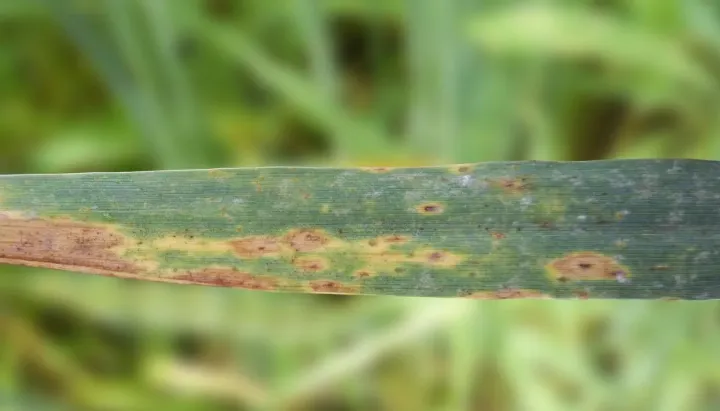
The initial signs of Poa leaf spot are small, water-soaked, yellowish dots on the leaf blades. As the infection progresses, these spots expand and turn into brown or dark brown lesions.
These lesions are frequently elongated or oval-shaped and may feature a light-colored halo around the central necrotic area. This appearance is diagnostic for many spot-related fungal infections.
Under persistent high-humidity conditions, a dark-colored fuzzy growth of conidiophores may become visible within the lesions. This signifies active spore production and the potential for widespread infestation.
Severely infected leaves show a yellowing effect (chlorosis) followed by tip dieback. Eventually, the entire leaf blade turns brown and shrivels, leading to a scorched look of the lawn.
- Dark brown leaf lesions
- Light yellow halos around spots
- Tip dieback and leaf necrosis
- Stunted growth in infected patches
Pathogen
The disease is caused by the fungus Pyrenophora poae, an ascomycete pathogen known for affecting various Poa species, particularly Kentucky bluegrass. It is a common cause of foliage degradation in both managed turf and natural meadows.
The fungus produces conidia which act as the primary inoculant during the growing season. Its life cycle allows for rapid asexual multiplication, enabling the disease to spread quickly across lawns during periods of high humidity.
Pyrenophora poae overwinters on plant debris and thatch as dormant mycelium or as pseudothecia. When spring temperatures rise, the fungus produces spores that are dispersed by wind and water splashing.
The mycelium colonizes the leaf tissue, secreting enzymes that break down the plant cells. This disruption of cellular integrity leads to the visible necrotic spots characteristic of the disease.
Laboratory confirmation of Pyrenophora poae is often necessary to distinguish it from other spot-causing fungi like Bipolaris or Drechslera, which share similar visual symptoms on grass blades.
Conditions for development
The development of Poa leaf spot is strongly correlated with cool, wet weather. Spring and autumn are the most critical times for disease outbreaks due to the prevalence of moisture.
Temperatures between 15°C and 25°C provide the ideal metabolic rate for the fungus to colonize host tissues rapidly. Extended periods of cloud cover and fog further exacerbate the problem.
Poor cultural practices such as high-frequency irrigation or watering in the late evening keep the leaf surfaces wet for too long, encouraging fungal spore germination.
Excessive nitrogen fertilization promotes succulent, fast growth that is highly susceptible to fungal invasion. Proper nutrient management is essential to keep the plant cell walls robust.
Lack of airflow due to improper mowing height or dense canopy architecture creates a microclimate within the turf that traps moisture and facilitates the survival of Pyrenophora poae.
Why it matters
The damage caused by Poa leaf spot is primarily aesthetic, but it can lead to severe thinning of the turf density. This affects the uniformity and professional appearance of golf courses and lawns.
Significant loss of leaf surface area reduces the plant's photosynthetic capacity, leading to weakened root systems. This makes the grass less able to survive summer heat or winter cold.
If left untreated, the thinning turf allows invasive weeds and opportunistic grasses to establish themselves, leading to the permanent loss of the original grass stand.
In seed production fields, the presence of the pathogen directly impacts the quality of the harvest, making the seed a vector for long-distance transport of the disease.
Economic impact includes costs for intensive fungicide applications, overseeding to repair damaged areas, and increased labor for specialized lawn maintenance.
Protection
Effective management begins with improving cultural practices. Increasing the mowing height and ensuring that irrigation occurs only in the early morning can help leaves dry quickly.
Aerating the soil and removing excess thatch through verticutting are crucial steps to improve drainage and air circulation in the root zone.
Applying balanced fertilizers, ensuring potassium levels are adequate, helps improve the plant's tolerance to various environmental stresses and pathogens.
Chemical control involving fungicides should be used as a last resort or as a preventive measure in highly susceptible environments. Rotating chemistries is mandatory to prevent resistance.
In autumn, cleaning up grass clippings and debris is vital to reduce the amount of inoculum that will be present to infect the turf in the following spring season.
Discussion
No discussions yet — be the first.