
Canada thistle rust
Puccinia punctiformis
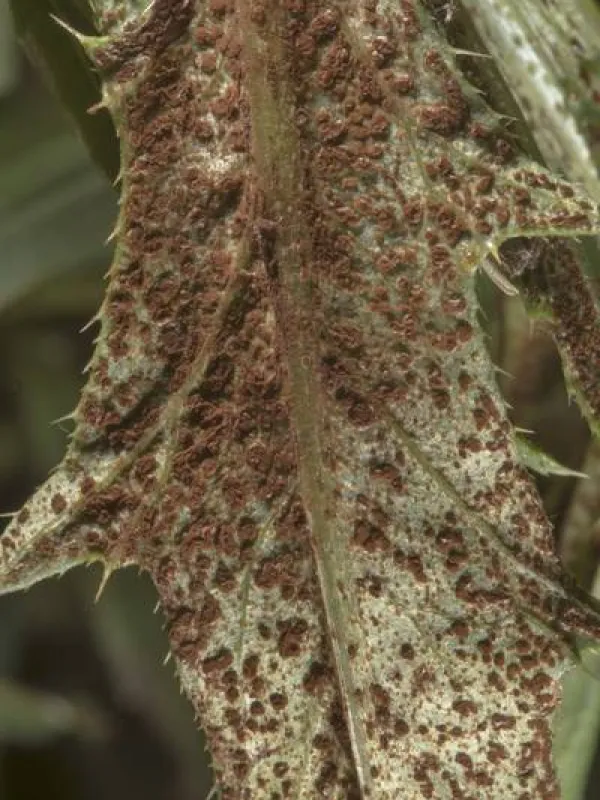
Description
Symptoms
The first sign of infection in spring is the appearance of chlorotic, stunted thistle shoots that look significantly weaker and more deformed compared to healthy plants.
On the undersides of the leaves of infected shoots, bright orange aecia (clusters of spores) develop. During this stage, the plant appears covered in a distinct dusty bloom.
Later in the summer, uredinia (brown-colored pustules) develop on the leaves, facilitating secondary infection cycles and the spread of the fungus to neighboring plants.
As the season nears its end, dark brown or nearly black telia form on the host tissues. This is the resting stage of the fungus, which allows it to survive throughout the winter.
Severe infection leads to premature drying and wilting of the leaves, resulting in patches of dead or dying thistle within the field.
Pathogen
The causative agent of this disease is the highly specialized rust fungus Puccinia punctiformis. It is an obligate parasite that specifically infects species of the Cirsium genus, most notably Canada thistle (Cirsium arvense).
The fungus has a complex lifecycle involving several spore stages, including aeciospores, urediniospores, and teliospores. It acts as a systemic pathogen within the host plant.
The mycelium of the fungus can overwinter inside the root system of the thistle. In the spring, the fungus grows systemically with the new shoots, infecting the weed from within before it fully matures.
The biology of the pathogen is intrinsically linked to the physiological processes of the weed. By colonizing the vascular system, the fungus depletes the plant's nutrient reserves.
Due to its high host specificity, Puccinia punctiformis is widely studied as a potential biological control agent to manage infestations of Canada thistle in agricultural landscapes.
Conditions for development
Disease development is most intense under conditions of moderate temperatures and high humidity. Optimal temperatures for spore germination range between 15 and 20 degrees Celsius.
The presence of free moisture, such as dew, fog, or rainfall, is a critical requirement for spores to germinate and successfully penetrate the epidermal tissue of the thistle.
Dense populations of Canada thistle facilitate rapid spread. In such clusters, the fungus moves easily from plant to plant, creating distinct, ever-expanding infection zones.
High humidity within the canopy of dense thistle patches creates a microclimate that strongly supports fungal activity throughout the growing season.
Spores are primarily disseminated by wind currents, allowing the pathogen to colonize new areas infested with the weed across significant distances.
Why it matters
The primary impact of Puccinia punctiformis is the systemic depletion of the thistle's root system. By draining the plant's energy, it reduces the weed's ability to reproduce vegetatively.
Infected plants show reduced competitive vigor and often fail to reach the flowering stage, preventing seed production and further colonization of the field.
Biological pressure from the fungus leads to the gradual degradation of thistle patches, effectively reducing weed density without the need for synthetic herbicides.
Under epidemic conditions, the pathogen can cause substantial dieback of the above-ground biomass, weakening the perennial root system over multiple seasons.
While the fungus is a powerful tool, it does not always completely eradicate the thistle population on its own, making it an essential component of integrated weed management programs.
Protection
The main strategy for utilizing this fungus is to promote the buildup and dispersal of inoculum within existing thistle infestations to maximize natural biological pressure.
Certain agronomic practices that maintain soil moisture or allow for undisturbed vegetation can help preserve the pathogen's viability in the field.
In organic farming systems, managing fields to favor the spread of the rust fungus is a sustainable way to suppress thistle growth without chemical intervention.
Regular field monitoring is necessary to assess the level of disease in thistle patches and determine whether additional management methods are required.
It is important to note that the application of broad-spectrum fungicides for crop protection can unintentionally suppress the rust fungus, so integrated strategies must be carefully balanced.
Discussion
No discussions yet — be the first.