
Sedge rust
Puccinia probabilis
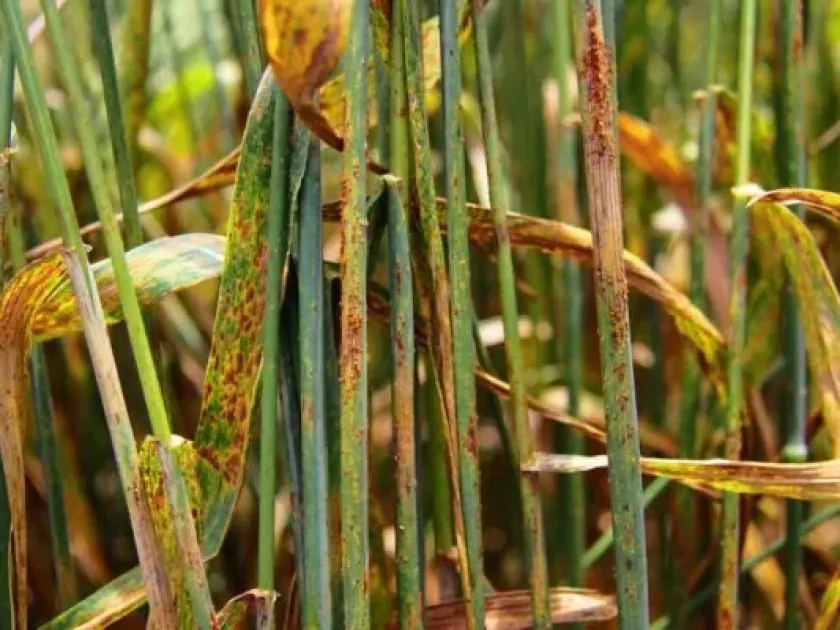
Description
Symptoms
The initial symptoms appear as small, yellowish or orange spots on the leaves. These spots soon develop into pustules that break through the epidermal layer of the leaf, releasing powdery spores.
As the disease progresses, the leaves exhibit significant yellowing and wilting. In advanced stages, the pustules turn dark brown or black, indicating the formation of teliospores for overwintering.
Visually, the disease is often identified by a rust-colored dust on the leaf surface. This powder can easily be wiped off, revealing the underlying damage to the plant's structural tissue.
Affected plants often show stunted growth and premature senescence of the foliage. The reduction in green leaf area is a clear indicator of the intensity of the infection throughout the field.
Careful scouting is necessary, as the disease often starts in moist, low-lying areas or within dense patches where airflow is restricted and micro-humidity is higher.
Pathogen
The causal agent of this disease is the fungus Puccinia probabilis, an obligate parasite belonging to the Basidiomycota division. This pathogen requires specific environmental conditions and alternate hosts to complete its complex lifecycle.
The disease is classified as a rust infection, characterized by the formation of pustules on the vegetative organs of the host plant. The fungus produces different types of spores, including urediniospores and teliospores, to propagate and survive.
Sedge species serve as the primary host and reservoir for the pathogen. In these plants, the fungus survives through the winter, serving as a source of primary inoculum in the subsequent growing season.
The fungal mycelium grows within the host tissue, utilizing haustoria to extract vital nutrients. This parasitic mechanism severely disrupts the metabolic balance and overall health of the affected plant.
As an obligate pathogen, the fungus is highly adapted to the host biology, making early detection and preventive management essential for limiting its impact on commercial crops.
Conditions for development
The development of Sedge rust is highly dependent on high atmospheric humidity and prolonged periods of leaf wetness, such as dew or heavy rain, which are required for spore germination.
The optimal temperature range for the pathogen's development is between +15°C and +22°C. These conditions significantly accelerate the infection rate and the cycle of secondary spread.
Dense plant populations and poor field ventilation create favorable micro-environments for the fungus. These conditions prevent the leaves from drying out, allowing spores to establish infections more effectively.
Wind is the primary vector for the dispersal of spores, which can be transported over long distances to infect healthy plants, leading to rapid disease development across large areas.
Failure to manage crop residues and surrounding vegetation provides a continuous source of inoculum, significantly increasing the risk of recurring outbreaks in subsequent years.
Why it matters
The damage caused by Sedge rust is primarily due to the reduction of photosynthetic capacity. By destroying leaf tissue, the fungus reduces the plant's ability to produce energy and synthesize nutrients.
Significant economic losses can occur due to reduced grain quality, such as shriveled kernels, and a decrease in total biomass production in forage or cereal crops.
The plant's energy resources are diverted to the pathogen rather than being used for growth and development. This exhaustion of resources weakens the entire plant and shortens its productive lifespan.
In severe cases, entire leaf blades may turn necrotic and die prematurely, drastically reducing crop yield and quality. This damage can be especially devastating during critical development stages.
Infected plants become more susceptible to secondary stressors, including other pathogens or extreme weather, as their natural immune system is heavily compromised by the parasitic invasion.
Protection
- Implementation of spatial isolation from known Sedge habitats to prevent initial infection.
- Application of systemic fungicides at the early onset of disease symptoms to protect crop yields.
- Adoption of crop rotation strategies and selection of disease-resistant varieties.
- Removal and destruction of Sedge and other weed hosts from field borders and drainage areas.
- Proper field sanitation, including deep plowing of crop residues to reduce the survival of fungal spores.
Discussion
No discussions yet — be the first.