
Daisy rust
Puccinia distincta
Description
Symptoms
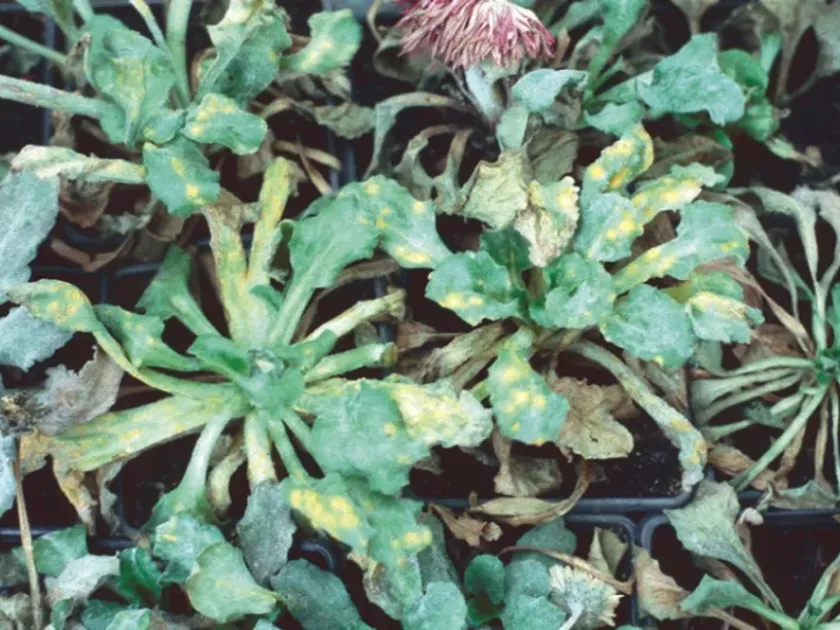
The disease is characterized by the development of small, raised, orange to reddish-brown pustules found primarily on the undersides of the leaves.
On the upper leaf surfaces, the corresponding areas show chlorotic or yellowish spots, which indicate the internal damage caused by the fungal mycelium.
In severe cases, the infection spreads to stems and petioles, causing distortion, stunted growth, and a significant loss of leaf turgor.
Plants affected by rust look sickly and lose their aesthetic appeal, as the leaves may wither, curl, and drop prematurely.
- Orange-brown pustules on leaf undersides
- Chlorotic yellow spots on top of leaves
- Stunted growth and distorted stems
- Premature leaf senescence and wilting
Pathogen
The causal agent of this disease is the fungus Puccinia distincta, which is an obligate parasite specialized in attacking plants of the Bellis genus.
This pathogen completes its life cycle by feeding on the nutrients of the host plant, forming localized colonies that eventually produce infectious spores.
The fungus is highly specialized and relies on the physiological integrity of the daisy plant to survive and propagate throughout the growing season.
Its biological cycle includes the formation of uredinia, which are structures that rupture the host epidermis to release masses of rusty-colored spores.
The pathogen is capable of overwintering in infected plant tissues or as dormant spores in the soil, ready to restart the infection cycle when weather conditions improve.
Conditions for development
Daisy rust thrives in cool, humid environments, which are characteristic of spring and early autumn, where the pathogen can spread rapidly.
Optimal conditions for spore germination occur when temperatures range between 15°C and 20°C combined with high relative humidity or dew.
Poor garden ventilation and dense plant spacing create a microclimate that traps moisture, making it much easier for spores to germinate on leaves.
Frequent overhead watering contributes to the spread of the fungus, as water droplets physically splash spores from infected leaves onto healthy ones.
Neglecting garden hygiene, such as leaving debris or infected plant material in the soil, provides the perfect habitat for the fungus to persist over winter.
Why it matters
The disease causes significant damage by depleting the plant's energy reserves, which inhibits proper flower development and weakens the overall vigor of the plant.
As the leaves are covered in pustules, the photosynthetic surface area is drastically reduced, leading to poor growth and a lack of bloom vitality.
Severely infected daisies exhibit poor winter hardiness, often failing to survive through colder months due to their compromised biological state.
If not managed, the disease spreads rapidly across the landscape, potentially ruining entire flower beds and requiring extensive cleanup and replanting.
The persistent nature of the pathogen makes it difficult to maintain the visual quality of the planting, as infected plants become unsightly and lose their ornamental value.
Protection
Effective management begins with strict sanitation, involving the removal and destruction of all symptomatic plant parts to reduce the spore load.
To improve airflow and minimize humidity around the foliage, gardeners should ensure adequate spacing between plants and maintain weed-free beds.
Application of fungicides, such as those containing sulfur or copper, or systemic agents, can be used to control outbreaks if caught early enough.
Watering practices should be adjusted to ground-level irrigation only, avoiding any wetting of the leaf canopy to limit the conditions favorable for the fungus.
Routine cleaning of garden beds after the growing season, including the removal of all organic matter, is crucial to prevent the pathogen from overwintering.
Discussion
No discussions yet — be the first.