
Musk thistle rust
Puccinia carduorum
Description
Symptoms
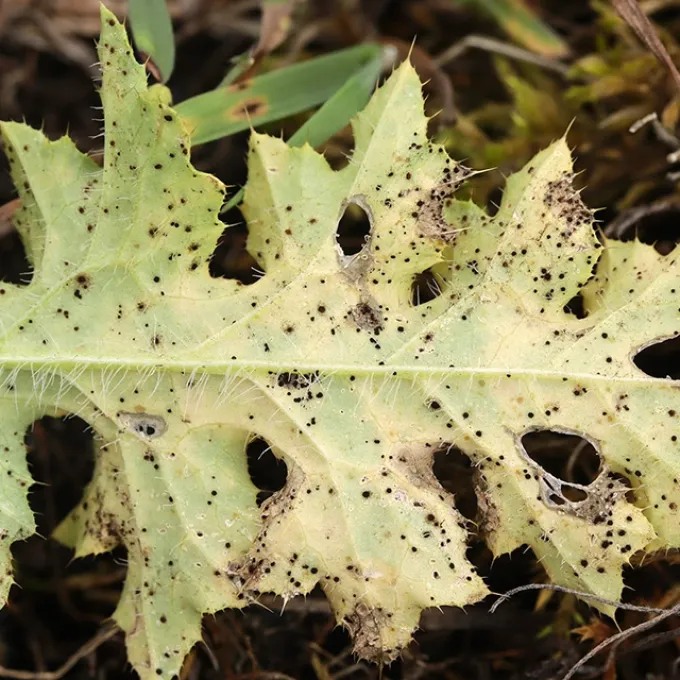
The primary symptom of the disease is the appearance of small, round to elongated pustules on the leaves, stems, and sometimes flower heads. These pustules are typically rust-colored or brown, reflecting the mass of fungal spores.
In the early stages, infection is visible as chlorotic spots, which eventually darken as the fungal growth progresses. If the infection is severe, these pustules merge, leading to widespread necrosis of the leaf tissue.
Infected plants exhibit stunted growth, leaf curling, and premature drying. The systemic nature of the infection in some cases can lead to the deformity of flower stalks, drastically reducing the plant's ability to produce viable seeds.
Touching the infected areas usually leaves a dusty residue on fingers, which is a key diagnostic feature of rust fungi. This indicates active sporulation and high potential for further spread.
As the disease progresses, the structural integrity of the thistle is compromised, making the plant brittle and significantly reducing its vigor compared to healthy specimens.
Pathogen
The causative agent of this disease is the fungus Puccinia carduorum, which belongs to the Basidiomycetes class. This is a highly specialized pathogen that primarily infects species within the Carduus genus.
The fungus has a complex life cycle, typically involving several spore stages, including urediniospores and teliospores. As an obligate parasite, it relies entirely on the nutrients derived from the living tissue of its host plant.
The pathogen spreads mainly through airborne urediniospores, which can travel significant distances under favorable wind conditions. It overwinters as teliospores on plant debris, ensuring survival through harsh weather.
During the infection process, the fungus produces pustules that rupture the plant epidermis to release spores. This mechanism allows the pathogen to rapidly increase its prevalence within a weed population during the growing season.
Scientific interest in Puccinia carduorum is largely driven by its potential as a biological control agent for managing invasive thistle populations in various ecosystems.
Conditions for development
The development of Puccinia carduorum is highly dependent on humidity levels. Free moisture on plant surfaces, such as dew or rain, is essential for spore germination and infection.
The fungus thrives in moderate temperatures, typically between 15°C and 22°C. Extreme heat or prolonged drought conditions will significantly inhibit fungal activity and the production of new spores.
Dense thistle stands create a humid microclimate that favors the rapid transmission of the fungus between individual plants. Lack of airflow within these stands acts as a catalyst for infection spread.
While the spores themselves are resilient to cold temperatures, their actual biological activation requires liquid water. Therefore, the disease is most prevalent during periods characterized by consistent moisture.
Infection primarily occurs via stomatal penetration, although the fungus can occasionally enter through the cuticle under high humidity conditions, facilitating rapid colonization of the host.
Why it matters
The disease causes significant physiological strain on the host plant, disrupting photosynthesis and nutrient transport. This leads to reduced biomass and lowers the weed's competitive advantage in its environment.
In severe cases, the cumulative stress from the rust infection results in the early death of the thistle plant. This prevents the weed from reaching reproductive maturity and shedding seeds.
From an ecological perspective, this fungus serves as a natural regulator of thistle populations, contributing to the limitation of invasive spread in rangelands and natural areas.
Puccinia carduorum is considered safe for agricultural crops due to its narrow host range, which is restricted to thistle species. It does not pose a threat to common crops like cereals or vegetables.
The economic impact of the disease is positive when viewed in the context of integrated weed management, as it reduces the density of invasive thistles without the need for chemical herbicides.
Protection
In biological control programs, management involves encouraging the spread of the fungus in areas where thistle is considered a troublesome weed. This is often achieved by redistributing infected plant material.
Conversely, if the disease needs to be managed in specific environments, sanitation practices such as the removal and destruction of crop residues are recommended to reduce the overwintering inoculum.
Tillage practices, specifically deep plowing, can bury infected plant debris, which accelerates the decay of the fungus and limits its ability to produce spores in the spring.
While fungicides can effectively kill the fungus, they are rarely used in this context as the goal is usually to promote the disease on weeds rather than suppress it.
Long-term monitoring of the pathogen population is essential for predicting the natural biocontrol efficacy of the rust fungus against musk thistle populations in a given region.
Discussion
No discussions yet — be the first.