
Sunflower rust
Puccinia abrupta
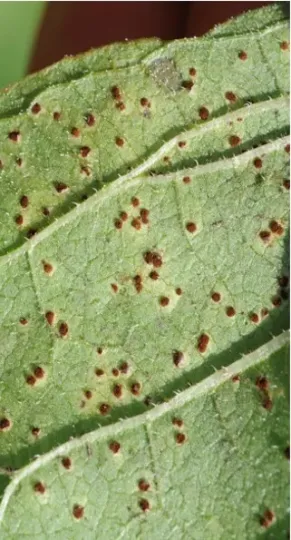
Description
Symptoms
Initial symptoms of sunflower rust usually appear on the leaves as small, yellow-green spots. These gradually develop into pustules, which are the visible signs of the fungus reproducing.
Pustules are typically round, raised, and exhibit a bright orange to rust-colored powdery appearance on the underside of the leaves. Each pustule contains millions of urediniospores.
In severe infections, these pustules can spread to stems and petioles, rupturing the epidermis and leading to significant loss of leaf integrity and premature senescence.
Toward the end of the growing season, the pustules turn dark brown or black. This color change indicates the production of teliospores, which are the resting stage of the fungus.
- Yellow spots on leaf surfaces
- Orange powdery pustules
- Early leaf drying and necrosis
- Blackening of pustules late in the season
Pathogen
The causal agent of sunflower rust is the fungus Puccinia helianthi. It is an obligate parasite that completes its life cycle strictly on sunflower plants during the growing season.
The fungus is characterized by a complex life cycle producing several types of spores. Urediniospores are the primary inoculum, causing multiple cycles of reinfection throughout the summer months.
The pathogen survives the winter in the form of teliospores, which remain on infected crop residues. These spores are highly resistant to cold, allowing the fungus to overwinter in varied climates.
High genetic diversity within the species enables the constant emergence of new physiological races of the fungus, posing challenges for breeding programs globally.
The rust is host-specific to plants of the Asteraceae family, particularly the genus Helianthus, which determines its restricted but intense impact on sunflower cultivation.
Conditions for development
The development of sunflower rust is heavily dependent on favorable environmental conditions, primarily high humidity and moderate temperatures.
Optimal temperatures for spore germination and colonization range between 18 and 22 degrees Celsius. Constant moisture on the leaf surface, such as dew or frequent rain, is essential for infection.
High planting densities create a microclimate with reduced air circulation, which helps maintain the leaf wetness required for the fungus to establish its infection cycles.
Excessive nitrogen fertilization can lead to vigorous but succulent plant tissue growth, which is often more susceptible to fungal penetration and rapid colonization.
Wind plays a critical role in the dissemination of urediniospores, allowing the disease to spread rapidly across fields and entire regions once the primary infection is established.
Why it matters
The rust significantly reduces the leaf area available for photosynthesis, leading to compromised nutrient production and severely affecting head development and seed filling.
Premature leaf loss causes the plant to enter senescence too early, resulting in significantly lower test weight and overall grain yield compared to healthy stands.
Oil content in sunflower seeds is negatively impacted by heavy rust infections, as the plant lacks the metabolic energy to properly fill the achenes with oil.
Plants weakened by rust are also more susceptible to opportunistic pathogens, such as stalk rots, which can further accelerate plant lodging and total crop loss.
In epidemic years, yield losses can range from 30% to 50%, especially in areas where environmental conditions favor the rapid proliferation of the fungal pathogen.
Protection
Crop rotation is the fundamental preventive strategy; avoiding sunflower cultivation on the same field for at least 4-6 years helps break the infection cycle of the fungus.
Deep plowing or burying infected crop residues immediately after harvest is essential to accelerate decomposition and destroy the primary source of overwintering teliospores.
The use of resistant hybrids is the most cost-effective and sustainable management tool, as genetic resistance provides built-in defense against local fungal races.
Application of systemic fungicides, particularly triazoles and strobilurins, during the vegetative stages can effectively suppress the spread of the disease when conditions are favorable for infection.
Strict control of volunteer sunflower plants in fields and fence lines eliminates the "green bridge" effect, preventing the pathogen from persisting from one season to the next.
Discussion
No discussions yet — be the first.