
Description
Symptoms
The first and most noticeable symptom of the disease is the yellowing or reddening of the terminal leaves on infected potato plants.
A characteristic sign is the upward curling of the leaf margins along the central vein, often accompanied by the development of an anthocyanin tint.
Affected plants show stunted growth and development; internodes become shortened, giving the plant a «bunchy» or «rosette» appearance.
In the underground part of the plant, severe infection leads to the development of numerous small, deformed tubers that often produce hair-like sprouts while still in the soil.
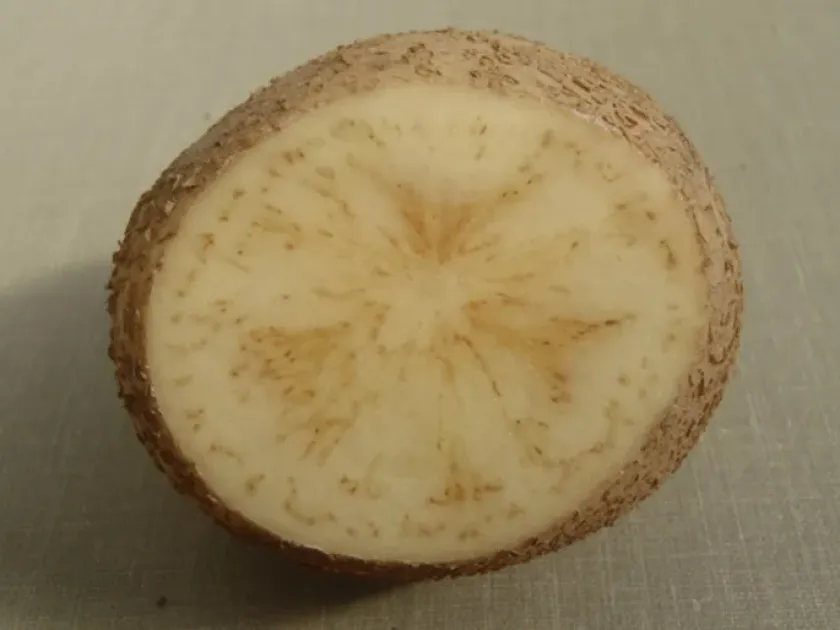
In the later stages of the disease, the tuber tissue may develop necrotic changes, rendering the crop unsuitable for storage and human consumption.
Pathogen
The causative agent of the disease is a specific phytoplasma-like bacterium (Candidatus Liberibacter solanacearum) that infects the plant's vascular system.
The primary vector for the infection is the potato psyllid (Bactericera cockerelli), a tiny insect from the psyllid family.
During the feeding process, the psyllid injects toxic saliva into the plant tissues, which contains bacterial pathogens that rapidly spread through the phloem.
Infection occurs the moment the insect probes the leaf, after which the pathogen begins to move systemically throughout the entire potato plant.
The disease disrupts photosynthesis and the normal transport of nutrients from the leaves to the tubers, triggering profound physiological changes.
Conditions for development
The progression of the disease is directly linked to the population density of the potato psyllid, which thrives in warm and dry weather conditions.
Optimal conditions for psyllid spread include prolonged periods of moderately hot temperatures, which facilitate rapid pest reproduction cycles.
The migration of insects from wild solanaceous weeds to commercial potato fields is a major factor in the seasonal spread of the infection.
The presence of poorly managed fields or zones with wild vegetation near potato plantings significantly increases the risk of rapid contamination.
Insufficient monitoring of field borders and the failure to remove primary infection hotspots trigger mass outbreaks of the disease.
Why it matters
The primary damage caused by the disease is a sharp decline in both the market quality and total yield, which can reach critical levels.
Infected plants produce small, unmarketable tubers that lack flavor and have very poor shelf life during warehouse storage.
The hair-like sprouts on tubers from infected plants make them entirely unsuitable for use as seed potatoes for the following season.
The loss of commercial value results in direct economic losses for farming operations specializing in industrial potato production.
Because early symptoms can be subtle, the disease often spreads undetected, eventually covering large areas of the field before intervention occurs.
Protection
The primary control strategy involves conducting regular insecticide applications aimed at suppressing the population of the potato psyllid.
It is essential to proactively remove solanaceous weeds, which serve as natural reservoirs for both the vector and the bacterial pathogen.
Utilizing monitoring tools such as yellow sticky traps helps identify the onset of psyllid migration, allowing for timely protective interventions.
The use of certified, disease-free seed potatoes prevents the introduction of the pathogen into clean fields through contaminated tubers.
- Maintaining proper crop rotation and spatial isolation from older potato fields.
- Preventive systemic insecticide treatments along field borders.
- Routine plant inspections to detect early signs of «rosetting» or leaf discoloration.
Pathogens and affected parts
Affects crops · 1
Discussion
No discussions yet — be the first.