
Citrus psorosis
Psoraceae
Description
Symptoms
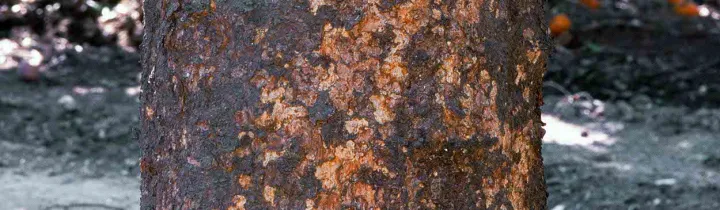
The most distinctive symptom of citrus psorosis is the scaling and peeling of the bark on the trunk and primary branches, resembling fish scales.
Early-stage infection often presents as a unique pattern on young leaves, characterized by clear spots, arcs, or rings appearing along the leaf veins.
As the disease progresses, gum deposits occur under the scaly bark, eventually leading to the death of the cambium and underlying tissues.
The tree canopy progressively declines, with symptoms including yellowing leaves, stunted growth, and the dieback of infected branches.
- Bark scaling on trunks
- Leaf chlorosis and spotting
- Gum exudation
- Gradual crown thinning
Pathogen
Citrus psorosis (Citrus psorosis virus, CPV) is a destructive viral disease that affects various citrus species worldwide, including oranges, mandarins, and grapefruit.
The virus is systemic, meaning it spreads through the entire vascular system of the host plant, causing long-term damage to the tree's health.
The primary method of virus transmission is through the grafting of infected scion wood into healthy rootstocks during propagation.
While the exact natural vectors are still under investigation, the virus is known to be spread mechanically through contaminated pruning equipment.
The disease remains latent for many years, making it difficult to detect before the onset of permanent structural damage to the tree.
Conditions for development
Symptoms typically do not manifest until the tree reaches maturity, often at 10 to 15 years of age or even later.
Environmental stress factors, such as drought, extreme heat, or cold, may trigger the rapid development of symptoms in latent carriers.
The misuse of propagation materials from infected mother trees remains the leading cause of wide-scale outbreaks in commercial orchards.
Lack of sanitation practices in orchards creates favorable conditions for the mechanical transmission of the virus from diseased trees to healthy ones.
Biological factors within the host plant, such as its age and overall vigor, influence how quickly the viral infection causes visible structural damage.
Why it matters
Citrus psorosis causes significant economic losses by reducing both the yield and the overall quality of the harvested citrus fruits.
The disease leads to the progressive decline and death of trees, shortening the commercial lifespan of the entire citrus orchard.
Infected trees become highly susceptible to secondary infections by wood-decay fungi, which further complicates management efforts.
There is currently no chemical treatment to eliminate the virus from infected trees, making the disease incurable once established.
The presence of psorosis in a grove necessitates the removal of infected trees to prevent further spread, resulting in significant capital loss.
Protection
The primary control strategy is to utilize certified virus-free budwood obtained from reliable, tested mother tree programs.
Strict orchard sanitation is essential, including the disinfection of all pruning tools with a suitable sanitizer between each tree.
Regular inspection and monitoring of the grove are necessary to identify and remove symptomatic trees before they become sources of infection.
Implementing a rigorous certification process for all nursery stock ensures that new plantings are free from systemic viral infections.
Good orchard management practices, such as proper irrigation and balanced fertilization, can help maintain tree health, though they do not prevent viral infection.
Discussion
No discussions yet — be the first.