
Psora decipiens
Psora decipiens
Description
Symptoms
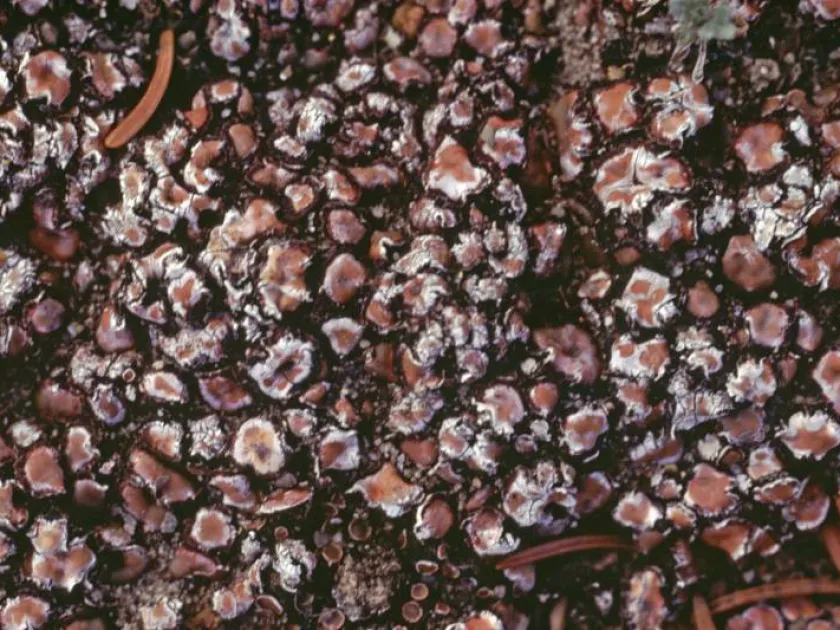
Psora decipiens is a soil-dwelling lichen that is frequently mistaken for a plant pathogen. Its appearance is characterized by small, scaly structures that are reddish-brown or rust-colored.
The thallus of this lichen consists of individual or clustered scales that adhere closely to the soil surface. The edges of these scales are often slightly elevated, giving the colonies a bumpy appearance.
These structures are most visible in open, well-lit areas where vegetation is sparse. In dry conditions, the scales become darker and harder, while they take on a vibrant red hue after rain.
The organism is not a parasite that affects crop tissues. Its presence on farmland is indicative of specific soil surface stability rather than the onset of a plant disease.
It colonizes bare ground effectively, forming thin biogenic crusts. Unlike fungal pathogens, it does not penetrate plant vascular systems or cause wilting and necrosis in crops.
Pathogen
Psora decipiens is not a plant disease pathogen. It is a biological organism belonging to the Psoraceae family and is recognized as a lichen.
Biologically, it is a symbiotic entity composed of a fungal component (mycobiont) and a photosynthetic algal component (phycobiont).
It lacks any pathogenic mechanism to infect higher plants. It derives energy through photosynthesis and absorbs nutrients from atmospheric sources and soil dust.
Classifying this species as a disease is an identification error often caused by the visual resemblance of its colonies to crusts or spots that might be wrongly attributed to infection.
In agronomy, it serves as an indicator species, showing that the soil surface has been stable and free from mechanical disturbance for a significant period.
Conditions for development
Psora decipiens prefers open, well-drained areas with a high concentration of carbonates. It is commonly found in semi-arid regions or salt-affected soils.
The primary factor for its growth is the lack of intensive tillage. It successfully colonizes abandoned fields, pastures, or areas with low plant density.
The species thrives under moderate moisture and ample sunlight. In areas with dense crop cover, it is typically outcompeted by higher plants.
Dispersal occurs via wind-borne spores. Under favorable microclimatic conditions, these spores germinate and develop into new scaly colonies.
The species is highly resilient to extreme temperature variations, allowing it to survive in arid environments where other vegetation might struggle.
Why it matters
Psora decipiens causes no direct harm to crops. It does not feed on plant fluids nor does it damage the cellular integrity of crop tissues.
In some cases, the lichen crust might slightly impede the germination of very small seeds in pastures or rangelands, but this is rarely a significant agricultural issue.
Conversely, in natural ecosystems, lichen crusts are beneficial as they prevent soil erosion and help sequester organic matter in the topsoil layer.
A large population of lichens on pasture land may indicate soil degradation due to overgrazing, serving as a warning sign for farmers to improve land management.
Thus, it is not considered an agricultural pest, and there is no need for chemical or biological control measures to manage its presence.
Protection
No specific protection measures are required against Psora decipiens. As it is not a pathogen, fungicides or pesticides are completely ineffective and unnecessary.
If the presence of the lichen is undesirable, the most effective management practice is regular soil tillage, such as deep plowing or harrowing, which destroys the colonies.
Enhancing soil fertility and promoting vigorous crop growth will naturally outcompete the lichen for space and sunlight, leading to its disappearance.
For pastures, implementing rotational grazing and overseeding with forage grasses will restore ground cover density, naturally suppressing lichen development.
The management of Psora decipiens is entirely dependent on sound agricultural practices and the maintenance of high land productivity.
Discussion
No discussions yet — be the first.