
Psilolechia lucida
Psilolechia lucida
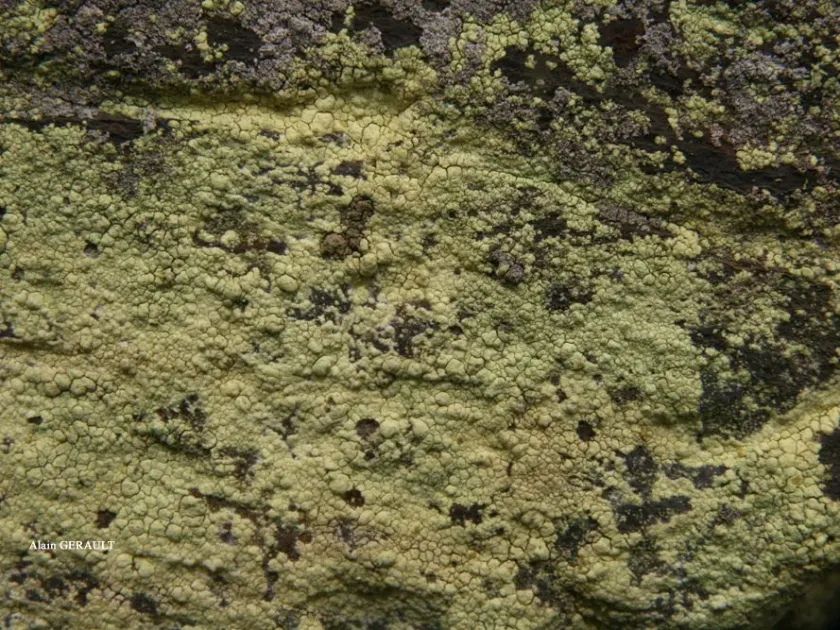
Description
Symptoms
Psilolechia lucida is a crustose lichen that forms a thin, often barely noticeable crust on various substrates. The most striking visual characteristic is its intense yellow-green or bright lime-yellow color, which can appear fluorescent under certain light conditions.
This organism is commonly found on the shaded or damp sides of tree bark, as well as on sandstone surfaces. In orchards, it is frequently mistaken for fungal pathogens because of its distinctive appearance, although it does not act as a true parasite.
Early signs of colonization look like small, dusty patches that gradually expand. The lichen grows tightly against the bark, making it difficult to detect the tiny, almost microscopic apothecia that characterize this species.
The thallus is firmly attached to the surface, which makes it challenging to remove without potentially damaging the protective outer layers of the tree bark. Its color intensity often shifts based on the moisture levels in the environment.
The presence of this lichen often conceals other underlying bark issues, effectively masking infections that may be occurring beneath the crust in the damp environment it creates.
Pathogen
The causative agent is the lichen Psilolechia lucida, a symbiotic organism composed of a fungal mycobiont and an algal photobiont. It is not a disease in the phytopathological sense as it does not feed on the host's plant tissues.
Biologically, it is classified as an epiphyte. The fungus provides structural attachment and protects the alga, while the alga performs photosynthesis, allowing the lichen to survive in nutrient-poor environments.
Unlike parasitic fungi, it does not penetrate into the vascular system of the tree. However, its ability to hold moisture creates a micro-habitat suitable for secondary colonization by bacteria and fungal pathogens.
It spreads primarily through vegetative fragmentation of the thallus or via wind-borne spores. This dispersal mechanism ensures rapid colonization of aging or weakened trees that provide stable, long-term substrates.
The relationship between the tree and the lichen is one of commensalism, though massive overgrowth can lead to physiological stress by obstructing the natural gas exchange of the bark.
Conditions for development
The primary driver for the development of Psilolechia lucida is high relative humidity. It thrives in shaded areas where moisture persists for extended periods, preventing the surface from drying out.
Poor orchard ventilation due to dense planting is a key factor promoting its growth. Limited airflow keeps the tree bark continuously damp, which is the ideal state for the germination of lichen spores.
The acidity of the bark influences colonization success, as this species prefers the specific pH levels commonly found on mature trees with slower growth rates and thicker, more stable cork layers.
Cooler seasons with minimal evaporation are when this species is most active. In arid climates, its growth is significantly stunted due to the inability to maintain the hydration required for biological activity.
Neglecting maintenance, such as lack of sanitary pruning and poor general tree health, creates a susceptible environment that allows this lichen to establish itself across the branches and trunks.
Why it matters
The primary concern is the creation of a damp environment beneath the thallus, which can soften the bark and facilitate the entry of decay-causing bacteria and fungi into the trunk tissues.
The layer of lichen provides a protective shelter for harmful insects and mites, shielding them from environmental extremes and chemical control applications used by orchardists.
By coating the bark, the lichen may hinder the natural gas exchange of the tree, which can contribute to the premature decline of branches or local areas of the trunk over a long period.
In terms of aesthetics and market value, massive lichen presence ruins the appearance of ornamental trees and nursery stock, making them undesirable in commercial landscaping.
While not a direct parasite, the presence of Psilolechia lucida is an indicator of poor tree vigor, suggesting that the plant's natural defenses are low and it requires improved cultural practices.
Protection
Mechanical cleaning remains the most effective control method. Careful brushing with stiff brushes or scrapers helps remove the lichen, provided that the underlying live bark and cambium are not damaged.
After manual removal, it is recommended to apply a protective lime wash containing copper sulfate (a Bordeaux mixture-like treatment) to sanitize the surface and prevent the re-establishment of the lichen.
Preventive annual application of iron sulfate solution (3-5%) is highly effective in suppressing lichens and mosses on tree trunks while simultaneously providing a trace element boost to the tree.
Improving orchard ventilation through proper pruning and thinning of the canopy is essential. Increased sunlight and airflow directly reduce the humidity that this lichen needs to survive.
- Regular fertilization to maintain bark strength and tree immunity.
- Maintaining clean orchard floors to reduce localized humidity.
- Monitoring bark health during routine site visits.
- Using systemic fungicides if secondary infections are detected.
Discussion
No discussions yet — be the first.