
Pseudoplea
Pseudoplea
Description
Symptoms
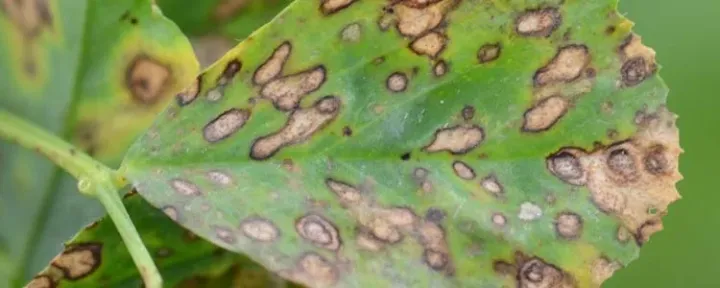
Initial symptoms of the disease appear as small, water-soaked, or light-colored spots on the leaves. As the infection progresses, these spots expand and become more distinct.
The characteristic necrotic spots typically have a gray or white center surrounded by a darker brown or black margin. This pattern is often referred to as a "target-like" lesion.
Under conditions of high moisture, small black pimple-like structures, which are the perithecia of the fungus, can be observed within the centers of the dead tissue.
Severe infestations lead to the chlorosis of leaves, followed by wilting, curling, and premature defoliation, which severely reduces the photosynthetic capacity of the plant.
- Small initial light spots on leaves.
- Dark margins surrounding necrotic areas.
- Gray/white centers of the lesions.
- Visible black perithecia on dead tissue.
- Leaf yellowing and premature drop.
Pathogen
The causal agent of the disease is the ascomycete fungus Pseudoplea trifolii (syn. Leptosphaerulina trifolii). It is a well-known pathogen that primarily affects various legume species, causing significant agricultural damage.
The fungus survives the off-season period in soil, plant debris, and seeds as mycelium or as fruiting bodies called perithecia. Under humid conditions, these release ascospores into the environment.
Infection occurs when ascospores land on leaf surfaces and germinate, penetrating the host tissue through stomata or directly through the epidermal layer. The fungus then colonizes the intercellular spaces.
The lifecycle of the pathogen can be completed in a short period, leading to secondary infection cycles during a single growing season. This makes it a persistent threat in favorable climates.
The pathogen's ability to remain dormant on crop residues makes field sanitation a critical component of any integrated pest management program.
Conditions for development
The development of Pseudoplea is heavily dependent on high relative humidity and prolonged leaf wetness. Rain splashes are the primary mechanism for dispersing spores within the field.
The optimal temperature for fungal development ranges from +18°C to +25°C. In regions with frequent rainfall and mild temperatures, the disease can reach epidemic levels quickly.
Fields with dense canopy growth are more susceptible because the reduced airflow keeps the plant surface moist for longer periods, providing a perfect environment for infection.
Inadequate mineral nutrition, particularly potassium deficiency, weakens the plants' structural defenses, making them easier targets for the fungal hyphae.
Lack of crop rotation contributes to the annual buildup of inoculum in the soil, ensuring that the disease returns with higher severity each season.
Why it matters
Pseudoplea is highly damaging to forage legumes like alfalfa and clover. The reduction in leaf area directly translates to a decrease in biomass production and feed quality.
Infected crops show significant declines in protein content and energy value, which impacts the productivity of livestock fed with such forage.
When the disease hits seed production fields, it affects flowers and pods, resulting in stunted, low-germination seeds, which reduces the potential of the next season's crop.
General vigor and winter hardiness of perennial crops can be significantly reduced, leading to thinning of the stand and early exhaustion of the fields.
Economic impact includes both direct yield loss and the financial burden of applying chemical fungicides to manage the infection in highly productive areas.
Protection
The most effective strategy is the use of proper crop rotation, which breaks the pathogen's lifecycle and prevents it from finding a suitable host for several years.
Deep plowing of crop residues is an essential practice to bury infected material, accelerating its decomposition and reducing the survival of fungal perithecia.
Breeding and planting disease-resistant cultivars is the preferred long-term solution, as it significantly minimizes reliance on chemical intervention.
Adjusting seeding rates to maintain optimal plant density improves canopy ventilation, which helps leaves dry faster after rain and prevents conditions favorable for the fungus.
In cases of high disease pressure, the targeted application of systemic fungicides may be necessary to preserve yield, always adhering to strictly defined safety intervals.
Discussion
No discussions yet — be the first.