
Dryad's saddle
Polyporus squamosus
Description
Symptoms
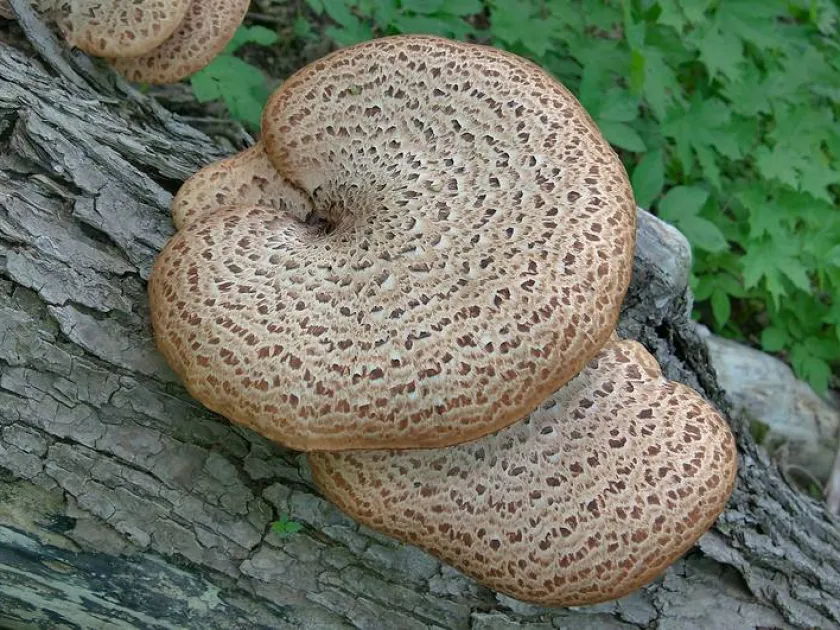
The first visual sign is the emergence of fungal fruiting bodies on the trunk, often arranged in overlapping clusters or individually. These can reach impressive sizes of up to 50 centimeters in diameter.
Leaves on infected branches begin to yellow and drop prematurely. Areas of dieback appear in the crown, indicating an interruption in the tree's nutrition due to damage to its vascular tissues.
Early-stage wood inside the trunk acquires a brownish tint. As the decay progresses, the wood becomes brittle and friable, easily crumbling into cubes under mechanical pressure.
At later stages of infection, bark cracking is observed where the mycelium is most active. The tree loses its structural integrity, making it dangerous during high winds.
Cavities may form at the base of the tree or on major branches. Exudate is often found at the exit points of the fungal mats, and the infected area typically emits a characteristic smell of fresh flour.
Pathogen
The causative agent of the disease is the wood-destroying fungus Polyporus squamosus, belonging to the Basidiomycetes division. It is a facultative parasite that primarily affects weakened broadleaf trees.
The fungus's mycelium penetrates deep into the wood of the trunk or branches through mechanical bark damage, pruning cuts, or frost cracks. In the process, it actively decomposes cellulose and lignin, gradually destroying the tree's internal structure.
Fruiting bodies appear on the bark surface in late spring or early summer. They possess a characteristic fan-like shape with a scaly surface ranging from cream to brownish in color.
The infection spreads via spores, which are dispersed by wind or insect vectors. Upon landing in a fresh wound on a tree, the spore germinates, initiating a new infection cycle.
The fungus acts as a typical necrotroph, killing the host's living tissues to extract nutrients, which inevitably leads to the gradual degradation of the entire woody structure.
Conditions for development
High air humidity and moderate temperatures are essential for the active development of Polyporus squamosus mycelium. May and June are the ideal periods for the formation of fruiting bodies.
Trees with weakened immune systems due to drought, soil salinization, or secondary pest infestations are most vulnerable to colonization by the fungus.
Open bark wounds are a prerequisite for primary infection. Any damage caused by tools, machinery, or sunburn serves as a gateway for spores.
Dense plantings and a lack of sanitary pruning promote moisture retention, which significantly increases the risk of the infection spreading throughout the orchard or forest area.
The fungus is capable of surviving in woody debris for many years. Even after a tree dies, it remains a source of infection for neighboring healthy trees.
Why it matters
The primary damage is the development of intensive white or brown heart rot. This results in the loss of the wood's mechanical strength and subsequent tree windthrow.
Infection with Dryad's saddle significantly reduces the productivity of fruit-bearing trees. The tree eventually stops producing fruit and dies from nutrient exhaustion.
The disease poses a serious threat to park areas and roadside trees. Due to the hidden nature of internal decay, a tree may collapse unexpectedly, creating hazardous situations.
Economic damage stems from the need to remove and dispose of infected trees, as well as the loss of valuable tree species in ornamental landscaping.
The rapid spread of spores under favorable conditions can cover a significant area in a short time, turning a local infestation into a large-scale epidemic.
Protection
Prevention begins with proper care: timely pruning, protection of the bark from sunburn, and immediate disinfection of any mechanical injuries using wound sealant.
Upon detection of fruiting bodies, they must be immediately removed and burned. It is crucial not to leave logs or stumps, which serve as long-term reservoirs for the fungal infection.
Sanitary felling and the complete removal of severely infected trees, including roots, are the only effective methods to stop the disease in an already infected grove.
It is recommended to apply fungicides to the root zones during high-risk periods to suppress spore activity in the soil and on the bark surface.
- Regular inspection of plantings in the spring.
- Strict hygiene protocols for all pruning tools.
- Maintaining optimal mineral nutrition to boost tree resistance.
Discussion
No discussions yet — be the first.