
Placynthium nigrum
Placynthium nigrum
Description
Symptoms
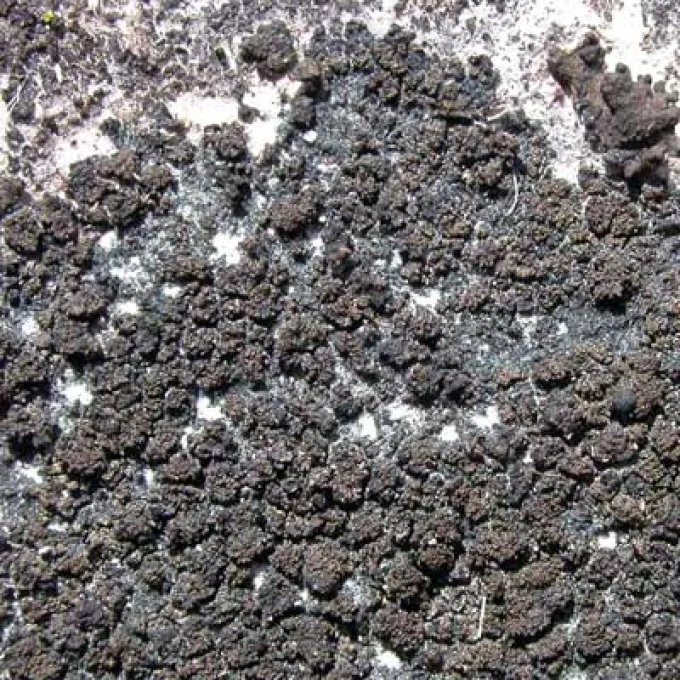
The primary sign of Placynthium nigrum is the presence of small, crust-like dark brown or black patches on bark or stone surfaces.
The thallus is densely attached to the substrate and has a granular or squamulose appearance. The color may intensify or shift slightly towards olive-green when hydrated.
Unlike common plant diseases such as canker or bark rot, the lichen does not create depressions, ulcers, or fissures in the bark. The plant tissue beneath the lichen remains healthy and intact.
During dry spells, the lichen appears brittle but retains its structure. It does not cause wilting, yellowing of leaves, or any growth abnormalities in the host plant.
- Dark, blackish crustose thalli.
- No visible necrosis or tissue damage under the lichen.
- Firm adherence to the bark.
- Preference for moist, shaded surfaces.
Pathogen
Placynthium nigrum is not a phytopathogen; it is a crustose lichen, a symbiotic organism composed of a fungus and a cyanobacterium. It does not infect or feed upon plant tissues.
Biologically, it is a cyano-lichen, typically associated with the cyanobacteria genus Dichothrix. It resides on surfaces like tree bark or stone strictly for physical anchorage.
The organism belongs to the family Placynthiaceae. It does not produce toxins, enzymes, or any secondary metabolites that would damage the host plant or interfere with its physiological development.
In an agricultural context, its presence is purely ecological. It is often observed on old orchard trees or hedgerows, acting as a passive indicator of environmental stability rather than a threat.
It lacks mycelial structures that penetrate plant cells, meaning it cannot induce necrotic, vascular, or fungal disease symptoms in crops.
Conditions for development
Placynthium nigrum thrives in environments with consistent moisture and moderate to high humidity. It is typically found in shaded, sheltered areas.
It has a high affinity for calcareous substrates, meaning it frequently colonizes bark in areas with lime-rich soils or where limestone is nearby.
The lichen is highly sensitive to air pollution, particularly sulfur dioxide. Its presence is generally considered a sign of good air quality in the local environment.
Colonization is a slow, gradual process, often occurring in older, established gardens or orchards where there is little to no mechanical disturbance to the bark.
Dense canopies that trap moisture and reduce sunlight facilitate the spread of this lichen by creating an ideal micro-environment for its survival.
Why it matters
The lichen does not cause any direct harm to the agricultural crop. It does not compete for minerals, water, or nutrients, as it derives its energy from photosynthesis and atmospheric moisture.
There is no impact on yield, fruit quality, or tree growth rates. Its presence is essentially neutral from a crop production standpoint.
In extreme cases, dense growth might slightly impede gas exchange in lenticels, but this is negligible and not associated with crop loss in managed systems.
The common misconception that this lichen is a disease often leads to unnecessary chemical applications, which are wasteful and potentially harmful to the orchard's ecosystem.
It should be regarded as a harmless component of the local biodiversity, posing no risk to the health of the host tree.
Protection
No control measures are necessary for Placynthium nigrum since it does not cause disease. It does not require eradication in healthy orchard systems.
Good agricultural practices, such as annual pruning to improve crown ventilation and sunlight penetration, naturally inhibit lichen growth by drying out the bark surface.
Standard orchard maintenance, including the use of copper-based fungicides for actual diseases, will incidentally limit the development of lichen colonies.
If removal is requested for aesthetic reasons, mechanical brushing is sufficient. There is no need for specialized herbicides or systemic plant treatments.
Focusing on overall tree health through proper fertilization and irrigation is more effective than attempting to eliminate environmental indicators like lichens.
Discussion
No discussions yet — be the first.