
Placynthium lichens
Placynthiaceae
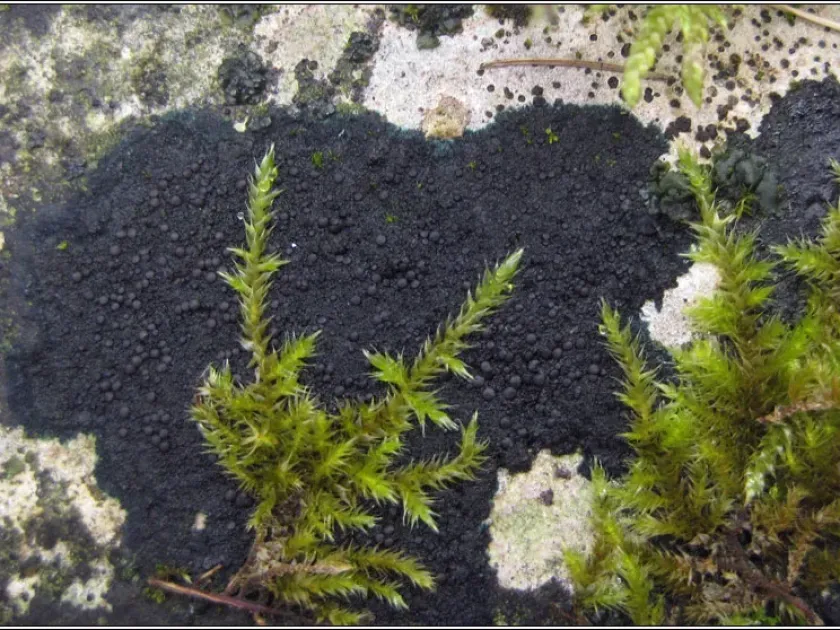
Description
Symptoms
The presence of these lichens is manifested by crustose or squamulose growths that can appear as olive-green, grey, or dark patches on tree bark.
These patches are often characterized by a granular or fine-textured surface that adheres firmly to the bark layers of the host tree.
Unlike necrotized tissue caused by bacterial or fungal infections, the bark underneath the lichen remains typically healthy and intact.
They are most commonly found on the shaded or wetter sides of trunks and major branches where moisture persists the longest.
- Granular or crust-like patches on the bark surface.
- Well-defined borders of the colony with no surrounding rot.
- Variation in color intensity according to local humidity levels.
Pathogen
The family Placynthiaceae consists of lichens, which are complex symbiotic organisms containing a fungal mycobiont and an algal photobiont.
From an agronomical standpoint, these lichens are not considered plant pathogens because they do not extract nutrients from the host plant.
They are classified as epiphytes, utilizing the tree bark strictly as a physical substrate for attachment rather than a food source.
Unlike true diseases that penetrate plant tissues, Placynthium lichens remain entirely superficial, posing no threat to the vascular system of the tree.
Their biological function is limited to photosynthesis and mineral absorption from atmospheric dust and moisture, independent of the tree's health.
Conditions for development
High humidity and poor air circulation within the tree canopy are the primary environmental drivers for the development of Placynthium lichens.
Trees that are neglected or have overly dense canopies provide a stable, moist microclimate that allows lichen spores to establish themselves.
These organisms thrive in areas where trees are slow-growing or the bark has not been shed or updated for several years, providing a stable base.
Regions with frequent rainfall or heavy fog often show higher concentrations of these epiphytes compared to drier, well-ventilated orchard environments.
Light levels also play a factor, as many species prefer the cooler, shaded areas of the tree trunk where evaporation rates are significantly lower.
Why it matters
Direct damage to agricultural crops caused by Placynthium lichens is non-existent, as they lack any parasitic interaction with the plant host.
Indirectly, the primary concern is that dense colonies can harbor overwintering pests such as mites, aphids, or scale insects.
Furthermore, an excessive accumulation of lichens can potentially restrict the bark's ability to breathe, though this is rare in healthy trees.
The main practical harm is visual or diagnostic, as the layer of lichen hides the initial symptoms of genuine bark diseases from the grower.
Their presence often serves as a bio-indicator of low tree vigor or an overall neglect in the maintenance of the orchard's physiological health.
Protection
Effective management focuses on overall orchard vitality, as vigorous trees are rarely inhibited by the presence of these harmless epiphytes.
Standard horticultural practices such as regular canopy pruning enhance sunlight exposure and ventilation, naturally discouraging lichen growth.
Mechanical removal of rough or loose bark using brushes or scrapers is a safe and effective way to clean the trunk without damaging the wood.
Applying lime wash to the trunks and base of major branches serves as a deterrent to lichen settlement while sanitizing the bark surface.
In cases where chemical intervention is desired for other pathogens, copper-based sprays used for general orchard hygiene will also inhibit lichens.
Discussion
No discussions yet — be the first.