
Phytophthora leaf blight of onion
Phytophthora porri
Description
Symptoms
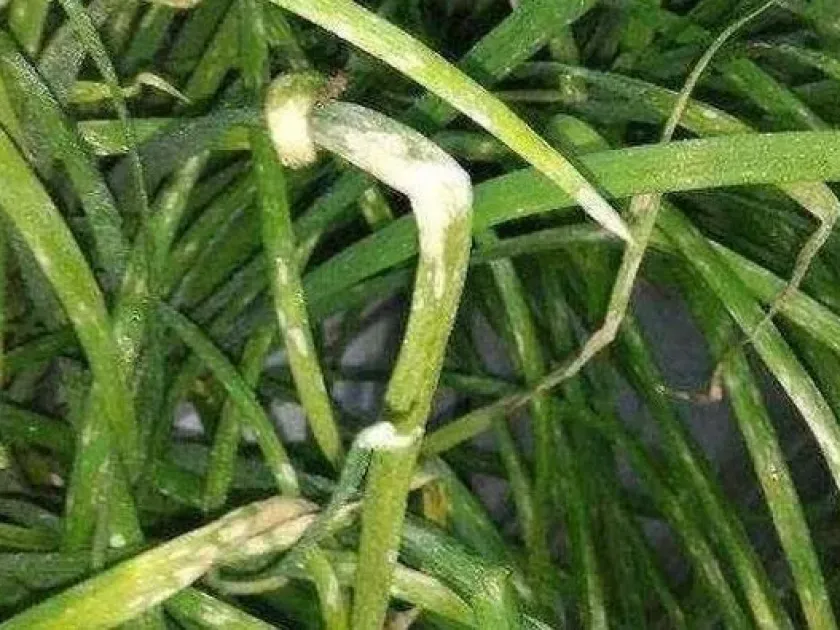
The initial symptoms are pale, water-soaked spots that eventually turn grayish or brownish. These lesions typically start on the leaf tips and gradually spread downwards towards the bulb.
Under high humidity, a white or grayish fungal growth appears on the surface of the lesions. This signifies active sporulation, allowing the pathogen to spread further to adjacent plants.
When the infection reaches the bulbs, the tissues become soft and watery. A longitudinal cut reveals darkened, decayed scales accompanied by a characteristic unpleasant odor, distinguishing it from other storage rots.
Plants affected by Phytophthora at early growth stages show significant stunting. Leaves turn yellow prematurely and collapse, while the root system may decay if the disease pressure remains high.
Visual diagnosis is often difficult due to the similarity of symptoms with downy mildew. However, Phytophthora leaf blight usually results in more severe bulb degradation and a complete loss of marketability.
Pathogen
The causal agent of this disease is the oomycete Phytophthora porri. This pathogen produces zoospores that facilitate rapid spread of the infection under conditions of high humidity and rainfall.
The microorganism can survive in the soil as oospores for several years, making it a persistent threat in agricultural fields. It is a highly specialized pathogen that requires targeted monitoring during the onion growing season.
The biology of the pathogen is closely linked to water availability. In the presence of free water, zoospores become mobile, swim across the plant surface, and penetrate the tissues through stomata or mechanical injuries.
The pathogen affects a wide range of Amaryllidaceae crops. Onion, leek, shallot, and garlic are particularly susceptible, posing a significant threat to specialized vegetable farming operations.
Development of the disease can remain subtle during early stages, but under favorable conditions, the fungal mycelium rapidly colonizes internal tissues, leading to cell degradation and plant collapse.
Conditions for development
The primary factor driving disease development is excessive moisture in both air and soil. Rainfall, heavy dew, and standing water in fields provide ideal conditions for zoospore germination and plant infection.
The optimal temperature for the pathogen's growth ranges between 15 and 22 degrees Celsius. During cool, wet seasons, outbreaks can spread rapidly across entire fields, leading to significant yield losses.
Poor soil drainage and high-density planting prevent the leaves from drying quickly after rain, creating an ideal microclimate for the pathogen to penetrate the leaf cuticle.
Failure to follow proper crop rotation, where onions are planted on the same plot more frequently than every four to five years, leads to an accumulation of oospores in the soil, creating a permanent infection source.
Using infected planting material serves as another major pathway for the disease, allowing the pathogen to establish itself in the field immediately after planting.
Why it matters
The main danger of Phytophthora leaf blight is the loss of yield, both in the field and during post-harvest storage. Infected bulbs decay rapidly in storage facilities, potentially infecting surrounding healthy produce.
Damage to the foliage reduces photosynthetic capacity, preventing bulbs from reaching their full size and quality. Yield losses can range from 30 to 50 percent under severe epidemic conditions.
The disease severely impacts storability. Even lightly affected bulbs act as infection foci in storage bins, which can destroy a significant portion of the stored harvest over time.
Economic impact includes not only yield losses but also the increased cost of fungicide applications, which often require multiple treatments throughout the growing season.
In cases of heavy infestation, the product loses its market value and taste, rendering it unsuitable for retail chains or processing industries.
Protection
Prevention begins with strict adherence to crop rotation. Onions should not be planted on the same field for at least four years to minimize exposure to the soil-borne pathogen.
Seed treatment and the use of healthy, disease-free sets are crucial. Fungicide dips or heat treatment of sets, where appropriate for the specific variety, can help reduce the initial inoculum load.
Agronomic practices include deep autumn plowing to bury and destroy plant debris, effectively breaking the disease cycle. It is also essential to remove and destroy symptomatic plants from the field immediately.
During the growing season, preventive fungicide applications targeting oomycetes should be employed. Early intervention is necessary to prevent the disease from reaching epidemic proportions.
- Selection of resistant onion varieties and hybrids.
- Ensuring optimal irrigation without overwatering the fields.
- Maintaining proper plant spacing to facilitate air circulation.
- Harvesting onions during dry weather conditions.
- Ensuring thorough curing and drying of bulbs before storage.
Discussion
No discussions yet — be the first.