
Phytophthora disease of alder
Phytophthora europaea
Description
Symptoms
The first visual sign of infection is premature yellowing and shedding of leaves. The crown of the tree becomes visibly sparse, starting from the upper branches, which indicates a failure in nutrient uptake.
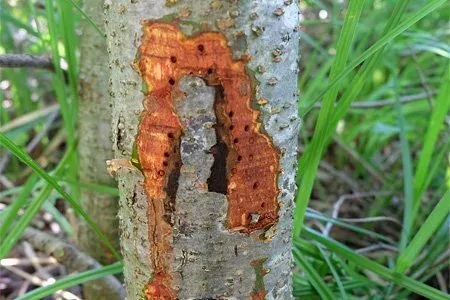
Dark, necrotic spots often appear on the lower trunk near the root collar. If the bark is removed from these areas, one can observe dying tissues that exhibit a characteristic reddish-brown discoloration.
As the disease progresses, fine lateral roots die, turning black and brittle. This damage leads to a general decline in tree vigor and its inability to acquire essential nutrients from the surrounding soil.
In severe cases, cracks may develop on the trunk, exuding a dark, thick liquid. Eventually, the tree loses turgor, dries out, and becomes prone to windthrow due to structural weakness of the roots.
- Sparse canopy and leaf chlorosis.
- Necrotic lesions on the bark at the root collar.
- Root rot and loss of lateral root fine structure.
- Reduced annual shoot growth.
- Exudation of dark liquid from trunk fissures.
Pathogen
The causative agent of this disease is the microscopic oomycete Phytophthora europaea. This pathogen belongs to a group of soil-borne, fungus-like organisms specialized in infecting the root systems of various tree species.
Unlike the more aggressive Phytophthora alni, Phytophthora europaea is often found in association with other Phytophthora species. It is capable of surviving for long periods in the soil as oospores, which are highly resilient to adverse environmental conditions.
The pathogen attacks cambium and phloem tissues, primarily entering the tree through the fine root hairs. During its life cycle, it releases toxins that disrupt the plant's vascular system and nutrient transport.
The biology of this pathogen is closely linked to water, as its zoospores are motile in moist soil. Consequently, infections are most prevalent in areas with high soil moisture or poor drainage.
The genetic plasticity of Phytophthora europaea allows it to adapt to different environmental niches, making it a challenging pathogen to manage in both forest and nursery settings.
Conditions for development
Excessive soil moisture is the primary driver for disease development. Phytophthora europaea thrives along riverbanks, in floodplains, and in areas where surface water tends to accumulate.
Temperature plays a critical role, as moderate warmth combined with high soil moisture provides ideal conditions for zoospore germination and colonization of host roots.
Human activities, such as moving contaminated soil via heavy machinery or equipment, are major factors in introducing the pathogen to previously healthy sites.
Trees under stress—due to drought, mechanical root damage, or pest infestations—are significantly more susceptible to infection. Compromised trees succumb much faster than healthy ones.
Seasonal floods contribute to the rapid dispersal of zoospores across large areas, which explains the patchy and cluster-like nature of the disease outbreaks in riparian forests.
Why it matters
Phytophthora disease of alder causes significant ecological damage by triggering mass mortality in riparian stands, which degrades ecosystem services and compromises bank stability.
Economic losses include reduced timber quality and the loss of productive forest stands. Affected trees become unsuitable for industrial use and timber processing.
The pathogen is highly persistent in the soil, making it impossible to replant alder in infected sites for many years, as the inoculum remains active for extended periods.
The decline of alder stands negatively impacts local biodiversity, as many specialized insect and bird species depend on these trees for their habitat and food sources.
Due to the pathogen's high impact, forestry agencies often implement strict quarantine measures to prevent the spread of contaminated soil or wood material between regions.
Protection
The primary control measure is strict phytosanitary inspection of planting stock. It is essential to use only disease-free seedlings sourced from certified, reputable nurseries.
Silvicultural efforts should focus on improving soil drainage. Effective removal of excess water from a site significantly reduces the activity of zoospores and prevents their spread.
It is vital to avoid mechanical damage to root systems during forest management practices. Any injury acts as an entry point for the pathogen, often leading to rapid infection.
If isolated outbreaks are detected, removing infected trees along with their root systems and incinerating the material is an effective measure to halt further dispersal.
Chemical fungicides are rarely used in natural forests; however, in nursery environments, phosphite-based products can be applied to suppress pathogen development within the plant tissues.
Discussion
No discussions yet — be the first.