
Kauri dieback
Phytophthora agathidicida
Description
Symptoms
The most visible symptom of kauri dieback is the premature yellowing of the foliage, which is frequently followed by significant leaf drop. This indicates that the tree is failing to maintain its hydration levels.
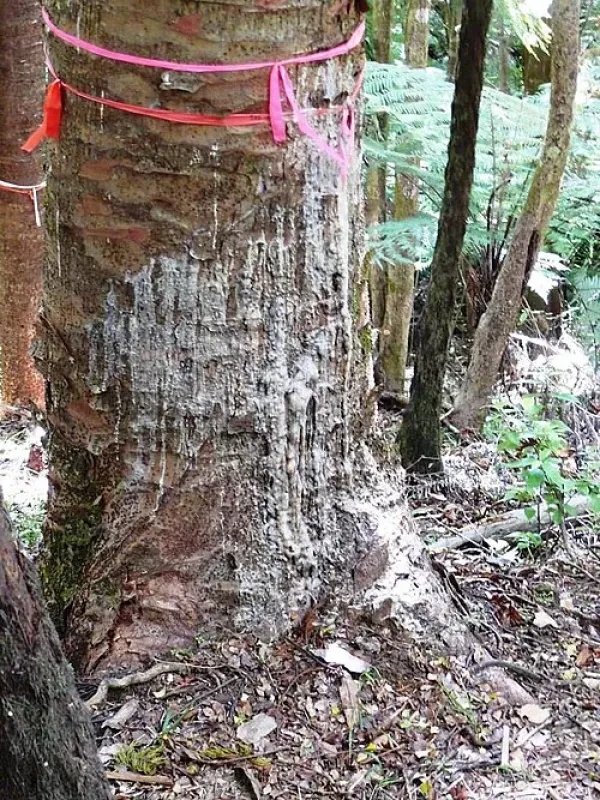
A classic diagnostic indicator is the presence of heavy gum (resin) bleeding on the lower trunk. This happens as the tree attempts to seal off areas where the pathogen has attacked the inner bark and cambium.
The root system becomes severely compromised, showing signs of decay and necrosis. As the primary roots die off, the tree loses its stability, leading to an increased risk of windthrow.
Canopy thinning is a progressive symptom, starting from the upper branches and moving downwards. The tree may take several years to show the full extent of the damage, making early detection difficult.
- Yellowing of leaves
- Resin bleeding on the trunk
- Root rot and necrosis
- Canopy thinning
- Progressive tree death
Pathogen
The causative agent of the disease is the oomycete Phytophthora agathidicida. This soil-borne pathogen is a specialized microorganism that poses a critical threat specifically to the kauri tree (Agathis australis).
Being an oomycete, it acts similarly to fungi but possesses a distinct biological cycle. It produces motile zoospores that utilize moisture in the soil to navigate and locate the root systems of healthy trees.
The pathogen creates highly resilient structures known as oospores. These resting spores can persist in the soil for several years, remaining viable even in the absence of a living host tree.
Upon reaching the roots, the pathogen colonizes the tissue, causing necrotic lesions. This disrupts the tree's ability to transport essential water and nutrients from the soil to the canopy, leading to a slow decline.
Research confirms that Phytophthora agathidicida is a relatively recent discovery, identified as a distinct species that has evolved specific mechanisms to bypass the tree's internal defenses.
Conditions for development
The proliferation of the pathogen is heavily dependent on environmental conditions, particularly soil moisture levels. High humidity and persistent rainfall facilitate the movement of zoospores through the soil matrix.
Temperature patterns in New Zealand's native forests are ideal for the pathogen's growth. Mild, damp environments allow the oomycete to thrive and expand its infection range effectively.
Human activity is the primary driver of disease spread. Soil contaminated with spores can be easily transported over long distances via footwear, hiking gear, or heavy machinery used in forestry or maintenance.
Damage to the forest floor or root systems during construction or hiking activities creates entry points. Even minor abrasions on the roots can allow the pathogen to gain access to the host's vascular system.
Poor drainage in forest areas contributes significantly to the survival of the pathogen. Sites that remain waterlogged for extended periods serve as permanent reservoirs for the disease.
Why it matters
Kauri dieback is an ecological catastrophe for the kauri forests of New Zealand. These trees are ancient, long-lived giants that serve as the foundation of unique ecosystems.
The lethality of the disease is nearly 100% for infected trees. There is currently no known cure that can completely eradicate the infection from a host once it has established itself.
The loss of kauri trees threatens the entire food chain, as many rare species of birds, insects, and epiphytic plants depend directly on these giants for their survival.
Economic and cultural costs are substantial. The disease has led to the closure of many public trails, impacting tourism, and requires enormous investment in scientific efforts to preserve the species' genetic material.
The loss of genetic diversity within the kauri population makes the species inherently more vulnerable to other climate-related stressors and potential future pathogen attacks.
Protection
Rigorous quarantine measures are currently the most effective defense strategy. Scrubbing and disinfecting footwear at designated cleaning stations is a mandatory practice for anyone entering kauri forest areas.
Phosphite injections, or the application of phosphite to the tree trunks, have shown promise in boosting the tree's natural resistance and slowing down the progression of the disease in infected individuals.
Managing public access to sensitive forest areas is vital to contain the spread. Restricting foot traffic near the root zones of healthy kauri trees prevents the further introduction of contaminated soil.
Advanced monitoring technologies, including aerial multispectral imaging and DNA analysis of soil samples, are used to detect early signs of infection and monitor the disease footprint.
Current conservation research is focused on identifying naturally resistant kauri genotypes, which may offer a long-term pathway for forest restoration and recovery efforts in the future.
Discussion
No discussions yet — be the first.