
Physoderma brown spot
Physodermataceae
Description
Symptoms
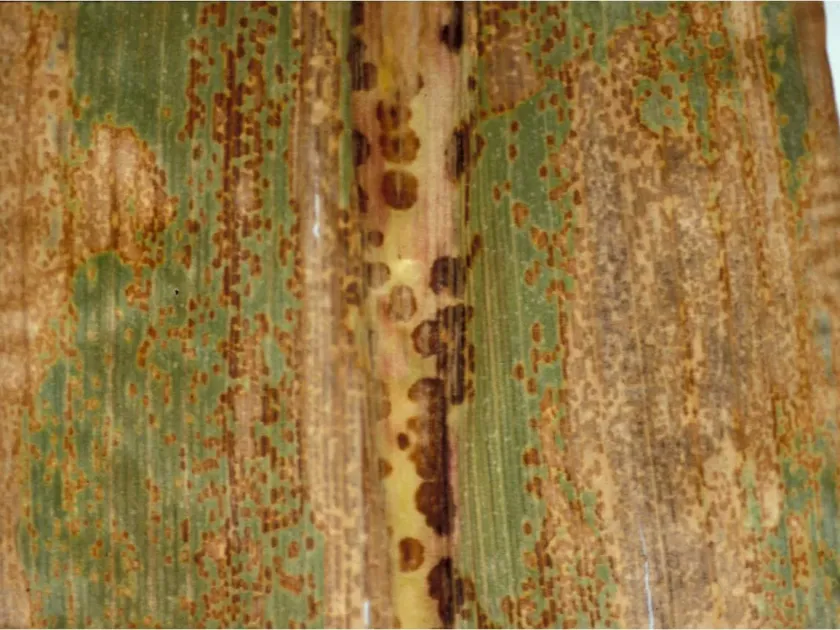
The first symptoms appear as small yellow or light brown spots on the leaves. These spots are often arranged in distinct bands or rows parallel to the leaf veins, which is a diagnostic feature of the disease.
As the infection progresses, the spots darken to a chocolate brown or black color. This darkening indicates the maturation of sporangia within the leaf tissue, which eventually ruptures the epidermis.
On leaf sheaths and stalks, the fungus can induce the formation of bumps or galls. When these ruptures occur, they release a dusty, dark brown mass of spores, often leading to the weakening of the stem structure.
Stalk breakage is a common and severe symptom. Because the fungus often colonizes the nodes, the structural integrity of the corn stalk is compromised, making the plants prone to lodging during wind or rain events.
- Yellowish to brown spots on leaves
- Distinctive linear arrangement of lesions
- Dark, powdery masses on stalks and sheaths
- Premature leaf necrosis and drying
- Significant stalk weakening and lodging
Pathogen
The causative agent of the disease is the chytrid fungus Physoderma maydis. This is an obligate parasite that relies on moisture to complete its life cycle and infect host tissues.
The fungus survives in the soil and on crop debris in the form of resting sporangia. These structures are extremely resilient and can persist for several years, making the disease difficult to eradicate once it is established in a field.
When environmental conditions become favorable, particularly under conditions of high soil moisture or standing water, these sporangia germinate to release motile zoospores. These spores swim toward the host plant to initiate infection.
The pathogen primarily affects corn, infiltrating the leaves, stalks, and leaf sheaths. It is highly specialized, targeting chlorophyll-rich tissues to thrive and eventually produce new resting spores.
Its biological cycle is strictly dependent on the presence of free water. Once inside the plant tissue, the fungus grows intercellularly before forming new sporangia, completing the cycle and ensuring the survival of the pathogen until the next season.
Conditions for development
The development of Physoderma brown spot is heavily influenced by weather conditions. High rainfall, humidity, and temperatures ranging from 20°C to 25°C are optimal for the infection process.
Standing water in the field acts as a catalyst for the disease. If the soil remains saturated for extended periods, the risk of zoospore movement and infection increases exponentially.
Monocropping corn is a major risk factor. Continuous cultivation of the same crop allows the pathogen population in the soil to build up to levels that can cause severe outbreaks during favorable years.
Poor soil drainage in low-lying areas of the field often correlates with higher disease incidence. These areas serve as hot spots for the initial infection, from which the disease can spread throughout the field.
Lack of proper residue management allows the fungus to remain in the top layer of the soil, ensuring that the inoculum is readily available for the next planting season.
Why it matters
The primary damage caused by Physoderma brown spot is the reduction of the photosynthetic surface area. Severe leaf blighting prevents the plant from filling the ears properly, leading to significant yield losses.
Stalk rot and breakage associated with this disease result in harvest difficulties. Lodged plants are harder to combine, and a portion of the grain is often left in the field, representing a direct financial loss.
Plants affected by the disease are significantly weakened, making them more susceptible to opportunistic pathogens, such as stalk rot fungi, which further degrade the quality of the crop.
The overall quality of the harvested grain is often compromised. Reduced test weights and lower grain fill quality are common in heavily infected fields, impacting the marketability of the corn.
In extreme cases of epidemic spread, farmers may experience yield reductions of 20% or more, highlighting the importance of managing this disease through integrated agronomic practices.
Protection
Crop rotation is the most effective management tool. By rotating corn with non-host crops, farmers can break the life cycle of the fungus and reduce the population of resting spores in the soil.
Deep plowing or tillage helps bury crop residues, accelerating their decomposition. By moving infested debris deeper into the soil, the release of zoospores toward the surface is significantly hindered.
The selection of resistant or tolerant corn hybrids is a critical line of defense. Breeders have developed varieties that show improved resistance to Physoderma maydis, which should be the preferred choice in areas with a history of the disease.
Improving field drainage is essential. By ensuring that water does not stand in the field, the environmental conditions necessary for spore germination are neutralized, significantly reducing the likelihood of infection.
Sanitation practices, such as removing infected biomass and cleaning equipment after working in infested areas, help prevent the further spread of the pathogen between different sections of the farm.
Discussion
No discussions yet — be the first.