
Phomopsis araucariae
Phomopsis araucariae
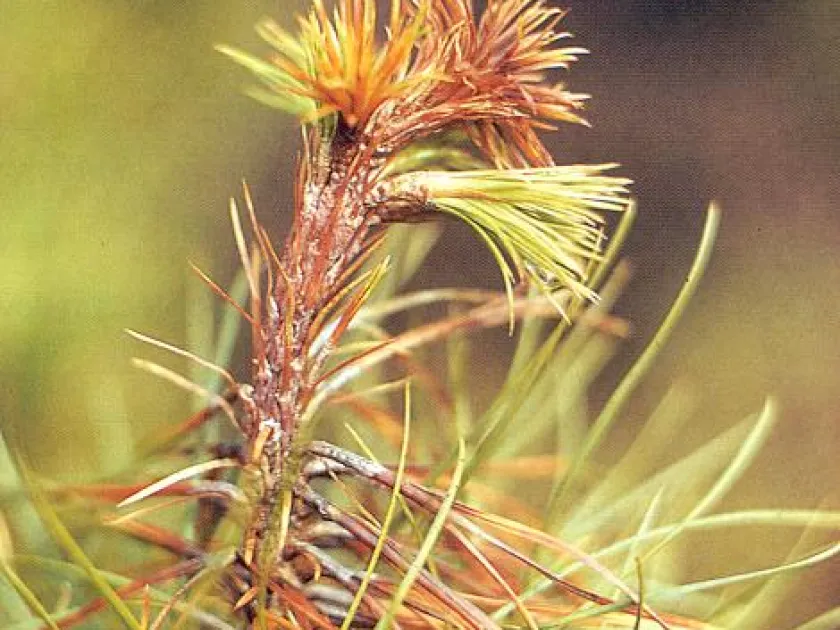
Description
Symptoms
The initial symptoms often appear as localized yellowing of needles on specific branches, which eventually turn brown and fall off. This needle drop results in bare, unsightly sections of the tree, significantly reducing its aesthetic value.
Necrotic, sunken lesions appear on the bark of infected shoots. These patches are typically brown or gray in color, and as the infection progresses, the bark often cracks, revealing the extent of the tissue damage.
A definitive diagnostic feature is the presence of tiny, dark-colored pimples (pycnidia) on the bark surface. These can be clearly seen under a magnifying glass and confirm the presence of Phomopsis araucariae.
When the disease spreads to the main branches or the trunk, resin bleeding often occurs. This flow of sap is an attempt by the tree to defend itself, but it often creates a damp environment under the resin crust, favoring further fungal development.
Terminal shoots may exhibit curling or bending, indicating the disruption of the vascular system. This distortion is a clear sign that the infection is severe and potentially impacting the structural integrity of the plant.
Pathogen
The causative agent of this disease is the fungus Phomopsis araucariae. It belongs to a group of fungal pathogens known for causing necrotic lesions on branches and stems, with a specific affinity for members of the Araucariaceae family.
The fungus colonizes the internal tissues of the plant, entering through wounds, pruning cuts, or natural openings. The mycelium spreads through the phloem and cambium, effectively disrupting the plant's nutrient and water transport systems.
During its life cycle, the pathogen produces small, flask-shaped fruiting bodies called pycnidia. These structures release thousands of conidia, which serve as the primary inoculum for spreading the infection to neighboring plants via water splashes or wind.
The pathogen can persist in dormant states within infected plant debris or in the soil, making it a persistent threat in nurseries and conservatories. It often remains latent until environmental conditions favor its aggressive growth.
The virulence of the fungus is highly dependent on humidity levels. Once environmental conditions trigger the release of spores, the rapid colonization of healthy tissue can lead to severe damage in a very short amount of time.
Conditions for development
High humidity and poor air circulation are the primary drivers of this disease. Stagnant air and wet foliage create an ideal environment for spore germination and mycelial spread.
The fungus thrives within a temperature range of +18°C to +25°C (64°F to 77°F). In these conditions, the metabolic activity of Phomopsis araucariae is at its peak, leading to rapid disease development.
Poor horticultural practices, such as overcrowding, insufficient lighting, or improper soil drainage, weaken the plant's resistance. A stressed araucaria is far more susceptible to infection than one grown under optimal conditions.
Overhead irrigation often worsens the problem, as water droplets sitting on the needles act as a medium for spore germination. Ensuring that the foliage remains dry is crucial for disease prevention.
Mechanical damage from improper pruning or handling is a common gateway for the pathogen. Failure to disinfect tools between plants is one of the most frequent reasons for the disease spreading through a collection.
Why it matters
Phomopsis araucariae is highly destructive, especially in nursery settings where it can quickly kill young seedlings. The loss of foliage and the resulting structural deformity often render the plants unsalable.
The systemic nature of the infection means that once it reaches the main vascular pathways, recovery becomes extremely difficult. The blockage of water flow leads to the death of distal branches and, eventually, the entire tree.
Beyond physical damage, the disease places the plant under significant physiological stress. This exhaustion leaves the araucaria vulnerable to secondary pests and other opportunistic pathogens.
The economic impact for growers is substantial, including the loss of stock and the cost of repeated fungicide applications. In severe cases, total destruction of infected specimens is required to protect the remaining collection.
Because the fungus can survive in dormant forms, recurring outbreaks are common if infected tissues are not completely removed and the growing environment is not properly sanitized.
Protection
The most important step is the aggressive removal of all infected branches. Pruning must be done well below the visible signs of necrosis, and tools should be sterilized with alcohol or bleach after every cut.
Chemical control involves the use of systemic fungicides, specifically those containing copper, mancozeb, or thiophanate-methyl. These should be applied as a full-coverage spray on a regular schedule.
- Improve ventilation to ensure foliage dries quickly.
- Avoid overhead watering to keep needles dry.
- Isolate all infected plants immediately to prevent spread.
- Keep tools sanitized at all times.
Focus on plant health to increase resistance. Proper light exposure, balanced fertilization, and avoiding temperature fluctuations help the tree maintain its natural defense mechanisms against the fungus.
In professional settings, the application of biological fungicides can provide a protective barrier on the needle surface, inhibiting spore germination and reducing the reliance on heavy chemical interventions.
Discussion
No discussions yet — be the first.