
Phellinus
Phellinus
Description
Symptoms
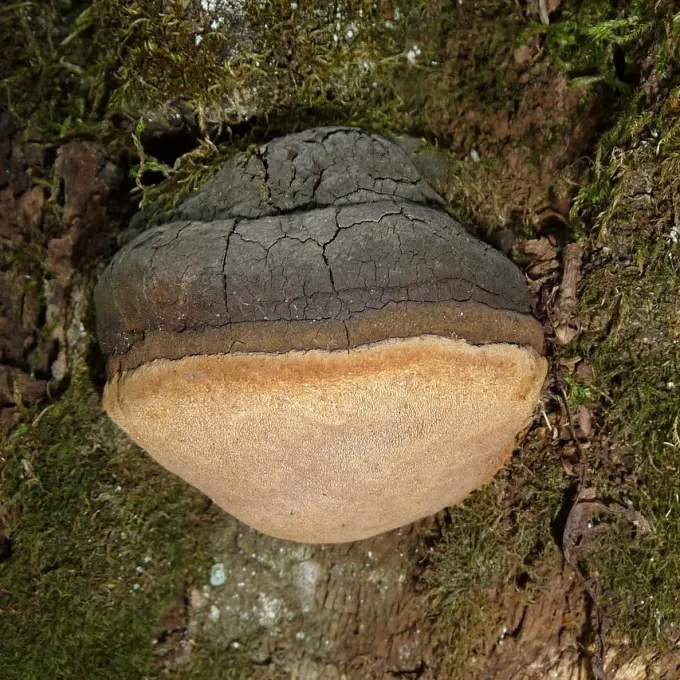
The most visible symptom of a Phellinus infection is the presence of hard, woody, hoof-shaped, or shelf-like fruiting bodies on the trunk or branches. These conks are often dark brown, black, or grey with a rough, fissured surface.
Affected trees often show signs of decline, including chlorosis (yellowing of leaves), stunted foliage, and reduced annual shoot growth. In many cases, the canopy becomes sparse due to the death of upper branches.
External examination of the trunk may reveal cankers, sunken areas of bark, or deep vertical cracks that may ooze resin or dark sap, indicating internal stress and structural failure.
Internally, the wood displays characteristic decay patterns. Cross-sections often show a distinct zone of rot separated from sound wood by thin, dark, zone lines produced by the fungus to defend its territory.
On advanced stages, the tree loses significant mechanical strength. This makes the tree prone to trunk snapping during windstorms, as the central part of the wood is essentially hollowed out by the fungal mycelium.
Pathogen
The fungus genus Phellinus consists of perennial, wood-decaying pathogens that primarily cause heart rot in living trees. These fungi belong to the hymenochaetoid family and are highly specialized in breaking down cellulose and lignin within the host wood.
Infection usually occurs when fungal spores land on exposed wounds, such as pruning cuts, broken branches, or frost cracks. Once established, the mycelium penetrates deep into the heartwood, slowly colonizing the internal structure of the trunk.
The fungi develop characteristic perennial conks (fruiting bodies) on the surface of the bark. These structures persist for many years, producing spores that facilitate the spread of the disease to neighboring trees throughout the growing season.
Unlike many other pathogens, Phellinus can survive as a saprophyte on dead wood, including stumps and fallen logs, making it a persistent threat in forests and orchards long after a tree has been removed.
The growth rate of the mycelium is typically slow, allowing the tree to appear healthy for years while internal destruction gradually compromises its structural integrity.
Conditions for development
The development of Phellinus is favored by high humidity and moderate temperatures, typically ranging from 18°C to 25°C. Such conditions support both spore germination and vegetative mycelial growth.
Mechanical injuries are a prerequisite for infection. Trees that are improperly pruned or those damaged by machinery are significantly more likely to be colonized by fungal spores than intact, healthy trees.
Densely planted areas with poor air circulation often experience higher disease pressure, as moisture remains on the bark for longer periods, providing a perfect environment for infection.
Trees under abiotic stress, such as drought, nutrient deficiency, or overcrowding, have weakened defense mechanisms, making them more susceptible to colonization by Phellinus compared to well-maintained trees.
Neglecting basic sanitation, such as leaving large open wounds or failing to remove dead wood, creates persistent inoculum sources that fuel the spread of the fungus within the entire plot.
Why it matters
The primary harm is the destruction of the tree's internal conductive and structural systems. This eventually results in the death of the tree and its loss from the landscape or orchard.
In economic terms, for timber production, heart rot significantly reduces the volume and quality of harvestable lumber, making the wood unfit for high-value construction purposes.
For fruit orchards, the disease causes a continuous decline in productivity and fruit quality, eventually requiring the expensive removal and replacement of mature, non-productive trees.
Safety is a critical concern, as trees infected with Phellinus pose a high risk of sudden failure, which can lead to property damage or personal injury in urban or public areas.
Management costs increase drastically due to the need for continuous monitoring, surgical removal of conks, and specialized arboricultural practices to prevent widespread infection.
Protection
Effective management begins with strict pruning standards. Ensure that all cuts are clean and immediately sealed with appropriate wound dressings or copper-based fungicides to block fungal entry.
Promote overall tree health through adequate irrigation, fertilization, and site management to keep the trees vigorous. A healthy tree can better isolate the fungal infection and limit the internal spread of mycelium.
If fruiting bodies are discovered, they should be carefully removed using a clean tool, cutting slightly into the wood to ensure complete removal. Disinfect tools thoroughly after each cut to avoid cross-contamination.
In severe cases, infected trees must be removed and the stumps ground or excavated to prevent the fungus from spreading via root contacts or persistent inoculum in the soil.
- Regular inspection of the orchard or forest stand to identify early symptoms.
- Prompt sanitation: removing dead wood and diseased limbs immediately.
- Disinfecting pruning equipment with alcohol or bleach after contact with diseased wood.
Discussion
No discussions yet — be the first.