
Soybean rust
Phakopsoraceae
Description
Symptoms
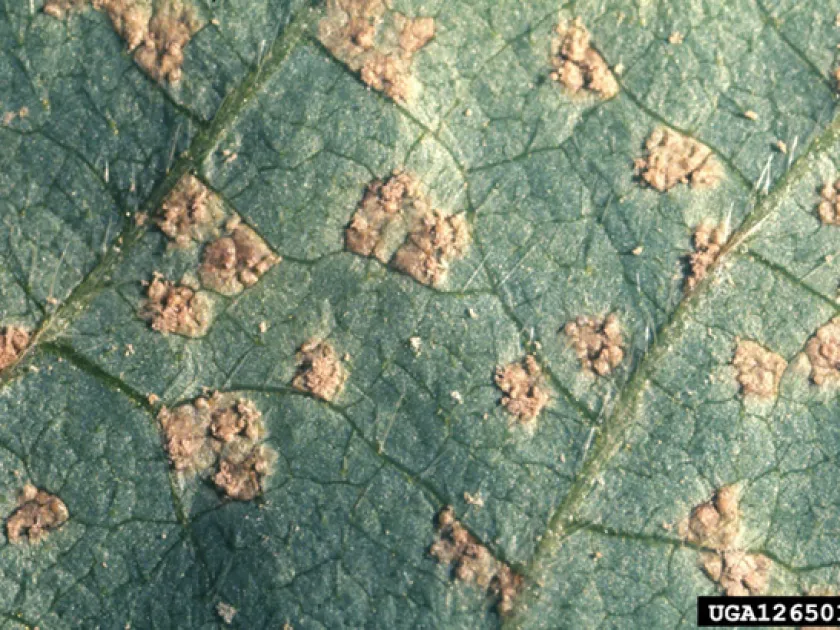
The initial symptoms appear as small, tan to dark brown lesions on the lower leaves. As the disease progresses, small pustules called uredinia develop on the underside of these lesions.
These pustules eventually rupture, releasing clouds of spores that give the leaves a distinct rusty appearance. Severely infected leaves turn yellow, then brown, and finally drop prematurely.
In cases of high disease pressure, lesions can also be found on petioles, stems, and even pods, leading to significant physiological stress for the crop.
The disease typically becomes noticeable during the reproductive stages (flowering and pod filling) when the crop canopy is closed and shading occurs.
- Lesions on the undersides of leaves.
- Development of tan to dark brown uredinia.
- Premature defoliation.
- Reduced pod filling and seed size.
Pathogen
The causal agent of this disease is the obligate fungal pathogen Phakopsora pachyrhizi, which belongs to the Phakopsoraceae family. It is a highly specialized parasite requiring living host tissue to complete its life cycle.
The fungus reproduces asexually via urediniospores, which are easily wind-dispersed over long distances. The pathogen has a high capacity for genetic variation, making resistant breeding a challenging task.
The disease is classified as a foliar rust. The pathogen invades host tissues through stomata, eventually producing uredinia, which are structures that release massive amounts of spores.
Because it is an obligate parasite, the fungus cannot survive as a saprotroph in soil and requires green tissue of a host to persist between cropping seasons.
Besides soybean, the pathogen can infect numerous other legume species, which serve as alternate or reservoir hosts in the landscape.
Conditions for development
Soybean rust thrives under moderate temperatures ranging from 15 to 28 degrees Celsius. Constant moisture on the leaf surface is a prerequisite for spore germination.
Periods of frequent rainfall or heavy dew provide the necessary surface moisture for the fungus to establish infection within the leaf tissue.
Dense canopies create a microclimate with reduced air circulation, which maintains higher humidity levels near the lower leaves, facilitating disease spread.
Prolonged cloudy weather prevents leaves from drying out, creating the ideal environment for the rapid colonization of the host plant by the pathogen.
Long-distance dispersal is driven by prevailing winds, which can move urediniospores across large geographical areas in a relatively short timeframe.
Why it matters
Soybean rust is a highly destructive disease capable of causing yield losses of up to 80-90% if not managed effectively. It primarily limits the photosynthetic capacity of the plant.
Premature leaf drop leads to poor seed development, resulting in smaller, shriveled seeds that significantly reduce the overall test weight and grain quality.
In severe infections, pod development is stunted, and some pods may fail to fill entirely, which leads to substantial economic losses at harvest.
The disease also negatively impacts the nutritional composition of the seeds, reducing the levels of protein and oil content desired for commercial market value.
The need for repeated fungicide applications significantly increases the cost of production, putting pressure on the profitability of soybean farming.
Protection
The primary control strategy involves systematic field scouting followed by the timely application of fungicides, particularly triazoles and strobilurins.
Crop rotation and the removal of volunteer soybean plants and wild legumes are essential cultural practices to break the disease cycle and limit early-season inoculum.
The use of resistant or tolerant soybean varieties is highly encouraged as it provides a baseline defense against the spread of the pathogen.
Adjusting row spacing and planting dates to ensure better airflow can modify the microclimate, making the environment less conducive to fungal growth.
Phytosanitary and quarantine regulations are critical to prevent the introduction of new, more aggressive strains of the rust into unaffected regions.
Discussion
No discussions yet — be the first.