
Beech leaf spot
Petrakia fagi
Description
Symptoms
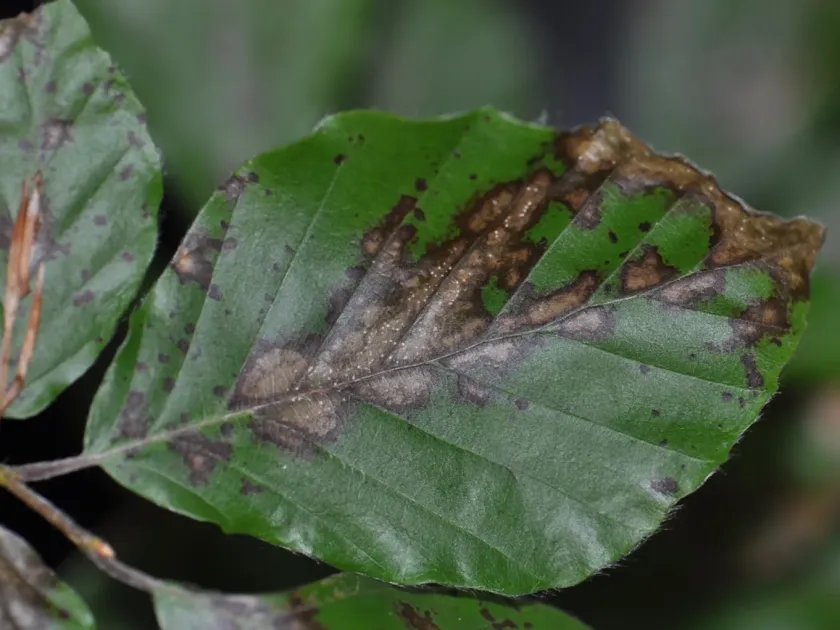
Symptoms initially appear as small, irregular spots on the leaf surface. These spots are typically brown or reddish-brown in color, indicating the start of tissue necrosis.
A distinctive dark border often develops around the lesions. As the infection progresses, the spots expand and may coalesce, covering a large portion of the leaf blade.
A common characteristic of this disease is the development of a "shot-hole" effect, where the dead tissue within the spots dries up and falls out, leaving holes.
On the undersides of the leaves, corresponding to the spots, minute dark fruiting structures (sporodochia) can be observed using a hand lens.
Severe infections lead to chlorosis and premature leaf drop, which can significantly alter the appearance and health of the tree's canopy.
Pathogen
The disease is caused by the fungus Petrakia fagi (syn. Septoria fagi), which is a specialized parasite affecting leaves of beech trees (Fagus species).
The pathogen is a deuteromycete that survives the winter primarily in infected fallen leaves. It remains dormant until environmental conditions allow for the production of spores.
During the spring, when temperatures rise and moisture becomes available, the fungus produces conidia. These spores serve as the primary inoculum for infecting new leaf buds.
The mycelium of Petrakia fagi grows intercellularly within the leaf tissue, secreting enzymes that break down cell walls and facilitate the spread of the infection.
Secondary infections are common throughout the growing season, as conidia are splashed by rainfall onto healthy leaves, creating a repeating cycle of damage.
Conditions for development
High humidity and prolonged periods of rainfall are the most critical factors favoring the development and spread of Petrakia fagi.
Beech trees growing in dense, poorly ventilated stands are particularly susceptible, as the lack of airflow keeps leaves wet for longer periods, encouraging fungal growth.
Spring weather characterized by frequent showers provides an ideal environment for the dispersal of fungal spores and the infection of newly emerging leaves.
Trees that are already stressed by drought, poor soil conditions, or other pathogens show reduced natural resistance and are hit harder by the disease.
The presence of decomposing leaf litter under the canopy ensures that the pathogen remains present in the immediate vicinity, ready to re-infect the tree annually.
Why it matters
The primary impact of beech leaf spot is the reduction of total photosynthetic leaf area, which decreases the tree's overall carbohydrate production.
Frequent and severe defoliation weakens the tree over time, making it less resilient to environmental fluctuations and secondary pest infestations.
In nursery environments, the disease can cause stunted growth in seedlings and significantly reduce their marketability or survival rate when outplanted.
For ornamental and parkland trees, the disease destroys the visual appeal of the canopy, causing it to look scorched, tattered, and prematurely aged.
- Reduced annual biomass accumulation
- Premature defoliation
- Increased vulnerability to secondary pests
Protection
Sanitation is the most effective management practice. Removing and destroying infected fallen leaves in autumn significantly reduces the primary inoculum for the next spring.
Improving air circulation by proper pruning and thinning of dense stands helps the canopy dry faster, which inhibits the conditions necessary for fungal development.
In high-value ornamental trees or nurseries, the application of copper-based or systemic fungicides during early leaf expansion can effectively suppress the disease.
Monitoring is crucial; arborists should keep a close watch on trees during wet springs to determine if fungicide applications are required to protect foliage.
Maintaining tree vigor through proper watering and mulching helps the beech build natural defenses against fungal leaf spot pathogens.
Discussion
No discussions yet — be the first.