
Pestalotiopsis microspora
Pestalotiopsis microspora
Description
Symptoms
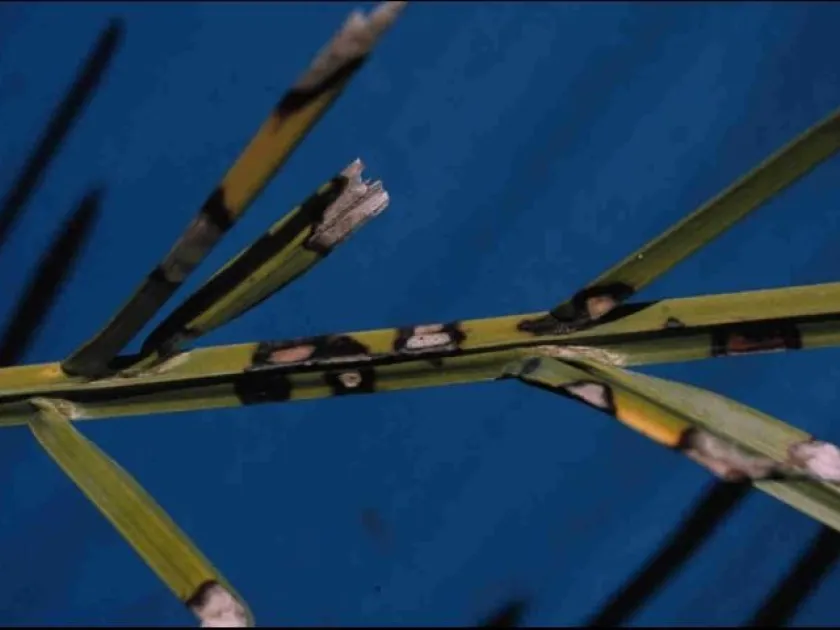
The primary signs of infection are characteristic spots on leaf blades, often referred to as "pestalotiopsis blight". Initially, they appear as small light or brown flecks surrounded by a dark margin.
Over time, the spots increase in size and turn gray or ash-colored, which is associated with the formation of fungal sporulation on the surface of the affected tissues. Upon close inspection, small black dots—pycnidia—can be observed.
The infection often affects not only leaves but also young shoots, causing their gradual wilting and death. In fruit crops, the pathogen can also infect fruits, causing rot and premature abscission.
Ulcers often form on the stems of shrubs and trees, which can lead to girdling of the branch and its complete death. Plant tissues at the site of infection become brittle, lose turgor, and gradually collapse.
Under high humidity, a whitish or gray mycelial mat may appear on the spots, which is a critical indicator of active infection progression and requires immediate intervention.
Pathogen
The causal agent of the disease is the fungus Pestalotiopsis microspora, an imperfect fungus belonging to the class Deuteromycetes. This microorganism is widely recognized in the scientific community for its unique ability to degrade polyurethane, but in agronomy, it acts as a dangerous phytopathogen.
The fungus belongs to the group of conidial fungi that reproduce actively by asexual means via conidia. These spores have a characteristic structure: they are multicellular, often fusiform, with colorless cells at the ends and pigmented cells in the center.
The pathogen persists in infected plant debris, soil, and on seed material in the form of mycelium or pycnidia. Under favorable conditions, the spores are easily dispersed by wind, rain splashes, or during agricultural operations.
Infection occurs through stomata, lenticels, or mechanical tissue damage. Once inside the plant, the fungus begins to develop actively, feeding on host cells, which leads to the development of necrosis of varying shapes and intensity.
The biology of the pathogen allows it to lead both a saprotrophic and parasitic lifestyle. It is this adaptability that makes it a difficult pathogen to eradicate in warm and humid greenhouse conditions or in regions with subtropical climates.
Conditions for development
The key factor for the development of Pestalotiopsis microspora is high relative humidity, exceeding 70-80%. Moisture is essential for spore germination and the formation of conidia.
Optimal temperature ranges for the growth of fungal colonies are between +20 to +28 degrees Celsius. This is when the most severe outbreaks of the disease are typically observed in nurseries.
Compromised plant immunity is a predisposing factor for infection. This includes improper watering regimes, lack of mineral nutrition, pest damage, or sunscald.
Crowded plantings with poor air circulation create a microclimate with high humidity, which serves as an ideal incubator for the active spread of the pathogen.
The presence of free moisture on leaves at night or after heavy precipitation significantly accelerates the infection process, as spores require water to activate the enzymatic apparatus for penetration.
Why it matters
The damage caused by this pathogen is expressed in a sharp reduction of the photosynthetic leaf area, which directly leads to a weakening of the plant's overall metabolism.
For ornamental crops, the market value of plants is diminished due to mass spotting, rendering them unsuitable for sale and reducing the economic value of the nursery.
In fruit crops, the infection is dangerous because it affects shoots, reducing their cold hardiness and the ability to produce a full crop in the following season, resulting in yield losses.
In severe cases, the development of the disease can lead to the death of young seedlings, as the pathogen is capable of spreading from leaves to petioles and eventually to the plant's main vascular system.
Prolonged infection leads to plant exhaustion, making it highly vulnerable to secondary infections, including various types of rots that finally destroy the affected organism.
Protection
The foundation of control is strict planting hygiene. It is necessary to regularly remove and destroy infected plant parts to prevent the accumulation of an infection reservoir in the soil.
An important practice is thinning out plantings to improve ventilation and reduce humidity around vegetative parts. Strict adherence to spacing schemes is recommended to avoid overcrowding.
- Use of copper-based fungicides (copper sulfate, Bordeaux mixture) for preventative treatments.
- Application of systemic fungicides from the triazole or strobilurin groups during the growing season at the first signs of the disease.
- Provision of balanced nutrition to enhance the plant's natural resistance to pathogens.
Overhead irrigation should be avoided, especially in the evening, as prolonged moisture on the leaf surface creates conditions for conidial germination.
In greenhouse environments, optimal humidity and temperature regimes should be maintained, and tools and equipment must be regularly disinfected to prevent the transfer of spores between plots.
Discussion
No discussions yet — be the first.