
Statice downy mildew
Peronospora statices
Description
Symptoms
Initial symptoms of statice downy mildew appear on young leaves as yellow, diffused spots that eventually turn brown and become necrotic over time.
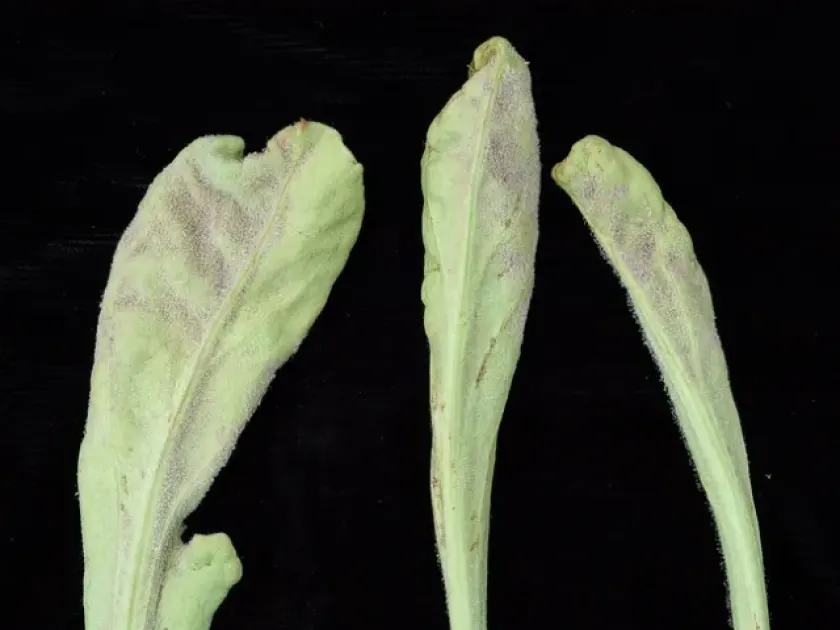
On the underside of the leaves, corresponding to the spots, a characteristic gray or whitish moldy growth appears, representing the fungal sporulation. This sign is a key diagnostic feature of the disease.
As the disease progresses, leaves begin to curl, dry out, and drop prematurely, leading to a significant loss of the plant's aesthetic appeal. Flower stalks may become distorted or experience stunted growth.
In severe cases, the entire aerial part of the plant, including flower buds, becomes infected, rendering the cut flowers useless for floristry. The plant appears stunted, weak, and chlorotic.
- yellowing of the leaf blade;
- gray fuzzy growth on the underside of leaves;
- formation of necrotic brown spots;
- distortion and twisting of young shoots;
- premature wilting and leaf drop.
Pathogen
The disease is caused by the obligate parasite, a fungus-like organism from the oomycete group known as Peronospora statices. This pathogen specifically targets plants of the genus Limonium, inducing a classic downy mildew infection.
The pathogen reproduces through sporangia, which are disseminated by wind currents, splashing rain, or overhead irrigation. The fungus can persist in plant debris and seed material, posing a significant threat to commercial greenhouse operations.
The life cycle of the pathogen is closely tied to environmental humidity, which is necessary for zoospore germination. The fungal mycelium develops within leaf tissues, inserting haustoria into plant cells to absorb vital nutrients.
This oomycete has a high reproductive rate, especially in protected cultivation environments with high plant density. The inoculum level builds up rapidly unless strict sanitation protocols for tools and soil are implemented.
The biology of Peronospora statices includes a dormant phase characterized by oospores that can overwinter in the soil. This necessitates rigorous crop rotation and the sterilization of growth media for seedling production.
Conditions for development
The development of statice downy mildew is favored by high relative humidity (above 80%) and moderately cool temperatures, typically ranging from 15 to 22 degrees Celsius.
Poor ventilation in greenhouses and tunnels creates an ideal microclimate for pathogen spore germination. Persistent moisture on leaf surfaces is critical for initiating the infection process.
High planting density, which restricts airflow, significantly increases the risk of an epidemic. Under these conditions, spores are easily transported from infected to healthy plants.
Overhead irrigation is a primary factor in the spread of zoospores. The use of cold water can also induce stress in plants, lowering their natural resistance to infection.
Inadequate lighting and nutrient deficiencies, particularly potassium, weaken statice plants, making them more susceptible to the penetration of fungal mycelium.
Why it matters
The disease causes substantial economic loss as affected plants lose their commercial quality and become unsuitable for the cut flower market or as nursery seedlings.
Massive outbreaks on plantations often require the total destruction of infected batches, resulting in direct financial loss for ornamental crop producers.
The long-term survival of the pathogen in the soil presents a persistent threat for subsequent production cycles, requiring expensive chemical soil disinfection measures.
Plant exhaustion due to fungal infection leads to a decrease in seed quantity and quality, negatively impacting the profitability of seed production businesses.
The hidden nature of the infection in early stages makes timely detection difficult, often resulting in the disease spreading throughout the entire greenhouse before control measures are initiated.
Protection
The foundation of effective management is prevention: maintaining optimal humidity, ensuring proper ventilation, and avoiding overwatering of the substrate.
It is recommended to use only high-quality seed material treated with fungicides, and to conduct regular sterilization of all equipment and growing containers.
At the first sign of the disease, affected plant parts must be immediately removed and destroyed. Monitoring crop health at least twice a week is essential for early detection.
For chemical control, apply systemic and contact fungicides containing copper, mancozeb, or specialized anti-oomycete agents (phenylamides).
It is crucial to rotate fungicides with different modes of action to prevent the development of resistance in the pathogen. Applications must follow strict regulatory guidelines regarding frequency and dosage.
Discussion
No discussions yet — be the first.