
Geranium downy mildew
Peronospora oerteliana
Description
Symptoms
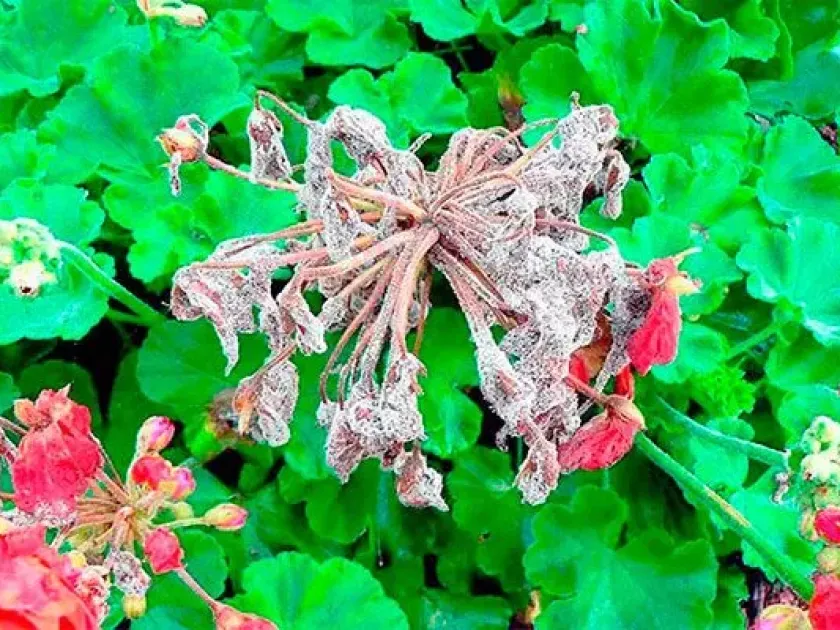
The first symptoms of geranium downy mildew typically appear on the upper surface of the leaves as yellow or chlorotic spots that are often bounded by veins.
On the underside of the leaves, a distinct grayish or purplish fuzzy growth develops, which corresponds to the sporulation of the pathogen.
As the infection progresses, these spots coalesce, leading to rapid yellowing and premature death of the leaves, starting from the base of the plant.
Severe infections may cause leaf curling, stunted growth, and a significant reduction in the aesthetic value and vitality of the geranium.
Unlike powdery mildew, the fungal growth in downy mildew is primarily localized on the underside of the leaf, which is a key diagnostic feature.
Pathogen
The disease is caused by Peronospora oerteliana, an obligate oomycete pathogen that specifically targets geranium and pelargonium species.
This pathogen thrives by invading the intercellular spaces of the plant tissue, drawing nutrients directly from the host cells to survive.
It reproduces via zoospores, which require a thin film of water on the leaf surface to swim, germinate, and penetrate the host plant's stomata.
The survival of the pathogen in the absence of a host is facilitated by oospores, which can remain dormant in soil or plant debris for long periods.
Spread of the disease occurs mainly through wind-borne sporangia or splashing water that carries the spores to healthy parts of the plant.
Conditions for development
High relative humidity (above 85%) is the most critical environmental factor that triggers the rapid development and spread of the downy mildew fungus.
Cooler night temperatures followed by warm days often result in dew or condensation on the foliage, providing the perfect medium for spore germination.
Inadequate spacing and poor airflow in greenhouses create stagnant microclimates that allow the infection to move rapidly through a plant collection.
Overhead irrigation systems that wet the foliage are highly conducive to disease transmission, especially if the leaves do not dry out quickly.
Poor sanitation, such as failing to remove dropped, infected leaves, serves as an ongoing source of inoculum for healthy plants in the same area.
Why it matters
Geranium downy mildew is highly destructive, capable of rapidly defoliating plants and rendering them completely unsuitable for display or sale.
The speed at which the disease spreads makes it a severe threat to nurseries and commercial growers, where one infected plant can threaten an entire batch.
Continued infection leads to severe physiological stress, resulting in poor flower production and the eventual collapse of the plant structure.
Infected plants are often weakened, making them susceptible to secondary pathogens like Botrytis (gray mold), which further accelerates tissue decay.
Economic losses arise not only from plant death but also from the high costs associated with repeated fungicide applications and strict hygiene protocols.
Protection
The most effective strategy involves environmental management, specifically lowering the humidity and increasing air circulation around the plants.
Immediate removal and destruction of symptomatic leaves are vital to decrease the spore load and slow down the spread of the infection in the area.
Preventative fungicide applications using systemic products or contact fungicides can protect healthy tissue from infection during periods of high risk.
- Water plants at the base to ensure foliage stays dry.
- Provide adequate spacing between containers to improve airflow.
- Sterilize all tools and pots between uses to prevent cross-contamination.
- Source only disease-free cuttings for new propagation.
Monitoring the crop regularly for signs of yellowing on the upper leaves is essential for early detection and successful containment of the outbreak.
Discussion
No discussions yet — be the first.