
Basil downy mildew
Peronospora belbahrii
Description
Symptoms
The first symptom of Basil Downy Mildew is the yellowing of leaves, which often mimics a nutrient deficiency or chlorosis. The yellowing typically starts from the veins and spreads outwards across the leaf blade.
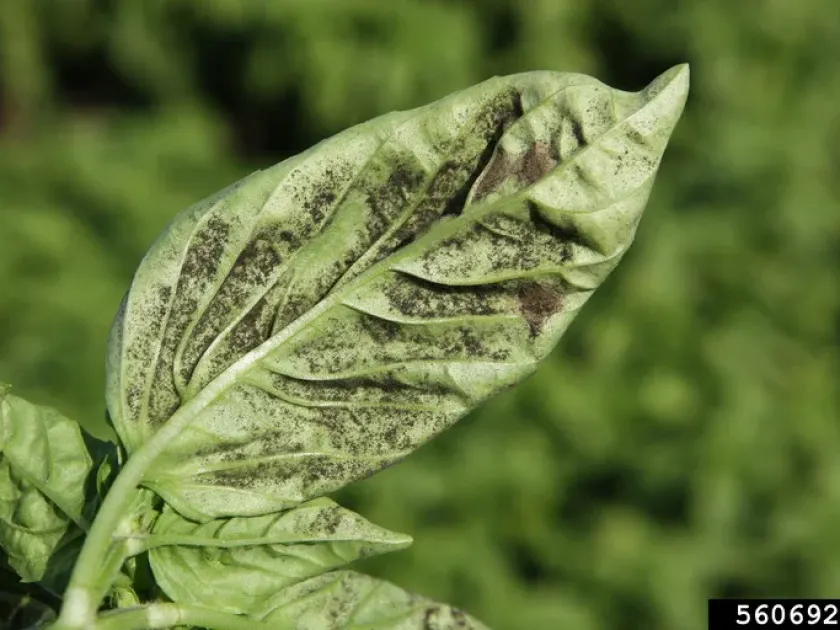
A distinctive fuzzy, greyish-purple growth appears on the undersides of the leaves. This is the sporulation of the pathogen and serves as the primary diagnostic feature of the disease.
As the disease progresses, the yellowed areas turn brown and necrotic. These lesions can cause the leaves to wilt, curl, and eventually fall off the plant.
In humid conditions, the sporulation can become very dense, covering the entire underside of the leaf and potentially spreading to stems if conditions remain favorable.
The infection can move very rapidly through a field or greenhouse, leading to a sudden collapse of the foliage and significant crop loss.
Pathogen
The disease is caused by the oomycete Peronospora belbahrii, an obligate parasite specifically adapted to basil varieties and related species in the Lamiaceae family.
The pathogen reproduces via conidia, which are easily disseminated by wind, rain splashes, or movement within the greenhouse, facilitating quick spread.
The life cycle requires a living host and thrives in specific environmental windows, with spores germinating quickly in the presence of leaf moisture.
The pathogen can also be seed-borne, meaning that contaminated seeds can introduce the disease into new production areas where it was not previously present.
P. belbahrii has shown remarkable ability to evolve, with various strains emerging that can overcome traditional agricultural resistance in some basil cultivars.
Conditions for development
High relative humidity (above 85%) is the most critical environmental factor for the successful infection and colonization by the pathogen.
Temperatures ranging from 15°C to 25°C are ideal for the development of the oomycete, and constant leaf wetness for several hours is required for spore germination.
Poor airflow, overcrowding of plants, and improper irrigation methods such as overhead watering create the high-moisture microclimate that the fungus prefers.
Dew formation on leaves during cool nights in greenhouses often provides sufficient moisture to trigger a new infection cycle.
The disease is highly dependent on climate; while it spreads rapidly in summer under high humidity, it can be suppressed during very dry or hot periods.
Why it matters
Basil Downy Mildew is a devastating disease for both commercial growers and home gardeners, capable of ruining entire crops within a few days.
The cosmetic damage caused by the yellowing and fuzzy growth makes the leaves completely unmarketable for fresh herb sales.
In addition to physical damage, the presence of the pathogen severely reduces the quality and aromatic profile of the basil, making it unacceptable for culinary use.
Economic losses are compounded by the rapid speed of the disease, which often leaves growers with little time to react or implement protective measures.
The pathogen persists in the environment and can contaminate the soil or greenhouse infrastructure, making it difficult to maintain continuous basil production.
Protection
Managing the environment is the cornerstone of controlling Basil Downy Mildew, focusing on keeping leaves dry and humidity low.
- Select resistant cultivars which are now becoming available through breeding programs.
- Use drip irrigation instead of overhead sprinklers to keep foliage dry.
- Ensure adequate spacing between plants to maximize air circulation.
- Practice rigorous sanitation by removing and destroying all infected plant materials promptly.
- Implement good greenhouse management, including heating and venting, to keep relative humidity below the infection threshold.
Biological fungicides based on beneficial bacteria like Bacillus subtilis can provide some preventative protection if applied before symptoms appear.
While some fungicides are labeled for use, the harvest interval and the rapid nature of the disease often make chemical control difficult to implement effectively.
Discussion
No discussions yet — be the first.