
Sorghum downy mildew
Peronosclerospora sorghi
Description
Symptoms
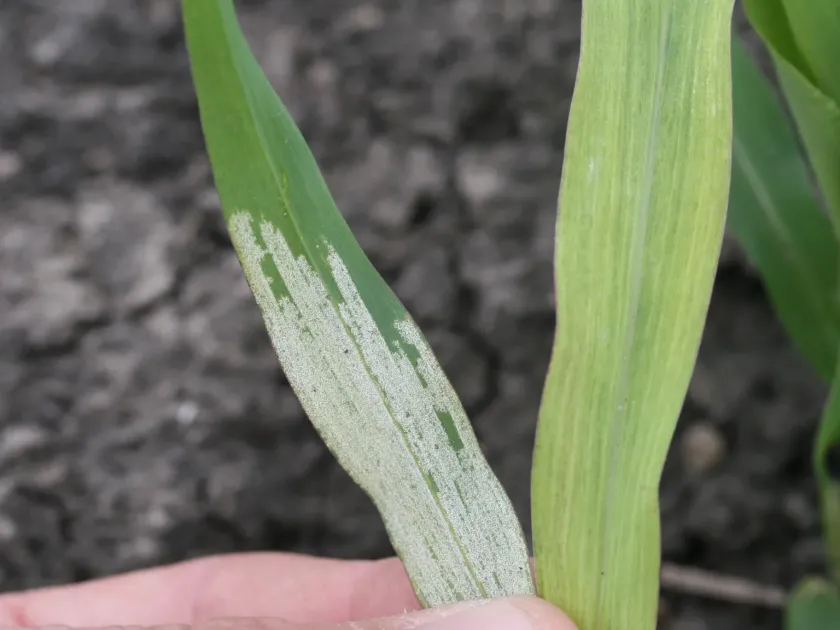
Initial symptoms manifest as chlorotic streaks or spots on the leaves, which eventually turn white and necrotic. A characteristic sign is the appearance of abundant whitish-gray downy growth on the underside of the leaf, consisting of the pathogen's conidiophores.
In cases of systemic infection, young plants appear stunted, their internodes shorten, and the leaves become rigid and vertically oriented. These plants often fail to produce a panicle or develop sterile inflorescences.
In later developmental stages, leaf tissues may disintegrate, exposing the vascular bundles, which gives the plant a shredded appearance. This symptom is diagnostic for the stage known as "crazy top."
When the root system is infected, the plant's ability to absorb water and nutrients is reduced, leading to premature wilting even under sufficient irrigation.
- Yellowing and chlorosis of leaf blades
- White fungal growth on the underside of leaves
- Shortened internodes and panicle deformation
- Premature seedling death
- Tissue disintegration and "shredded" leaves
Pathogen
The causal agent of this disease is the oomycete Peronosclerospora sorghi, which is classified as a pathogen causing downy mildew. It is an obligate parasite that survives in the soil as oospores or within infected plant debris.
The life cycle of the pathogen includes the formation of zoosporangia, which are disseminated by wind and water droplets over long distances. The infection can affect both seedlings and mature plants throughout the growing season.
The pathogen primarily attacks plants in the Poaceae family, including crops and wild grasses. Sorghum is the main host, though the pathogen can also adapt to maize and some millet species.
The biology of the pathogen allows it to survive in various climatic zones; however, it requires the presence of free moisture on the leaf surface for the massive germination of spores.
The genetic plasticity of Peronosclerospora sorghi contributes to the emergence of new physiological races, which complicates the breeding of resistant hybrids and necessitates continuous field monitoring.
Conditions for development
The development of the disease is most intense under high relative humidity, exceeding 80-90 percent. Night temperatures ranging from +15°C to +25°C are considered favorable.
The presence of free moisture from dew or rain during evening and night hours is a critical condition for the effective germination of zoosporangia and subsequent infection of plant tissues.
Soil-borne infection is more active during periods of waterlogging during the early stages of crop development. Soil infection is particularly dangerous when untreated seeds are used.
The rate of epidemic spread depends directly on wind speed, which transports conidia to neighboring fields, facilitating secondary infection of sorghum crops.
While temperatures above +30°C may slow down fungal growth, the pathogen can remain active during hot periods if high humidity levels are maintained.
Why it matters
Sorghum downy mildew poses a serious threat to yields, as it causes massive seedling mortality and significant stand thinning. In cases of early infection, grain yield losses can range from 50 to 80 percent.
The disease disrupts photosynthesis and plant metabolism, leading to a sharp decrease in vegetative biomass. Even with partial infection, grain weight and quality are significantly reduced.
Systemic infection makes plants extremely vulnerable to secondary pathogens and environmental stresses, including drought and stalk lodging.
The presence of the pathogen in sorghum fields limits export opportunities and necessitates the implementation of strict quarantine measures in affected regions.
The economic loss stems not only from direct yield reduction but also from the costs of additional fungicide applications and the necessity of crop rotation planning.
Protection
The primary method of control is the use of high-quality seeds treated with systemic fungicides, which suppress pathogen development during the early stages of seed germination.
Cultivating resistant or tolerant sorghum hybrids remains the most reliable and cost-effective method for minimizing risks associated with this disease in the long term.
Implementing a crop rotation schedule with a 3-4 year interval between growing susceptible crops allows for a significant reduction in the amount of inoculum present in the soil.
Agronomic practices, such as optimizing planting dates and controlling weed species that can serve as infection reservoirs, help reduce disease pressure on the crop.
If initial symptoms are detected in the field, it is recommended to apply fungicides from the phenylamide or strobilurin groups, which provide both curative and preventive benefits.
Discussion
No discussions yet — be the first.