
Penicillium grain rot
Penicillium verrucosum
Description
Symptoms
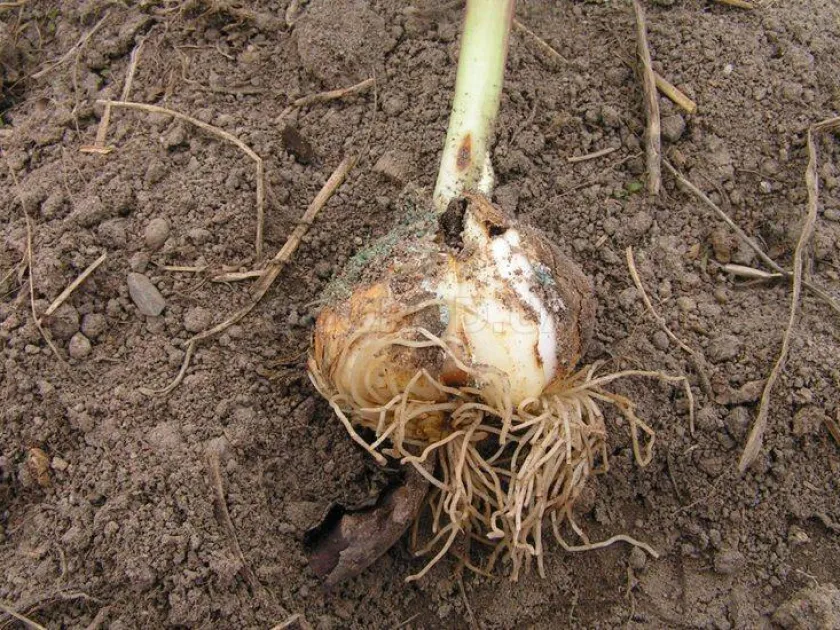
The primary symptom of the disease is the appearance of a characteristic mold on the surface of the grain. Initially, this manifests as small, greyish-green or bluish-green spots that gradually spread to cover the entire grain surface.
As the pathogen develops, the grain loses its natural luster and becomes dull. The embryo of the infected grain often darkens, which can be observed upon close inspection or by cutting the seed open.
As the infection progresses, the grain mass develops a specific musty, "dusty" odor. Infected grain becomes brittle, and in cases of severe infestation, it may disintegrate completely into powder.
In the final stages of mycelial growth, the grain loses its flowability due to the formation of clumps. This occurs because the fungal mycelium binds adjacent grains together in a tight, tangled web.
It is important to note that this disease primarily affects harvested crops during storage rather than plants growing in the field. Early signs may be subtle, making regular inspection of grain lots essential.
Pathogen
The pathogen is the microscopic fungus Penicillium verrucosum, a member of the Ascomycota division. It is a typical storage pathogen that thrives in closed, enclosed environments.
The fungus reproduces via conidia—specialized spores that are easily transported by air currents, dust, or contaminated storage equipment and facility surfaces.
A key biological characteristic of this species is its extremely high enzymatic activity. The fungus quickly penetrates deep into the grain kernel, utilizing the nutrients of the endosperm for its growth.
Penicillium verrucosum is classified as a xerophilic fungus, meaning it can survive in various conditions but is strictly dependent on the moisture content within the grain itself.
The fungus is highly resilient. Even under unfavorable conditions, the spores can remain viable for several years, waiting for the right moment to germinate when moisture levels increase.
Conditions for development
Grain moisture is the critical factor for the development of Penicillium grain rot. The disease begins to proliferate actively when the moisture content of the grain mass exceeds 14–15%.
Temperature plays a significant role: the optimal range for the fungus is between +20 and +25 °C. However, the pathogen can grow at lower temperatures as well, down to +5 °C.
Poor ventilation in storage facilities often leads to "self-heating" of the grain, creating ideal conditions for a major outbreak. In these pockets, humidity and temperature rise, accelerating the fungal life cycle.
Contamination of the grain mass with organic debris, such as broken kernels or chaff, promotes faster colonization by the fungus, as these particles absorb atmospheric moisture more readily.
Inadequate sanitation of storage facilities and equipment before placing new grain into storage is the primary cause of initial contamination in grain lots.
Why it matters
This disease causes significant economic loss by degrading the market quality of the grain. Infected produce loses weight and becomes unsuitable for food processing or milling applications.
The greatest danger lies in the accumulation of mycotoxins, specifically ochratoxin A. These compounds are highly toxic and pose a serious health risk to both humans and livestock.
Grain affected by Penicillium rot loses its seed quality. Germination energy and laboratory viability decline sharply, rendering the grain unsuitable for sowing in the following season.
Biochemical changes in the grain include the breakdown of proteins and fats, resulting in poor organoleptic properties. Using such grain in animal feed can lead to toxicosis in livestock.
Massive fungal infestation can result in total loss of the crop during storage if emergency drying and cleaning measures are not taken to remove the moldy spots.
Protection
The primary preventive measure is to dry the grain to a safe moisture level (below 14%) before it is placed in storage. Grain drying is the most effective way to inhibit fungal growth.
Ensuring high-quality ventilation in storage units helps maintain a stable microclimate and prevents the formation of zones with excessive humidity.
Regular monitoring of temperature and moisture within the grain pile allows for the timely detection of hot spots, preventing the pathogen from spreading throughout the entire batch.
Disinfecting grain silos and cleaning equipment of dust and old grain residues before accepting a new harvest is critical for reducing the overall infection pressure.
If signs of Penicillium rot are detected, the infected batch must be isolated immediately, subjected to intensive drying or cooling, or disposed of entirely if the infestation is severe.
Discussion
No discussions yet — be the first.