
Penicillium citrinum
Penicillium citrinum
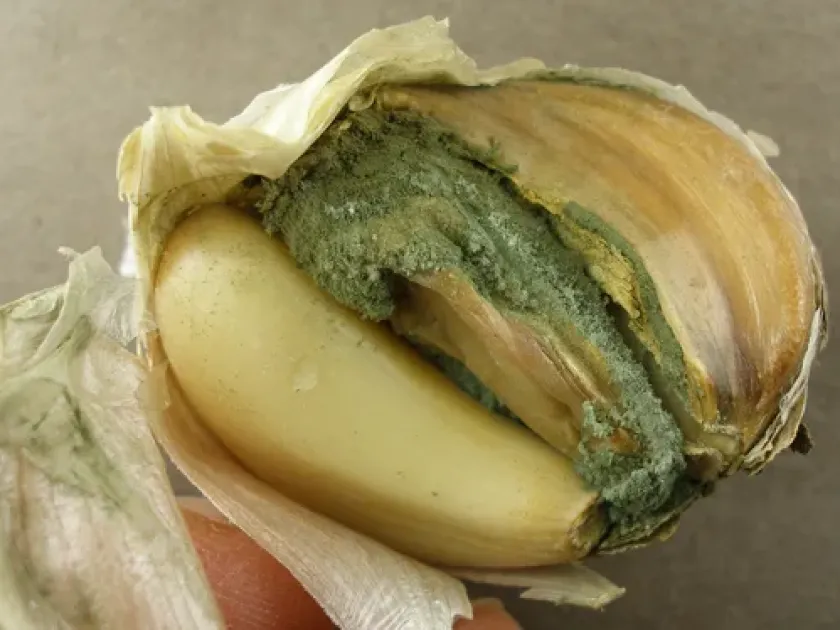
Description
Symptoms
In the initial stages of infection, the surface of produce, grain, or feed becomes covered with a faint, white, web-like mycelial growth. Shortly after, the growth develops a characteristic lemon-yellow or greenish-blue tint due to mass sporulation.
In cereal seeds, infection results in discoloration of the embryo and the loss of the natural sheen of the seed coat. In areas colonized by the fungus, tissues often soften, emitting a distinct "moldy" odor that quickly permeates the entire storage batch.
Under high humidity, droplets of exudate may appear on infected plant parts or kernels. Through the action of fungal enzymes, cell walls are degraded, leading to rapid decay and structural collapse of the plant tissues.
Microscopic examination of affected areas reveals the characteristic brush-like conidiophores of Penicillium. In bulk, the conidia form a dense, powdery layer that is easily dispersed by air currents during even minimal mechanical handling.
A specific diagnostic sign is the bleaching or abnormal pigmentation of the affected tissues, caused by both the mycelium itself and the organic acids secreted by the fungus during its metabolic activity.
Pathogen
The causative agent of the disease is the microscopic mold fungus Penicillium citrinum, belonging to the genus Penicillium. It is an aerobic organism widely distributed in soil and air, typically functioning as a saprophyte, but capable of becoming a parasite on plant tissues under favorable conditions.
The fungus develops a well-organized septate mycelium that penetrates deeply into the substrate. A characteristic feature of this species is the formation of conidiophores with characteristic brushes, upon which single-celled bluish-green or lemon-yellow conidia mature.
This microorganism is well-known for its ability to synthesize secondary metabolites, including mycotoxins, specifically citrinin. This substance is highly toxic to both humans and livestock, posing significant risks if contaminated crops enter the food or feed supply chain.
Biologically, Penicillium citrinum is extremely hardy and capable of thriving across a wide range of temperatures and pH levels. It rapidly colonizes organic debris, turning it into a persistent source of infection for subsequent agricultural product batches.
The fungus survives as spores (conidia) on equipment surfaces, warehouse structures, in soil, and on seeds, making it highly difficult to eradicate in commercial agricultural environments.
Conditions for development
The critical factor for the development of Penicillium citrinum is substrate moisture. The fungus proliferates most actively when relative humidity exceeds 75–80% and grain moisture content rises above 14–15%.
The optimal temperature for the development of this fungus ranges from +20°C to +30°C. However, the fungus remains viable at lower temperatures, allowing it to persist and grow slowly in unheated warehouses during cooler seasons.
Poor warehouse ventilation facilitates moisture accumulation and air stagnation, creating an ideal environment for spore germination. High dust levels in storage facilities also provoke the rapid spread of the infection.
Storage management failures, such as temperature fluctuations that cause surface condensation on produce, serve as the primary trigger for massive disease outbreaks in storage environments.
Mechanical damage to the skins of fruits, vegetables, or seed coats significantly eases the penetration of spores into deeper tissues, providing the fungus with direct access to nutrients and accelerating infection progress.
Why it matters
The primary danger lies in the spoilage of agricultural products and their subsequent unsuitability for food or feed due to mycotoxin accumulation. The produce loses its commercial value, germination capacity, and nutritional content.
The mycotoxin citrinin, produced by this fungus, poses a severe health risk. Consumption of contaminated feed can lead to kidney and liver failure in livestock, poultry, and humans.
The disease causes substantial economic losses, as infected batches often require total disposal. During storage, Penicillium citrinum can destroy the structure of grain heaps, transforming them into a rotting, solid mass.
Furthermore, infection of seed stocks results in reduced field germination and low seedling vigor. Affected seeds may fail to germinate entirely, or produce weak seedlings highly susceptible to secondary pathogens.
The spread of infection in storage facilities occurs rapidly. A single hotspot can infect large volumes of stored products within a short period, requiring immediate professional intervention.
Protection
The primary protection strategy is strict adherence to moisture and temperature control protocols in storage facilities. Grain must be dried to below critical moisture levels (typically 13–14%) before storage.
Effective ventilation of storage rooms and regular monitoring of produce quality are essential. The use of active ventilation systems helps prevent grain self-heating and condensation formation.
Before storing new crops, warehouses must undergo thorough disinfection (fumigation or fungicide application) to eliminate fungal spores from wall surfaces, equipment, and containers.
An important preventive element is the control of storage pests, such as insects and mites, which not only damage the produce, creating entry points for infection, but also mechanically transport fungal spores.
If signs of mold are detected, affected products must be isolated immediately, and the remaining material should be re-dried and treated with approved preservatives to halt further spread of the infection.
Discussion
No discussions yet — be the first.