
Lawn mowers mushroom
Panaeolina foenisecii
Description
Symptoms
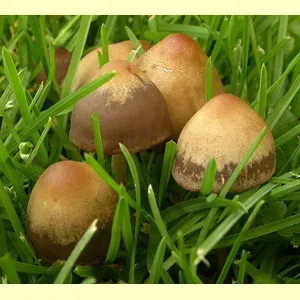
Panaeolina foenisecii, commonly known as the lawn mower's mushroom, manifests as the emergence of small gilled mushrooms on lawns and pastures.
The caps are typically conical or bell-shaped, displaying a range of colors from light tan to dark brown depending on the local moisture level.
When the caps dry out, they often fade to a lighter, pale gray or buff color, making them quite distinct against the green backdrop of the grass.
The mycelium resides within the thatch layer, often spreading out to occupy areas where organic debris has accumulated over several seasons.
These mushrooms often appear in groups or clusters, appearing quickly after rainfall or periods of high humidity in the lawn ecosystem.
Pathogen
The causative agent is the fungus Panaeolina foenisecii, a saprotrophic species within the family Strophariaceae that feeds on decaying matter.
Its biological function is the decomposition of organic debris, particularly thatch, which makes it a natural component of grassland soil biology.
It is not a parasitic fungus and does not cause structural damage to the root systems or the blades of living lawn grasses.
The fungus propagates through wind-blown spores that land on the soil surface, germinate, and eventually colonize the thatch layer.
Mycelial growth is strictly confined to the organic matter layer where the fungus extracts nutrients necessary for its life cycle.
Conditions for development
Growth is strongly stimulated by cool to mild weather conditions, particularly during spring and autumn when soil moisture remains consistently high.
A thick layer of thatch—the accumulation of dead grass clippings and roots—provides the primary food source required for mushroom formation.
Lawns with poor drainage, which tend to stay waterlogged, are significantly more prone to frequent outbreaks of this particular fungal species.
High humidity and lack of proper air circulation near the soil surface create an optimal microclimate for the development of fruiting bodies.
Heavy rainfall periods or over-irrigation in the evenings significantly increase the likelihood of the fungus emerging on the lawn surface.
Why it matters
The primary concern regarding Panaeolina foenisecii is aesthetic, as it causes no direct biological harm to the grass plants themselves.
For professional turf managers and homeowners, the appearance of these mushrooms is often perceived as a sign of poor lawn management practices.
The presence of mushrooms disrupts the visual uniformity of a groomed lawn, leading to concerns about the overall health of the turf area.
Excessive mushroom growth may indicate that the thatch layer is too thick, which can physically impede water and nutrient infiltration into the soil.
While the mushrooms themselves are not damaging, they highlight underlying issues such as soil compaction or drainage problems that need attention.
Protection
Effective management begins with dethatching or scarification to reduce the accumulation of dead organic matter that fuels fungal growth.
Improve soil drainage through aeration to prevent water from pooling at the surface, which effectively limits the environment for mushroom production.
Adjust irrigation schedules to water early in the morning, allowing the grass and soil surface to dry out thoroughly during the daylight hours.
Regular mowing and proper disposal of clippings can help minimize the organic buildup that supports the fungal mycelium in the long term.
Manual removal of the mushrooms as they appear is the most practical solution, as chemical fungicides are rarely recommended for this saprotroph.
Discussion
No discussions yet — be the first.