
Pachyella violaceonigra
Pachyella violaceonigra
Description
Symptoms
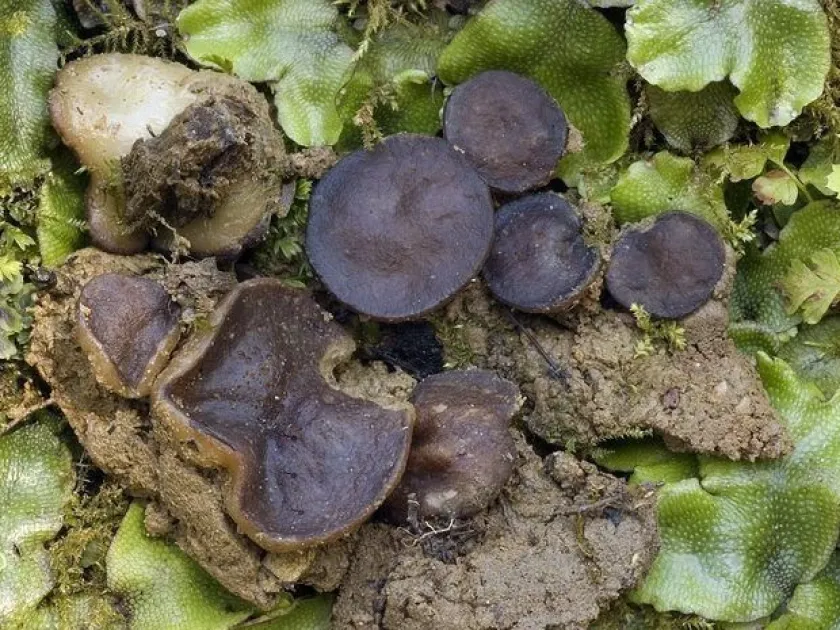
The primary external sign of Pachyella violaceonigra appearance is the presence of fruit bodies (apothecia) on the surface of bark or wood. They appear as small, cup-shaped structures tightly attached to the substrate.
The surface of these fruit bodies is smooth or slightly wrinkled, often with a glossy or matte finish depending on the humidity and light levels of the environment.
When woody tissues are affected, a gradual softening of fibers is observed, indicating the enzymatic activity of the fungus as it breaks down structural polysaccharides.
Visually, the affected areas may change color, acquiring darker or brownish shades as the fungal hyphae progress deeper into the wood structure.
Unlike many parasitic fungi, damage caused by this species rarely manifests as rapid necrosis of living tissues, as it prefers already dying or dead parts of plants.
Pathogen
The causative agent is the ascomycetous fungus Pachyella violaceonigra, belonging to the order Pezizales. In mycological terms, this object is often classified as a xylotrophic fungus developing on dead plant material.
Morphologically, the fungus forms apothecia that have a characteristic cup-shaped or discoid form. Their surface is distinguished by a dark, almost violet-black color, which gave rise to the species name.
Biologically, this fungus acts as a saprotroph, although in certain conditions, it may show opportunistic activity on weakened plant tissues by participating in the degradation of lignin and cellulose.
Spores of the fungus are dispersed primarily by air currents. Upon reaching a suitable substrate, they germinate to form mycelium, which penetrates deep into the material of the host plant.
This species is a component of the natural microflora of forest soils and leaf litter, exhibiting activity primarily during autumn or periods with stable moisture availability.
Conditions for development
For the successful development of Pachyella violaceonigra, high substrate moisture is critically important. The fungus thrives in shaded, poorly ventilated areas of forest plantations.
The temperature optimum for mycelium vegetation and the formation of apothecia lies within a moderate range, typical of the autumn climate in temperate regions.
The presence of a sufficient amount of accessible plant residue is a prerequisite for colonizing a territory with this fungal species.
Soil compaction and poor drainage facilitate moisture retention, creating a favorable microclimate for the propagation of Pachyella spores.
The absence of direct sunlight and the presence of organic mulch allow the fungus to colonize new areas of woody debris more rapidly.
Why it matters
The main harm consists of accelerating the decomposition process of woody debris, which is part of the natural cycle but undesirable in managed gardens or parks.
In ornamental gardening, the presence of the fungus on tree trunks degrades the aesthetic appeal of the planting and indicates poor moisture management.
While the fungus is not an aggressive pathogen, its activity on weakened trees may contribute to the expansion of decay zones, further compromising the tree's immunity.
Prolonged presence of the mycelium at the root collar of a tree can disrupt normal nutrient transport and lead to secondary infections.
In industrial timber, the development of this fungus leads to loss of wood quality and a decrease in its physical and mechanical properties.
Protection
The main prevention method involves adhering to agronomic standards designed to prevent moisture stagnation in the root zones and surrounding soil.
It is necessary to carry out regular sanitary pruning of dead branches, as they serve as the primary substrate for colonization by this fungus.
Ensuring good canopy ventilation and spacing out dense plantings significantly reduces the risk of spore spread within the plantation.
If mass development of apothecia is detected, mechanical removal of the affected bark areas followed by treatment with broad-spectrum fungicides is recommended.
To prevent the spread of spores in plant nurseries, cleanliness should be maintained by eliminating the accumulation of rotting plant debris on the site.
Discussion
No discussions yet — be the first.