
Otidea concinna
Otidea concinna
Description
Symptoms
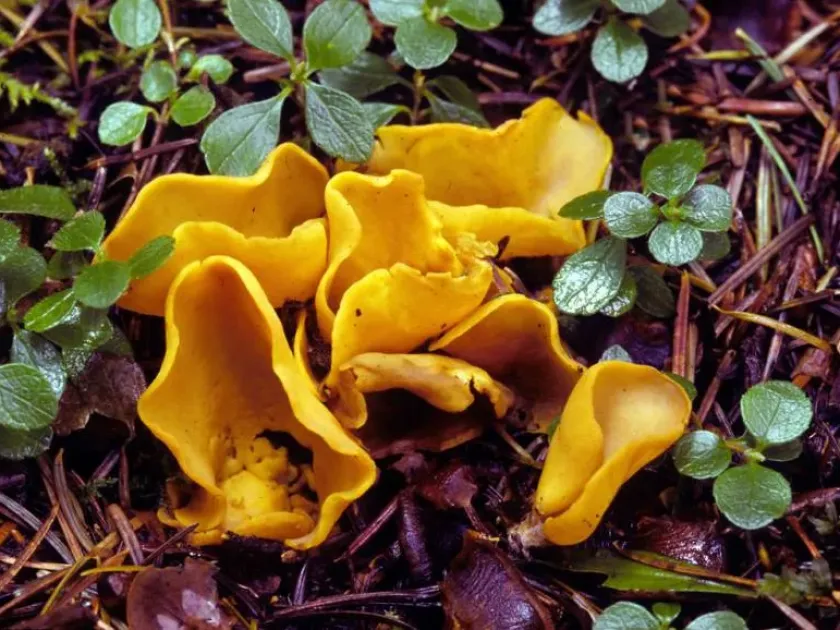
Otidea concinna produces characteristic ear-shaped or cup-shaped fruit bodies. The surface is typically smooth, colored in yellowish-brown or ochre tones, with edges often curved inwards.
The primary sign of this fungus is the emergence of groups of fruit bodies directly on the soil or among leaf litter in deciduous and mixed forests. They rarely grow singly, often forming small clusters in moist environments.
Unlike plant pathogens, this fungus does not cause necroses, spots, or deformations on living plants. Its presence is visible only through the appearance of its fruit bodies during the summer and autumn seasons.
Fruit bodies usually measure between 2 and 5 centimeters in diameter. The stalk is often short or partially buried in the substrate, giving the fungus a pressed-to-the-ground appearance.
The texture of the fruit body is fleshy and fragile. Microscopic analysis shows that the spore powder is white or cream-colored, which is common for many cup fungi in this family.
Pathogen
Scientifically, Otidea concinna is not a plant pathogen affecting crops or trees. It is a soil saprotroph belonging to the Ascomycota division.
The organism feeds exclusively on dead organic matter, breaking down forest litter, fallen leaves, and twigs. It plays a significant role in the natural nutrient cycling of forest ecosystems.
Biologically, this species is closely linked to humus decomposition. Its mycelium actively penetrates the topsoil, secreting enzymes to break down complex organic compounds into simpler forms.
Despite being classified as a fungus, it lacks the mechanisms to infect living plant tissues. Its life cycle depends entirely on the availability of accessible dead plant substrate.
In an agronomic context, Otidea concinna is not a target for plant protection. It poses no threat to yields and does not require fungicides or other specific control measures.
Conditions for development
The development of Otidea concinna fruit bodies occurs primarily under humid conditions. The optimal time for their appearance is after prolonged rainfall when soil moisture is at its peak.
It prefers shaded areas with nutrient-rich, organic soil. In gardens, it may appear in mulched areas if conditions are close to those of a forest floor.
Temperature requirements for the formation of fruit bodies range from moderate to cool, typical of late summer and early autumn. Intense heat and drought stop fruiting processes.
Soil acidity is secondary, though the fungus tends to inhabit neutral or slightly acidic forest soils. High levels of mineral nitrogen can sometimes inhibit the growth of many saprotrophic fungi.
Soil aeration and the presence of sufficient plant residues are key factors that support the survival and development of this species in its natural environment.
Why it matters
Otidea concinna is not a pest. It does not harm crops, ornamental plants, or forest trees, as it does not engage in pathogenic relationships with living organisms.
There is no damage to agroecosystems. On the contrary, the activity of saprotrophic fungi contributes to improving soil structure by converting plant residues into nutrients available to higher plants.
It does not cause diseases that reduce plant productivity. The appearance of the fungus on a site is not an indicator of soil or plant disease but merely a sign of moist organic material.
The absence of negative impact makes Otidea concinna a component of biodiversity rather than an agricultural threat. Control measures for this species are unnecessary and inappropriate.
Its economic importance is minimal. It is neither an edible mushroom (due to its lack of flavor and fragility) nor toxic to humans, requiring no management or eradication.
Protection
As Otidea concinna is a harmless soil saprotroph, no special control measures are required. The use of chemical fungicides to combat this species is not recommended.
Prevention in agronomy usually boils down to proper agricultural practices. If the presence of the fungus in a garden seems aesthetically undesirable, removing excess plant debris and ensuring good soil drainage is sufficient.
Aeration and soil tilling promote drying of the top layer, which slows down the growth of fungal fruit bodies. This is a natural control method that does not harm beneficial soil microbiota.
No quarantine measures are needed, as the spread of fungal spores is natural and occurs via air currents. Completely isolating a site from spores is neither possible nor necessary.
An agronomist should remember that healthy soil is often populated by diverse saprotrophic fungi. Their presence is a sign of soil biological activity rather than a need for human intervention.
Discussion
No discussions yet — be the first.